Charter Gainesville GA: Airport Fit and Booking
Charter Gainesville GA from Lee Gilmer: which jets fit, when Atlanta is smarter, and how to book.
14 min read

The most popular advice about charter Gainesville GA is that Lee Gilmer Memorial Airport puts a private jet minutes from your door, so pick a cabin and go. That advice is backwards. The airplane picks the airport, and at KGVL the published numbers decide which airplanes qualify on which day. Your job as a traveler is to find out what the airplane can do with your people and bags on it, not to hope the ramp is long enough.
Lee Gilmer Memorial Airport carries the identifier KGVL. It is the general-aviation field in Gainesville, Georgia, in the northeast corner of the state, and it is not the Gainesville in Florida that keeps surfacing in search results. A flight there is a Part 135 on-demand charter: one aircraft, one operator, one set of performance numbers that either work or don't.
The main runway is 5,496 feet long by 100 feet wide in the current federal publication. That is a real runway and it carries plenty of business aircraft. It is not a blank check. Fill a light jet with six passengers, heavy bags, and full fuel on a 92-degree afternoon and the takeoff calculation gets tight fast. Settle that before you compare hourly rates.
Table of Contents
- Why Gainesville Charter Starts at Lee Gilmer
- KGVL Runway Data That Screens the Jet
- Read the runway row as a capability limit
- Why elevation and fuel sit in the same conversation
- The numbers to send with the request
- When a Nearby Atlanta Airport Is the Better Field
- How Payload and Baggage Change the Aircraft
- The family with oversized cases
- The crew with equipment
- The group that also wants full fuel
- Sample Charter Days From Northeast Georgia
- Brief the Operator and Request the Quote
Why Gainesville Charter Starts at Lee Gilmer
The field's history explains why it's still a working charter airport rather than a decommissioned strip with a plaque. In 1941, Gainesville had only a dirt airstrip when the city petitioned the Civil Aeronautics Administration for a municipal airport, as the published record of Lee Gilmer Memorial Airport describes. In 1943, the U.S. Navy leased the property from the city for $1 and built it into a military airfield with intersecting paved runways around 4,000 feet long, parallel taxiways, maintenance facilities, and barracks.
The Navy decommissioned it in 1947 and handed it back to the city, buildings and equipment included. In 1971 the field was named for local aviation pioneer Lee Gilmer, who ran Gilmer Flying Services before, during, and after the war. From 1964 onward, improvement money from the Federal Aviation Administration, the state of Georgia, Appalachian programs, and city government totaled more than $4.3 million, paying for runway strengthening and extension, lighting, navigation equipment, and taxiway work.
Practical rule: A runway is a budget. You can spend it on passengers, on baggage, on fuel, or on temperature margin, but you can't spend it twice.
That public investment is why the approaches and lighting exist today, and why a durable general-aviation center grew up around private, corporate, maintenance, and charter flying in northeast Georgia. None of it answers the question a travel manager asks on a Thursday afternoon with a Monday departure.
Picture the call. Two couples from a house on Lake Lanier want a Friday afternoon departure to south Florida. Four passengers, four midsize cases, a two-hour stage length. A light jet clears that mission comfortably on a mild day, and the drive to the ramp takes minutes instead of the run down I-985 into Atlanta traffic. Now change one variable: eight passengers, golf bags, and a full-fuel leg to the Midwest in July. Same airport, different answer, possibly a different aircraft.
Everything after this point is about producing that answer before money changes hands. The airport fit question, not the advertising, is what a charter Gainesville GA booking turns on.
KGVL Runway Data That Screens the Jet
Screen the airplane before you ask anyone for a price. The table below holds the figures that decide whether a given tail number can serve Gainesville. Read each row as a go or no-go check, not as airport trivia.
Item | Published figure | What dispatch checks | Planning use |
|---|---|---|---|
Runway 05/23 | 5,496 x 100 ft FAA; about 5,500 ft Georgia DOT | HIRL, MALSR on 05, PAPI both ends, precision ILS | Primary instrument runway for most business aircraft |
Landing distance 05 and 23 | About 5,370 ft for 05; about 5,100 ft for 23 | Direction in use, not the longer published length | Use the landing number for the expected direction |
Runway 11/29 | About 4,001 ft; shorter FAA declared distances | Wind, condition, and aircraft performance | Light aircraft or reduced payload only after a calculation |
Field elevation | About 1,276 to 1,277 ft | Temperature and density altitude | Hot-day takeoff and payload penalty |
Fuel and oxygen | 100LL and Jet A or Jet A+; oxygen listed | Uplift versus payload | Confirm Jet A before a longer nonstop |
Read the runway row as a capability limit
The FAA airport data for KGVL list Runway 05/23 at 5,496 by 100 feet with high-intensity runway lighting, MALSR approach lighting on Runway 05, and PAPI visual guidance on both ends. Fuel is listed as 100LL and Jet A+, with oxygen service. Georgia's own report on the field describes 05/23 as the primary runway of about 5,500 feet with a precision instrument landing system, and puts Runway 11/29 at 4,001 feet, per the Georgia DOT airport report.
That second runway is where optimistic plans go wrong. The same FAA data show declared distances on 11/29 that are substantially shorter than the published length. If the wind favors it, or if the long runway is unavailable, your available distance drops and the performance run changes.
Landing distance is its own line item. Declared landing distance available runs about 5,370 feet for Runway 05 and about 5,100 feet for Runway 23. A crew landing on 23 has roughly 400 feet less pavement to work with than the headline number suggests, and that matters on a wet runway with a tailwind.
Why elevation and fuel sit in the same conversation
Field elevation is about 1,276 to 1,277 feet, which is modest but not zero. Hot air is thinner air. Think of a 90-degree afternoon as shortening the runway without moving any pavement, because the engines produce less thrust and the wing produces less lift in the same distance. A light jet that fits neatly on a cool spring morning can be payload-limited on a July afternoon at the same weight.
Fuel competes with people for that same allowance. Jet A+ at the field means you can uplift before departure, but every gallon aboard is weight the airplane carries off the ground. On a short regional hop you might take just enough for the leg plus a healthy reserve. On a long nonstop you might need full tanks, which is exactly when the passenger count and bag weight have to give.
The numbers to send with the request
Give the operator five inputs and you'll get a real answer instead of a brochure: maximum takeoff weight of the proposed aircraft, passenger and bag load, fuel uplift, runway in use, and forecast temperature at departure time.
Published RNAV procedures improve access when visibility drops, but they don't erase weather minima, current notices, obstacle limits, or the equipment the aircraft carries. Before you lock a time-critical departure, ask for the runway-specific takeoff and landing calculations, the operator's instrument-approach authorization, the fuel plan, and a named alternate airport.
A six-passenger light jet on a short regional hop is the routine yes at this field. A full-fuel nonstop with a heavy cabin is the case that needs arithmetic. If someone quotes you a Gainesville departure without asking your bag weights and the forecast, you've been given a price, not a plan.
When a Nearby Atlanta Airport Is the Better Field
Pavement numbers only matter because of the decision they feed. KGVL wins when the party is small, the stage length is regional, the bags are modest, and the value is skipping the drive into Atlanta. It loses when payload, fuel, or weather margins get thin, and no amount of local convenience fixes a takeoff that won't clear the obstacles.
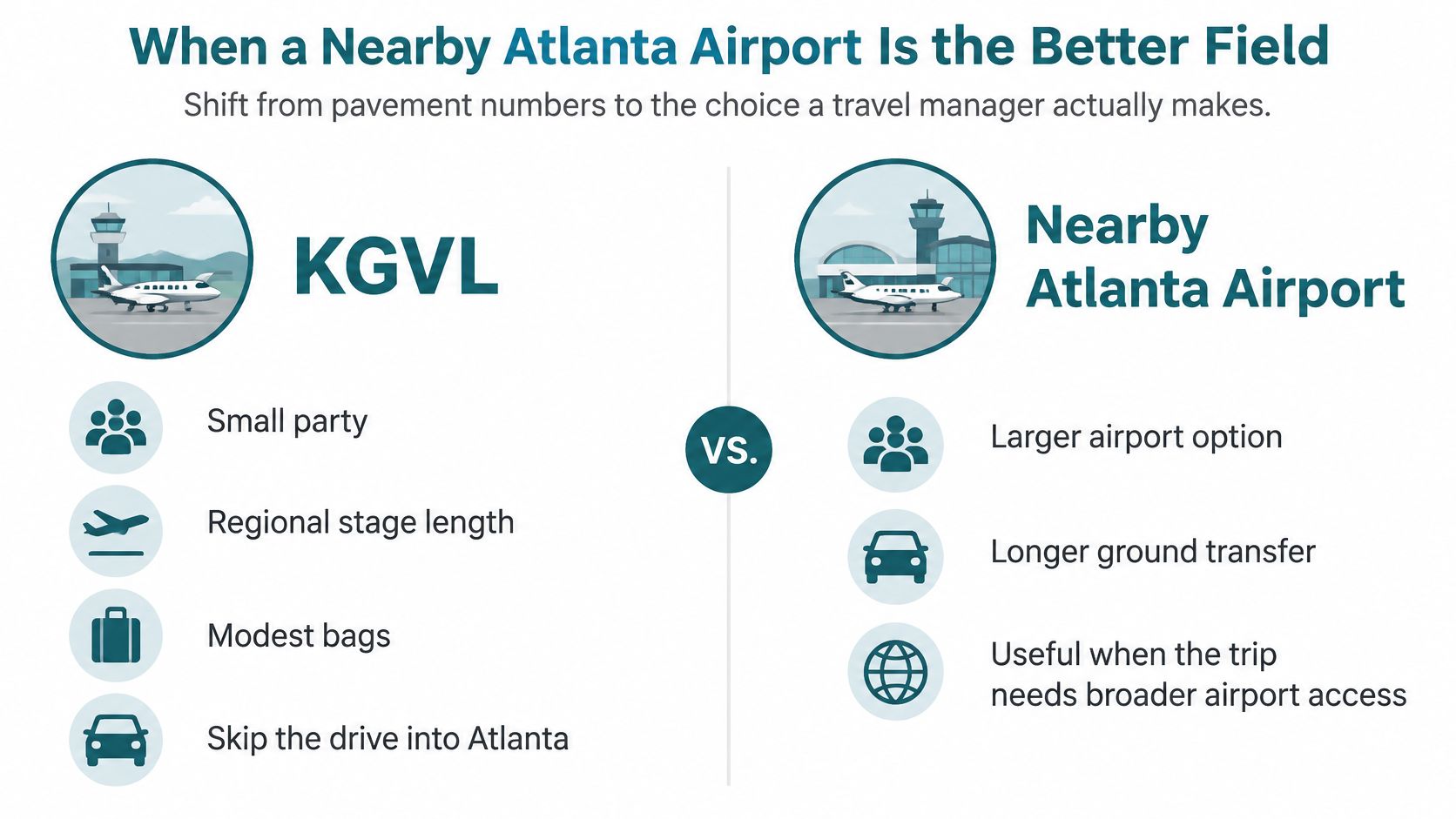
The City of Gainesville airport page is clear that the field has two runways, one at 4,001 feet and another at 5,500 feet, with the longer one carrying the instrument landing system and approach lighting. It also makes the point that runway length alone doesn't establish suitability for every light, midsize, or heavy jet. Weight, payload, temperature, wind, runway condition, weather minimums, current notices, parking, fuel, and handling all get verified for the specific mission. And scheduled passenger service at a big airport is not evidence that a charter can use it.
Mission | Typical aircraft | Start at KGVL when | Move the departure when |
|---|---|---|---|
Regional hop, 4 to 6 passengers | Light jet | Mild temperature, modest bags, short stage | Hot day, full fuel, or forecast near minimums |
Longer nonstop, 7 to 9 passengers | Midsize jet | Operator numbers clear both runways in use | Payload or fuel must be cut to meet the distance |
Team, crew, or heavy cabin | Heavy jet or small airliner | Rarely, and only with a written performance sign-off | Gear, headcount, or range needs a longer runway |
Medical or time-critical IFR | Equipped light or midsize | Approach is authorized and weather is above minima | NOTAM, equipment, or minima block KGVL |
International with customs | Super-midsize or heavy | Only if fuel, payload, and handling all clear | A customs-capable longer runway is the practical plan |
The heavy-cabin row is the one people argue about. A sports staff with equipment trunks, or a family of eight with golf bags flying nonstop, usually belongs at a longer Atlanta-area business field such as DeKalb-Peachtree, or wherever the operator's performance run points once the load is real. That isn't a knock on Gainesville. It's the same airplane flying the same trip from a field that has the margin. If you want to see how the metro side of that comparison works, the Atlanta private jet charter guide walks through the field options in more detail.
Choose KGVL when the calculation clears with a reserve. Choose the alternate when the operator would have to leave people, bags, or fuel behind to make it work.
Price the trade with clear eyes. Driving an extra hour to a bigger field costs you time and a car service. A refused takeoff costs you the meeting, the deposit, and the day. Those aren't equivalent risks, and a broker who won't name an alternate is telling you something about how the quote was built.
How Payload and Baggage Change the Aircraft
Luggage is a compliance limit, not a concierge preference. U.S. on-demand charter flies under Federal Aviation Regulations Part 135, and the baggage and cargo stowage rules in 14 CFR Part 135 require cargo and carry-on baggage to sit in an approved rack, bin, or compartment, secured with an approved restraint or otherwise fastened so it can't shift in flight. Bags can't block emergency exits or aisles, obscure required safety signs, exceed seat or floor load limits, or ride directly above a seated passenger. Under-seat bags have to be restrained against sliding.
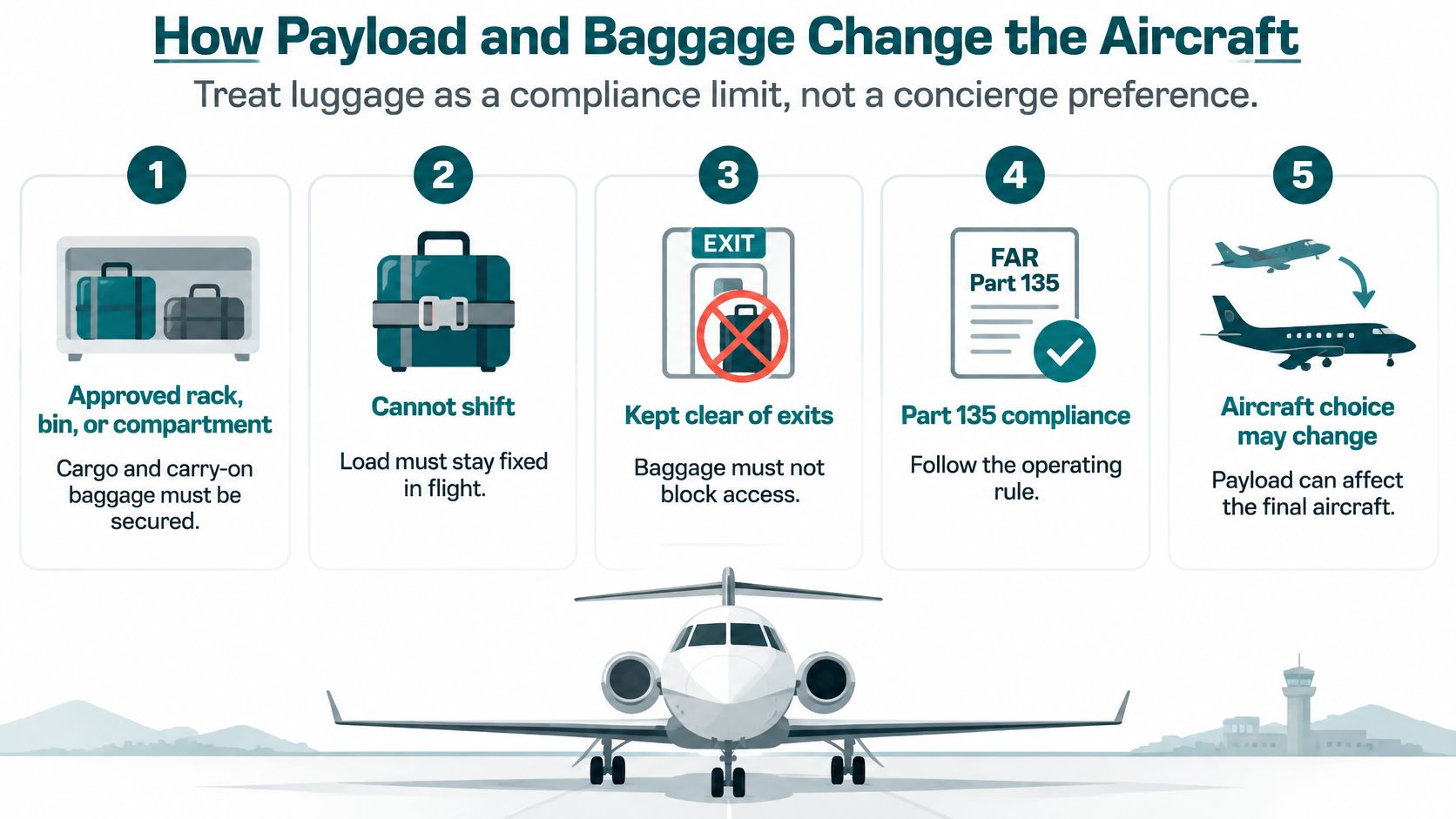
Three loads show how that changes the airplane you book.
The family with oversized cases
Four people, six large hard cases, a stroller, and a cooler. A light jet's baggage bay can fill before the seats do. The operator weighs each bag, and one oversize item may be refused outright or need to ride in a second compartment that doesn't exist on that airframe. The fix is usually a step up in cabin, not creative repacking at the ramp.
The crew with equipment
A sports staff with stick bags, video cases, or a medical team with devices needs a baggage door with real dimensions and a payload number that survives the trip. Headcount alone tells you nothing here. Ask what the baggage door measures and what the compartment holds, because a seven-seat airplane can still be a two-trunk airplane.
The group that also wants full fuel
Corporate six flying a long nonstop is solving one equation: people plus bags plus fuel cannot exceed what the runway and the airframe allow that day. Something gives. It's the passenger count, the bag weight, the fuel load, or the airport. A smaller cabin on a shorter leg with a fuel stop sometimes beats a bigger cabin with three people left behind.
Bring to the brief: passenger count, each bag's estimated weight, anything longer than a standard suitcase, and whether pets or medical equipment travel in the cabin.
Pets usually fly when the operator accepts them and the paperwork is ready, but the match is aircraft-specific. Before you approve a quote, ask for the baggage diagram and a payload sign-off for your actual load. If the numbers don't fit, expect a different aircraft rather than a squeezed loading plan. The guide to small charter aircraft covers how cabin classes differ in baggage volume and range, which is the practical way to decide whether you need the step up.
Sample Charter Days From Northeast Georgia
Timing decisions come after the airport and payload screens are already done. Three calendar days show what that looks like in practice, including the moment a plan needs adjusting.
Lake Lanier weekend. Two couples, a light jet already cleared for KGVL, wheels up Friday at 4 p.m. for south Florida, home Sunday evening. They arrive at the FBO 20 minutes before departure with four midsize cases and skip a commercial connection entirely. The Sunday risk is temperature and fuel: if the afternoon heat pushes the takeoff run past the runway in use, either move wheels up earlier or plan a fuel stop. That call gets made Friday, not Sunday at the curb.
Same-day plant visit. Six people in a midsize cabin, Gainesville to a Midwest city and back the same day. The gain isn't luxury, it's the commercial day you don't lose to a connection through Atlanta. One direct block each way, a meeting in the cabin on the way out, and a working dinner on the way home. Standard snacks are usual. Special meals need advance notice. Ask for block time before you compare it with an airline itinerary, because the connection you're avoiding is the whole point of the trip.
Event departure. A family of eight with golf bags, or a small sports staff with equipment, flying nonstop. This is the case where seats exist and volume and weight don't. The operator limits bags, steps up in cabin, or starts at the longer Atlanta-area runway already selected in the mission table. Nobody enjoys hearing it, and hearing it a week out is far better than hearing it at the airplane.
Regional light-jet pricing moves with flight hours, date, positioning, and fuel. Two quotes for the same city pair can differ because one aircraft is based nearby and the other has to be ferried in.
Each of these days ends with the same three figures to request: block time, passenger count, and bag weight. Give those to the operator and you get an aircraft that fits the mission. Withhold them and you get a number that fits a brochure.
Brief the Operator and Request the Quote
Send one brief, in this order, and the quote comes back usable.
- Date, both airports, and local time. Include the return leg. Half the friction in charter comes from an arrival airport nobody confirmed.
- Passenger count, including lap infants and anyone who needs a specific seat.
- Bag weights, pets, and medical items. Estimated weights are fine. Silence isn't.
- Any time that cannot move. A hard meeting start, a wedding, a surgery. Say which parts of the schedule are fixed and which are flexible.
- Whether KGVL is required or an Atlanta-area alternate is acceptable. This single line determines how much performance margin the operator has to work with.
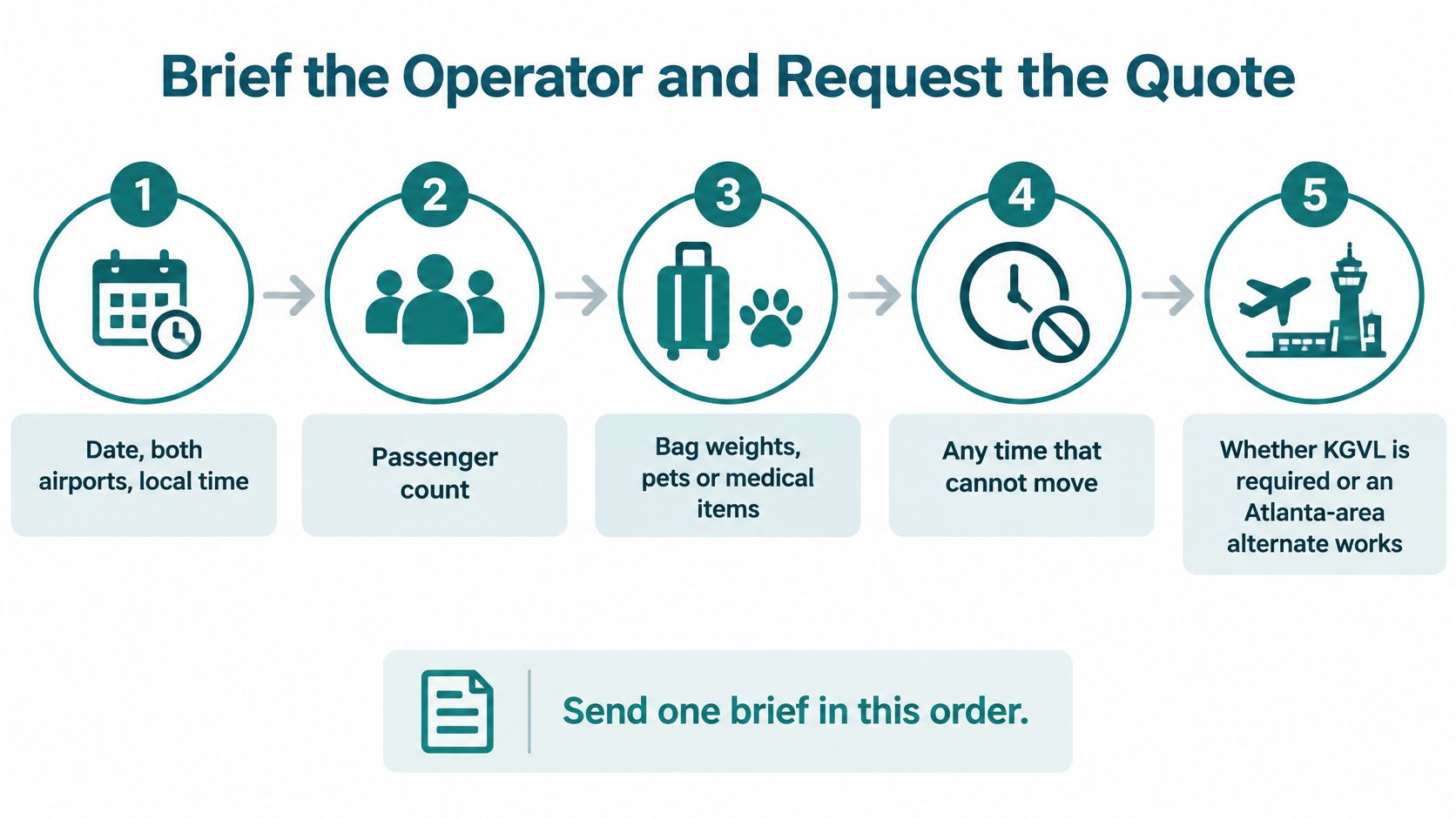
From there, ask for two or three aircraft from Part 135 operators, not an owned fleet, each with seat count, baggage space, and a KGVL performance note for your load and date. Ask for ARGUS or Wyvern credentials where the operator holds them, and the legal operator name on the quote. A quote without an operator name is a number with no accountability behind it.
Read the price the way a CFO would. Aircraft cost, then Federal Excise Tax, segment fees, and airport or international charges on top. The booking agreement is the price. The first estimate is an opening position.
Read the cancellation clause before you sign. Terms change with the operator, the aircraft type, and how close the cancellation lands to departure.
Approved Jets works this as a broker, which means we source aircraft through a vetted operator network and don't own or operate them. We're an Air Charter Broker under DOT Regulations, operating under Part 295. Call +1 (866) 678-1411 or email charter@approved-jets.com with the five-line brief above. The phone line is answered 24 hours a day for immediate charters, and the stated email response aim is about 15 minutes. An existing aircraft and crew can sometimes mobilize in two to four hours, though weather or runway limits can still move the field.
Then confirm the ground side: catering, cars, the FBO, and a 24-hour contact who answers. Accept only the option whose runway assumption, operator name, and cancellation text match the people, the bags, and the airport you'll drive to. The step-by-step guide to chartering a private jet covers the rest of the paperwork sequence if you want the full checklist in front of you.
Approved Jets arranges on-demand charter into and out of Lee Gilmer Memorial and the Atlanta-area fields that sit within a drive of it, matching aircraft to your passenger count, bag weights, and runway performance for the date. Send us your date, both airports, and the load you're carrying, and we'll come back with operator-named options and a written quote. Visit Approved Jets to start the brief.