Private Jet Charter Atlanta: Airports, Jets and Operators
Private Jet Charter Atlanta guide covering jet sizes, Hartsfield-Jackson versus reliever airports, operator checks and ground logistics before you book.
13 min read

Your executive needs to leave Atlanta, make the meeting, and get home without losing the day. You've got a passenger list, a departure window, and several aircraft photos in your inbox. What you may not have is the information that determines whether the trip will work: the right airport, a realistic baggage allowance, and the name of the company legally operating the flight.
For private jet charter in Atlanta, start with the mission, not the cabin photograph. Airport suitability and operator authorization should shape the quote before anyone commits to an aircraft. A broker can coordinate the journey, but the operating carrier must approve the aircraft's performance, supply qualified crews, and retain operational control.
Table of Contents
- Which Jet Size Fits Your Atlanta Trip
- Seats aren't the only limit
- Choose Hartsfield-Jackson or a Reliever Airport
- Choose for the loaded aircraft and the whole journey
- What Drives Your Atlanta Charter Quote
- Compare the complete mission cost
- How to Verify the Operator Before You Pay
- Run the document check
- Ground Logistics From Pickup to Wheels-Up
- Assign each handoff
- Mistakes Executives and Teams Make in Atlanta
- Judgment failures and their fixes
- Request an Atlanta Charter Quote With Verified Details
- Make the responsibilities explicit
Which Jet Size Fits Your Atlanta Trip
Jet categories for Atlanta charter trips
Category | Typical passenger seats | Best fit for Atlanta trips |
|---|---|---|
Light jet | 4-6 | Short regional hops and small teams |
Midsize jet | 6-8 | Cross-country trips with checked bags |
Super midsize jet | 8-9 | Longer legs, more luggage or equipment |
Heavy jet | 10-16 | Large groups and international range |
Use these seating bands as planning examples, not guaranteed configurations. A light jet is a sensible starting point for Atlanta to Charlotte or Nashville with a small party. A heavy jet belongs on the shortlist when cabin space, group size, or international range warrants it, not because it looks more comfortable.
Browse the aircraft categories to establish a shortlist, then identify the actual model and interior configuration. A seat shown on a floor plan doesn't establish that your passengers, luggage, and required fuel can travel together.
Seats aren't the only limit
The FAA's Part 135 certification guidance describes on-demand airplane operations with no more than 30 passenger seats and a maximum payload capacity of 7,500 pounds. Those are certification thresholds, not a promise that every business jet can carry that payload. The operator's authorization, aircraft configuration, and mission still determine what's permissible.
Consider a hypothetical group of eight passengers with four checked bags. A midsize jet may have enough seats, but the operator still needs passenger weights, bag weights, and bag dimensions to evaluate the mission. Awkward cases can create a storage problem even when their combined weight looks manageable.
Put that same group on a super midsize jet and you may gain baggage space and a more suitable payload-range combination. You haven't automatically solved the problem: the operator must calculate the flight with the required fuel reserves and actual conditions. Paying for a larger category without checking the specific aircraft is an expensive shortcut.
Selection test: Establish how many passengers are traveling, how much baggage they're bringing, and how long the longest leg runs before comparing cabin amenities.
For sports or entertainment movements, include equipment cases separately from personal luggage. A larger group may need an appropriately authorized air-carrier operation rather than a conventional business-jet charter. Don't try to solve an authorization problem by searching for a different seating diagram.
Choose Hartsfield-Jackson or a Reliever Airport
Atlanta airports compared for charter planning
Airport | Best fit | Watch for |
|---|---|---|
Hartsfield-Jackson Atlanta International (ATL) | Large jets, international trips, full FBO and customs services | Included in the reported November 2025 restrictions; very high traffic |
DeKalb-Peachtree (PDK) | Light and midsize jets, convenient for Midtown itineraries | Outside those reported limits; confirm runway and FBO suitability for loaded weight |
Gwinnett County–Briscoe Field (LZU) | Light and midsize jets, north-metro itineraries | Outside those reported limits; confirm runway suitability for heavier loads |
Fulton County Executive (FTY) | Light and midsize jets, west-side and selected south-metro pickups | Outside those reported limits; check the actual ground-transfer route |
The restriction references above describe a historical event, not present-day airport availability. In November 2025, the FAA restricted private-jet activity at Hartsfield-Jackson and 11 other major commercial airports because of controller staffing shortages, while the named Atlanta reliever fields weren't covered, according to The Spokesman-Review's report.
That distinction matters when you're evaluating schedule resilience. A general-aviation airport can offer a useful alternative to the airline hub, but it isn't automatically suitable for every aircraft or immune to weather, operating restrictions, or congestion.
Choose for the loaded aircraft and the whole journey
Hartsfield-Jackson recorded 93,699,630 passengers and 724,145 aircraft operations in 2022, with operations increasing 2.3% from 2021, according to the airport's history page. These are total-airport figures, not charter volume. They show the scale of the operating environment, not your likely departure delay.
ATL offers the infrastructure relevant to large-aircraft and international handling, but confirm the exact FBO, customs arrangements, and service availability for your itinerary. A reliever airport may reduce terminal complexity or improve the drive from your pickup point. Its usefulness still rests on the aircraft's loaded performance and the services needed that day.
Choose a primary airport and a usable backup. A nearby runway that can't accommodate the mission isn't a contingency plan.
Ask the operator to validate the proposed field before you organize cars around it. Confirm current FAA notices and any applicable airport restrictions again before departure, rather than treating the original quote as an availability guarantee.
For a Midtown executive flying to a northeastern city, PDK may provide the better door-to-door plan once driving, parking, and FBO access are included. Compare it against ATL using the actual pickup address and departure window, not a map pin alone.
For a team flying internationally, the priorities change. Customs arrangements, baggage handling, aircraft servicing, and arrival procedures deserve explicit confirmation at each field. A longer drive to the right airport can be preferable to a convenient departure point that requires a technical stop or handling change.
What Drives Your Atlanta Charter Quote
Say a midsize jet is proposed for a hot-weather international departure with a full cabin and substantial baggage. The same aircraft that works comfortably on a lightly loaded domestic trip may not support that combination of payload, fuel, and runway conditions. The operator may propose another aircraft, a fuel stop, or a different field.
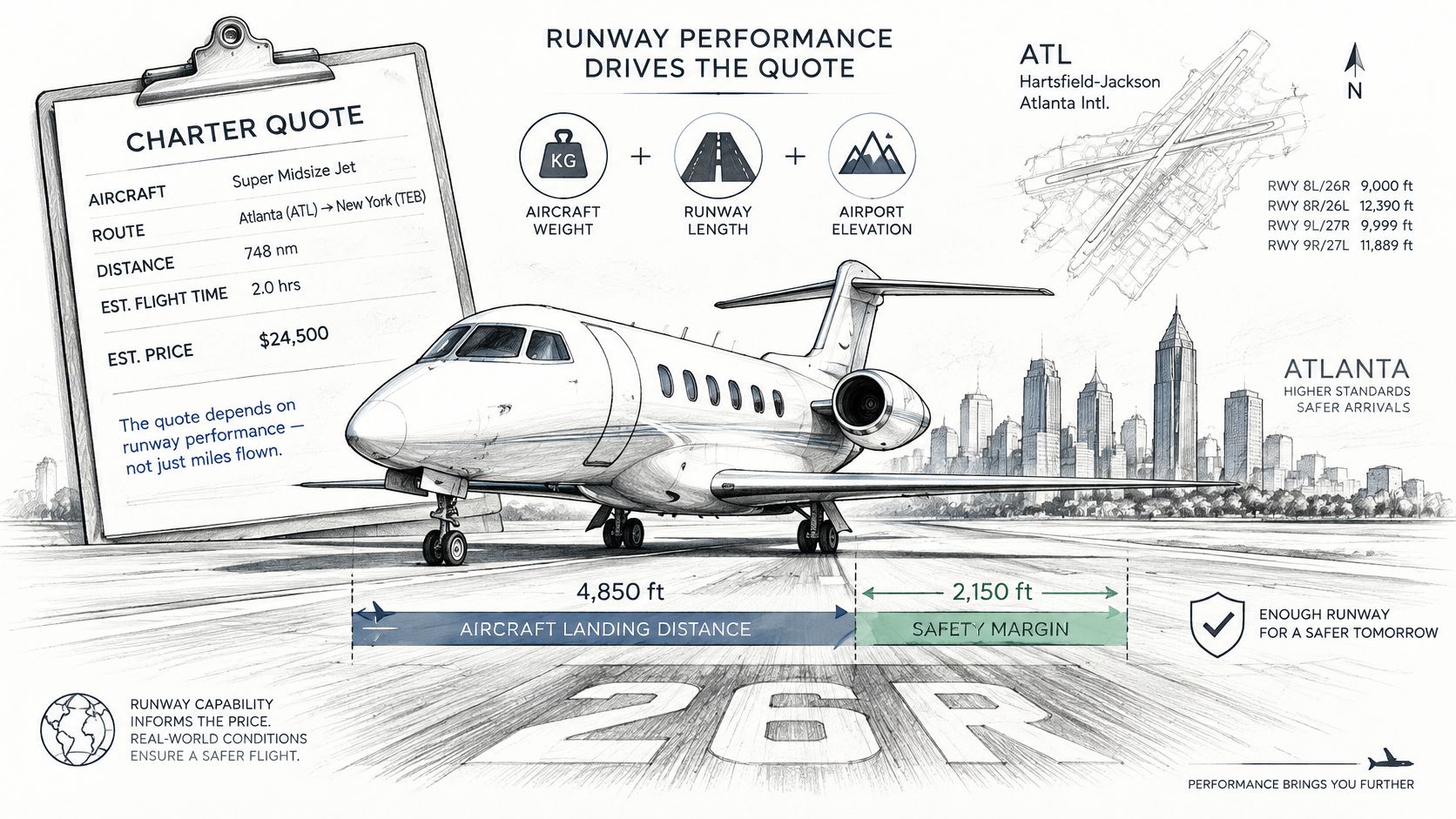
That's why a charter quote reflects more than distance and cabin category. Under Part 135's operating framework, destination-airport analysis may be required using manufacturer performance information and actual conditions, including aircraft weight, runway length, surface condition, temperature, elevation, wind, and obstacles. Applicable diversion planning also requires usable airports and defined conditions for their use.
The performance decision sits behind several apparent price differences.
Compare the complete mission cost
Quote cost drivers beyond the aircraft
Quote factor | How it moves the price | Question to ask the operator |
|---|---|---|
Positioning flight | Adds cost when the aircraft must fly in empty | Where is the aircraft based and is repositioning priced in? |
Landing and overnight fees | Airport charges and nights on the ground affect the total | Which airport fees are included in the quote? |
De-icing | Can add cost for cold-weather departures | Is de-icing included, and at which field? |
Catering and ground transport | May be itemized separately from the flight | Which ground and catering items are in the quote? |
Aircraft change for payload or runway | A different aircraft may be necessary when limits apply | Has performance been checked at both destination and alternate? |
At Approved Jets, our quotes are estimates and can change with aircraft availability, fuel costs, positioning, landing fees, overnight charges, de-icing, catering, and ground transportation. Compare inclusions and assumptions before deciding that the lowest headline amount is the lowest trip cost.
Your request should state the planned airports, proposed aircraft model and configuration, passenger and baggage weights, and any inflexible arrival deadline. The operator should establish fuel assumptions, alternate strategy, and runway or weather limitations.
A fuel stop isn't always a poor outcome. It may preserve the preferred cabin and departure field, provided the extra elapsed time is acceptable. For a meeting-critical trip, a different aircraft or airport may be the better use of the budget.
Before accepting the quote, ask: Has the operator checked performance at both the destination and the alternate?
How to Verify the Operator Before You Pay
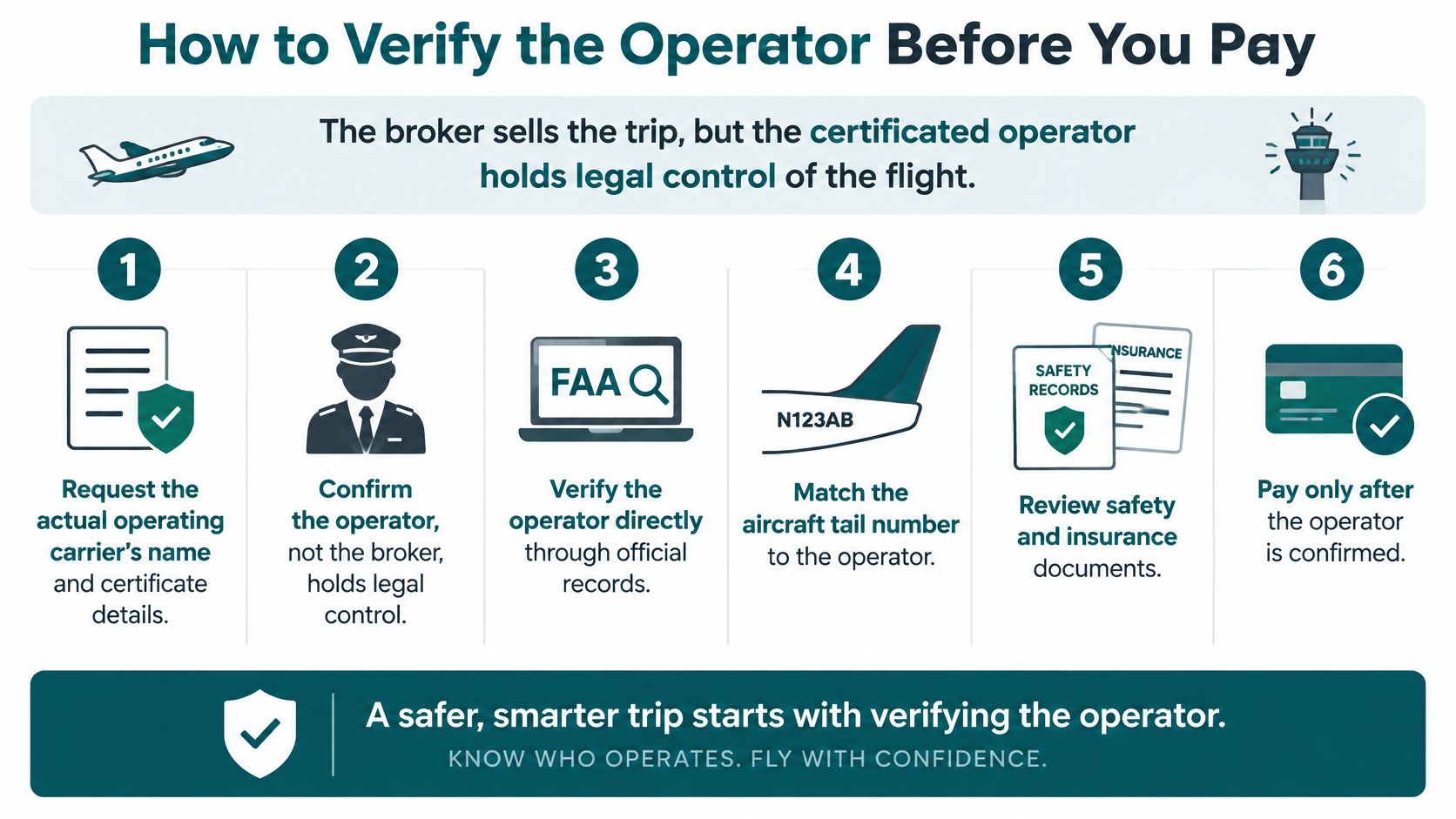
A quote for an Atlanta departure is not ready for approval until you know which company will operate the flight. The broker arranges the charter; the certificated operator holds operational control. An aircraft listing or familiar brand name does not establish that the company is authorized to conduct the trip.
Our guide to aircraft charter brokerage explains the broker's role. For a specific flight, verify the proposed operator and aircraft against the details of your itinerary.
Run the document check
- Get the operating carrier's name and certificate. Ask for the legal name of the company responsible for the flight and its Air Carrier or Operating Certificate. If the quote names only a broker, aircraft owner, or marketplace listing, request the operator's details before paying.
- Check the operator's Part 135 authorization. Search official FAA records using the operator's legal name, any applicable doing-business-as name, or the aircraft registration. Confirm that the record matches the company named for your flight. A broker's business registration is not a substitute for the carrier's aviation authorization.
- Match the aircraft to the operator. Confirm the proposed tail number and that the aircraft is assigned under the named operator's authority. Check that the registration and airworthiness status are current. Verification of one carrier does not automatically cover every aircraft later offered.
- Confirm the crew's qualification basis. Ask the operator to confirm that the pilots are qualified for the charter and operating under the certificate holder's operational control. A pilot biography alone does not establish either point.
- Ask which operations specifications cover the mission. Request confirmation that the operator's applicable OpSpecs authorize the proposed operation. The certificate identifies the carrier; the relevant operating specifications clarify whether the planned flight falls within its authorization.
- Set expectations for substitutions. Ask how changes to the aircraft or crew will be disclosed, who must approve the revised assignment, and how a change could affect the schedule or charges. Recheck the flight-specific details if the assignment changes.
Keep the request focused on written confirmation of authorization and crew qualification. You do not need sensitive crew records or to conduct a maintenance audit. If your organization has insurance requirements, request the relevant documentation separately; insurance does not establish operating authority.
Before payment, retain a record identifying the operator, certificate, tail number, crew qualification basis, and applicable operations specifications. That gives your travel team a clear reference for the flight it approved.
Ground Logistics From Pickup to Wheels-Up
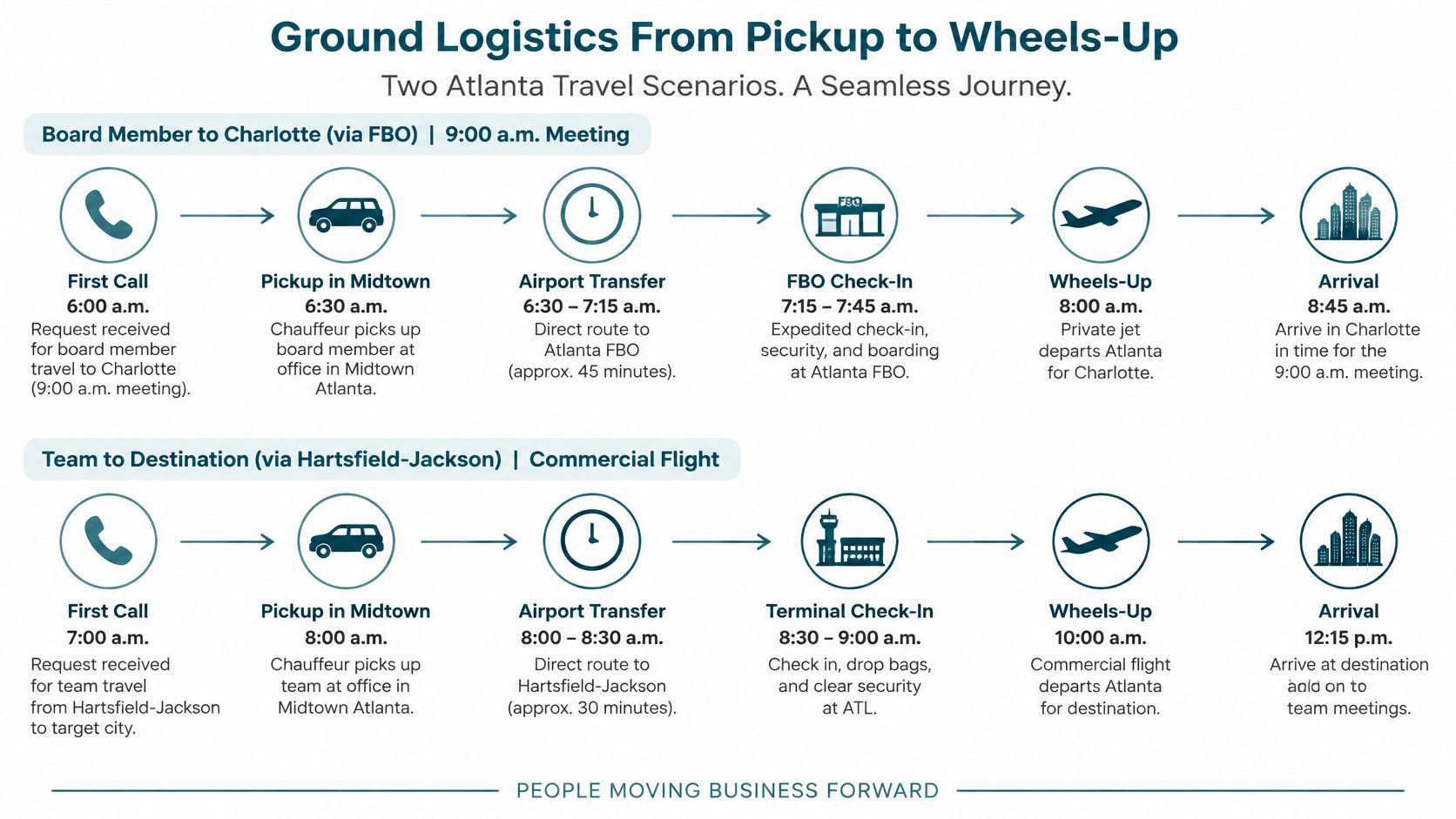
Consider a hypothetical board member leaving Midtown for a 9 a.m. meeting in Charlotte. Start with the meeting address and work backward through the arrival transfer, flight, boarding requirements, Atlanta drive, and a buffer before pickup. Don't choose a departure time first and squeeze the ground journey around it.
At booking confirmation, put the correct FBO address, passenger contact, driver instructions, and arrival destination into the itinerary. Compare live routing from the office to ATL, PDK, and Fulton County for the actual travel window. Fixed drive-time promises aren't useful when pickup location and road conditions haven't been established.
The handoffs matter as much as the flight.
Assign each handoff
We coordinate ground transport, catering, security, and special requests, and manage the complete trip. Our door-to-door transport approach connects those arrangements so passengers aren't left reconciling separate instructions from the driver, FBO, and flight team.
At the FBO, follow the operator's identification, security, and check-in instructions. Confirm catering and special equipment before boarding, and have the destination driver track the updated arrival rather than relying only on the original itinerary. International journeys also need customs paperwork and an agreed pre-departure reporting time.
For travel managers coordinating with a taxi fleet, Rally for taxi operators is a relevant resource for understanding the ground-provider side of passenger transport. The operational requirement remains simple: assign a dispatcher, a driver contact, and an escalation route.
Ground-time rule: If the extra transfer to a reliever field exceeds the overall time it saves, prefer the larger airport, provided it meets the mission's operational needs.
Copyable planning timeline
- First call: Record the meeting deadline, passenger list, luggage, and pickup address.
- Confirmation: Agree the airport, FBO, reporting instructions, and destination transfer.
- Office departure: Add a buffer before the driver pickup.
- Airport transfer: Use current routing and send changes to the trip coordinator.
- FBO arrival: Complete the required checks while the crew finalizes preparation.
- Wheels-up and arrival: Update the receiving driver and protect the transfer to the meeting.
For a team leaving ATL for a Florida venue, use the same sequence but assign responsibility for equipment loading and the arrival vehicle capacity.
Mistakes Executives and Teams Make in Atlanta
Booking before the operator is named is the mistake I'd eliminate first. It commits the organization before the responsible carrier, aircraft assignment, and crew basis have been established. A polished proposal doesn't make that gap less consequential.
Consider a hypothetical team of seven booking a midsize jet from a listing. On departure day, they discover a different operator has been assigned and miss the morning meeting while the travel department resolves approval questions. Requiring the operator's name and tail number in writing would have exposed the unresolved assignment before the booking became time-critical.
Judgment failures and their fixes
- Choosing the nearest airport without checking the loaded mission. The likely cost is a rejected payload plan or a departure-field change after cars are booked. Require operator confirmation of runway margins at both ends before treating proximity as an advantage.
- Assuming the model guarantees the aircraft. A model name doesn't identify the cabin configuration or registration. Put the proposed tail number and substitution conditions into the written request to avoid a last-minute mismatch with baggage or seating needs.
- Leaving out the backup airport. A disruption can become a delayed departure while everyone searches for an acceptable alternative. Name a primary and backup field and have both checked against current operating notices.
- Ignoring cancellation and substitution terms. A replacement aircraft may change timing, capability, or cost. Read how aircraft and crew changes affect your obligations before authorizing payment, not while passengers are waiting.
- Accepting an aircraft listing without an operating carrier. This creates legal and procurement exposure because the organization hasn't established who will conduct the flight. Apply verification step 1: no payment approval until the carrier and certificate are provided in writing.
- Treating presentation as proof of authority. Photos, amenities, and recognizable branding don't demonstrate authorization. Judge the operating documents and mission approval, or risk discovering that the marketed option can't legally perform the proposed flight.
Calendar discipline belongs alongside those decisions. For assistants managing board meetings, aircraft windows, and venue holds, guidance on how to prevent double bookings across calendars can help keep scheduling conflicts separate from aviation constraints. Assign one person to release obsolete holds when the itinerary changes.
A carrier name isn't administrative decoration. Every meaningful flight check depends on knowing the operator, which is why committing before that name is established causes so much avoidable trouble.
Request an Atlanta Charter Quote With Verified Details
Send a complete mission request before choosing the aircraft. A useful request gives the charter desk enough information to compare feasible options rather than return a collection of cabins that merely look suitable.
- Route: Include every stop and the final destination address where relevant.
- Date and time window: Identify flexible departure times and immovable arrival deadlines.
- Passengers: Provide the count and any assistance requirements.
- Baggage: Describe checked bags, oversized cases, equipment, and estimated weights.
- Airports: Name preferred and backup fields, or ask for an airport comparison.
- International status: Flag border crossings and documentation requirements early.
Use the Get a Quote option to begin the proposal process.
Make the responsibilities explicit
At Approved Jets, we receive your travel requirements, source aircraft and operators through our network, and present options, pricing, and itinerary details. We operate exclusively as a charter broker and don't own, operate, lease, or maintain aircraft. Operator verification therefore remains part of every proposed flight, regardless of how familiar the route or aircraft model appears.
Clients can request a personalized proposal through our flight advisors or the Get a Quote button. Our advisors are available 24/7 for immediate charters at +1 (866) 678-1411. Tell the advisor which parts of the itinerary are negotiable so the comparison reflects your actual priorities.
For Atlanta, attach questions about runway performance at departure and destination, current FAA restriction status, ground transport from the pickup address, and the operating carrier's certificate. Request an explanation of any assumption still awaiting operator confirmation. That distinction keeps a provisional option from being mistaken for a fully validated itinerary.
For another look at the charter offering, watch the video below.
The strongest comparison is not only between aircraft prices. It's between complete travel plans with identified carriers, suitable airports, realistic luggage assumptions, and clear responsibilities when conditions change. A slightly different departure field or aircraft can be worthwhile if it protects the meeting and avoids an unplanned stop.
Send the request with the checklist and verification questions attached before you approve any aircraft.
Approved Jets offers charter sourcing and complete trip coordination, including the ground transfers and special arrangements that make an Atlanta itinerary workable. Visit Approved Jets with your route, passenger list, baggage details, and timing requirements to request a personalized proposal built around the full journey.