Small Charter Plane Guide: Turboprop vs Light Jet Compared
Compare small charter plane options: turboprops, very light jets and light jets, with seating, range, baggage, costs and the right fit for each trip.
13 min read

You're trying to get a team to a regional meeting, move your family without a connection, or reach a site that's nowhere near an airline hub. The quotes show a turboprop, a very light jet, and a light jet, each with enough seats. What they don't immediately tell you is whether those seats remain usable once everyone's luggage and the trip's fuel are aboard.
The right small charter plane is the aircraft that can carry your actual load into your actual airports, with an operator qualified to conduct the flight. Start there, then compare speed, cabin comfort, and the all-in price.
Table of Contents
- Compare Small Charter Planes at a Glance
- Filter the quotes before comparing interiors
- How Each Class Performs on Real Routes
- Where the turboprop earns its place
- Ask for field performance, not just runway length
- Baggage and Passenger Limits Set the Real Capacity
- Build the load before committing to the aircraft
- What a Small Charter Plane Really Costs
- Separate flight time from the invoice
- Verify the Operator Before You Book
- Run these checks before paying
- Read evidence in context
- Match Your Mission and Request Quotes
- Choose the constraint you can't compromise
- Write a quote brief an operator can use
- Compare complete missions, not attractive line items
- The verdict by situation
Compare Small Charter Planes at a Glance
A turboprop may offer the best access to a short runway, while a light jet may cover a longer sector faster. Compare the classes by their typical cabin, relative range and speed, and the airports they can use. Actual capacity still depends on payload, fuel, configuration, and runway conditions.
Class and example | Typical seats | Max range | Cruise speed | Typical mission | Runway needs |
|---|---|---|---|---|---|
Turboprop, Cessna Caravan | Larger, utility-focused cabin, with passenger capacity varying by layout | Shorter than the PC-12 and jets in this comparison | Slowest class in this table | Remote strips, regional sectors, cargo | Short-field access, including suitable less-developed fields |
Turboprop, Pilatus PC-12 | Larger cabin than a very light jet; layout varies | Longer than the Caravan, generally shorter than the jets | Faster than the Caravan, slower than the jets | Regional business, medical transport | Check approved surface and actual field performance |
Very light jet, Embraer Phenom 100 | Small executive cabin | Shorter than a light jet | Faster than turboprops, slower than a light jet | Short hops, executive travel | Suitable paved runway with aircraft-manual margins |
Light jet, Cessna Citation CJ3 | Larger small-group cabin than a very light jet | Longest class-level range in this comparison | Fastest class in this table | Longer business sectors, family travel | Suitable paved runway and departure-performance clearance |
These are class-level comparisons, not guarantees for a particular aircraft or trip. A model name alone does not establish usable payload, seats, range, or runway performance. The aircraft's actual configuration and the planned load matter.
In the United States, on-demand charter generally operates under Part 135, distinct from informal transportation offered by a private aircraft owner, as the FAA's Part 135 guidance explains. A listed seat count is a ceiling, not a guarantee that every seat can be occupied on every route.
Filter the quotes before comparing interiors
Before shortlisting an aircraft, pin down the practical limits:
- Travelers and luggage: Who is flying, what are their planning weights, and what bags or equipment are coming?
- Sector requirements: Must the flight be nonstop, or would a fuel stop still meet the schedule?
- Airport suitability: Are the runways paved, long enough, and suitable for the proposed aircraft under expected conditions?
A family carrying bulky ski equipment may need a different aircraft from an executive group with soft overnight bags, even with the same headcount. The outbound and return legs may also call for different fuel plans.
Choose by usable payload and airport access first, then weigh cabin comfort and speed. Operator credentials matter more to safety than the aircraft's class or brochure specifications.
Buying rule: Compare aircraft against the passengers, baggage, airports, and departure window you'll actually book, not an empty-aircraft specification sheet.
How Each Class Performs on Real Routes
Consider a hypothetical 600-nautical-mile sector in still air. Dividing distance by the Caravan's published cruise speed gives about 3.2 hours; illustrative jet cruise assumptions produce about 1.5 hours for a very light jet and 1.4 hours for a light jet. These are arithmetic cruise comparisons, not block-time estimates or guaranteed performance for the named jet models.
The route illustration makes that distinction easier to visualize.
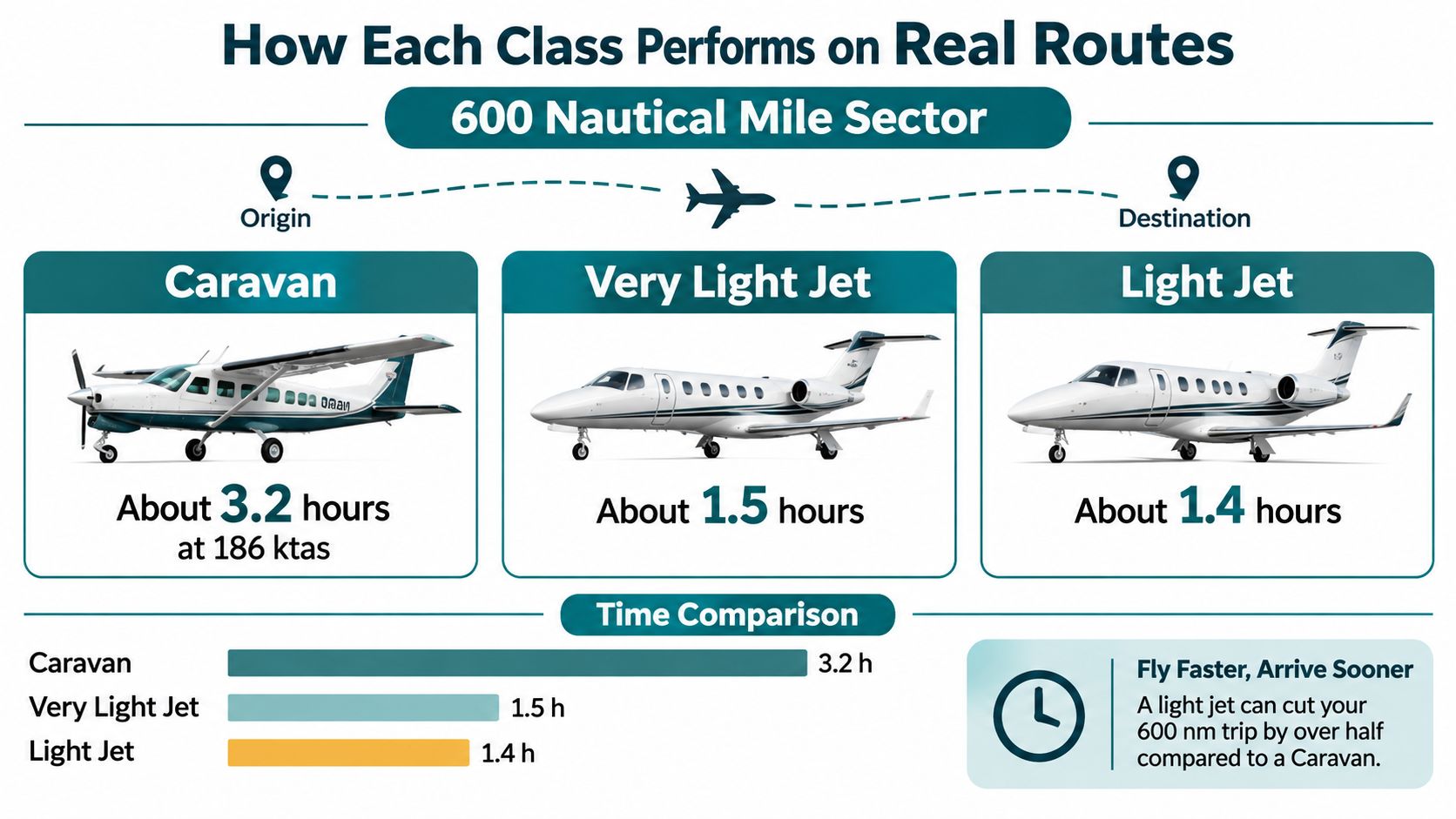
Actual block time runs from movement at departure to parking at arrival. Taxiing, climb, descent, routing, wind, and a possible fuel stop all change the result, so request a dispatch-based itinerary rather than multiplying brochure speed by distance.
Where the turboprop earns its place
The Cessna Caravan brochure publishes a 186-ktas maximum cruise speed, 1,070-nautical-mile maximum range, 3,305-lb useful load, 1,160-ft takeoff ground roll, 25,000-ft maximum operating altitude, and a 10–14-occupant rating. Those figures describe different aspects of capability; they aren't a promise that maximum occupants, maximum range, and shortest takeoff can be achieved together.
A Caravan can be the stronger choice when the destination is a suitable remote strip and the alternative is a jet landing farther away. But don't apply Caravan performance to every turboprop. A Pilatus PC-12 charter assessment should consider that aircraft's own cabin, payload, and airport requirements.
Very light jets make sense when a small group can use appropriate paved airports and values a quicker regional flight. Light jets become more attractive when the mission needs additional cabin room or a longer sector, provided the specific aircraft can carry the load without an unwanted stop.
Ask for field performance, not just runway length
The Caravan's ground-roll figure isn't the same as the total runway requirement. The EASA CS-23 certification specifications distinguish ground roll from applicable takeoff obstacle-clearance performance and define landing performance under specified conditions.
Ask for aircraft-specific analysis using temperature, elevation, runway slope and surface, wind, obstacles, payload, and fuel state. A cool-morning departure can be feasible when the same load on a hot afternoon isn't.
Speed buys time on long legs. Runway access buys trips on short ones.
My decision rule is to favor jets when longer paved-airport sectors make their time saving meaningful. If either endpoint is short or unpaved, investigate a suitable turboprop first, without assuming the aircraft is automatically approved for that field.
Baggage and Passenger Limits Set the Real Capacity
The seat count is a ceiling, not the aircraft's real carrying capacity. Say a cabin has a seat for every traveler, but everyone brings a heavy suitcase plus golf clubs or ski equipment. The operator may need to reduce baggage, change aircraft, schedule a fuel stop, or leave a seat unoccupied.
The constraint isn't just whether the bags fit through the door. Crew, passengers, baggage, equipment, and usable fuel must remain within the applicable weight limits, and their distribution must keep the aircraft within its center-of-gravity envelope.
Build the load before committing to the aircraft
The operator should establish passenger weights using its approved procedure, add actual or appropriately established baggage weights, and calculate trip fuel plus reserves. It must then check takeoff weight, landing weight, balance, and performance for the planned airports.
The safety consequences are concrete. The NTSB's review of Part 135 operations identified four single-engine airplane accidents involving unsafe loading conditions in its review of more than 500 accidents from 2010 through 2022, and recommended mandatory manifests and recorded weight-and-balance documentation.
Give the planner a load list that includes:
- Each traveler: Names and the weight information the operator requests.
- Every bag: Approximate weight, dimensions, and whether it's rigid or soft-sided.
- Oversized equipment: Golf clubs, skis, mobility aids, medical equipment, and cases that can't be stacked.
- Handling requirements: Items that must remain accessible or need special restraint.
A longer mission may leave less capacity for passengers because the aircraft needs more departure fuel. That doesn't mean the cabin changed; the load allocation did.
Practical rule: Resolve baggage restrictions before signing, not beside the aircraft.
Ground transport needs the same discipline. For an itinerary through New York, the Airport Vans NYC rental guide is a useful planning companion when coordinating a group's airport transfer; check luggage capacity alongside passenger seating.
Request a written passenger-and-baggage manifest and confirmation of how the operator will verify bag weights when loading margins are tight. Don't accept “the aircraft has enough seats” as the load assessment.
What a Small Charter Plane Really Costs
A short flight can still produce a sizeable bill if the aircraft has to reposition or the operator applies a minimum charge. Compare the full itinerary cost, not just the hourly rate.
Class | What sets the minimum | Main cost driver |
|---|---|---|
Turboprop | The operator's minimum for the itinerary | Fuel burn, positioning from base, and trip duration |
Very light jet | Short-sector and daily minimums | Positioning and minimum billable time |
Light jet | Flight-time and crew-related minimums | Aircraft time, crew requirements, and positioning |
Without a dated operator quote for your route, published price bands are screening tools, not a defensible budget. A written quote should show which flight hours are billable and how positioning affects the total.

Separate flight time from the invoice
For a hypothetical calculation, a very light jet priced at $3,200 per hour for two billable hours produces $6,400, or $1,600 each for four travelers, before additional charges. A hypothetical light jet at $4,200 per hour for four billable hours produces $16,800, or $4,200 each for four travelers.
These are example inputs, not market rates or Approved Jets quotations. The calculation shows why the hourly figure matters only after you know which hours are billable.
An aircraft may need to fly empty to reach your departure airport or reposition after dropping you off. That can make a short passenger flight expensive. A better-positioned aircraft with a higher hourly rate may cost less overall.
Ask the broker or operator for a breakdown of:
- Billable flying: Passenger sectors, positioning legs, and minimum charges.
- Trip expenses: Crew arrangements, handling, parking, and any fuel surcharge.
- Conditional charges: Deicing, itinerary changes, and other items not fixed at booking.
The client is responsible for taxes, duties, surcharges, and regulatory fees, including Federal Excise Tax, segment fees, international customs and immigration fees, and local airport taxes. Cancellation terms vary by operator, aircraft type, and proximity to departure. The exact terms are provided before the charter agreement is signed.
This video offers another way to approach the charter comparison.
Use the private jet charter cost guide to organize your questions, then compare written, all-in quotes. Divide each total by the travelers who will fly. For a useful comparison with commercial travel, include connections, overnight stays, ground transfers, and lost working time.
Verify the Operator Before You Book
A small jet can have the right range and still be a poor choice if the operator, crew, or loading plan does not suit the trip. Verify who will operate the flight and how the aircraft and crew will be assessed before signing.
The NTSB's aviation statistics resource separates charter operations from airlines and general aviation. Compare accident rates across multiple years within the relevant operating category, accounting for differences in exposure, mission, geography, and reporting.
Run these checks before paying
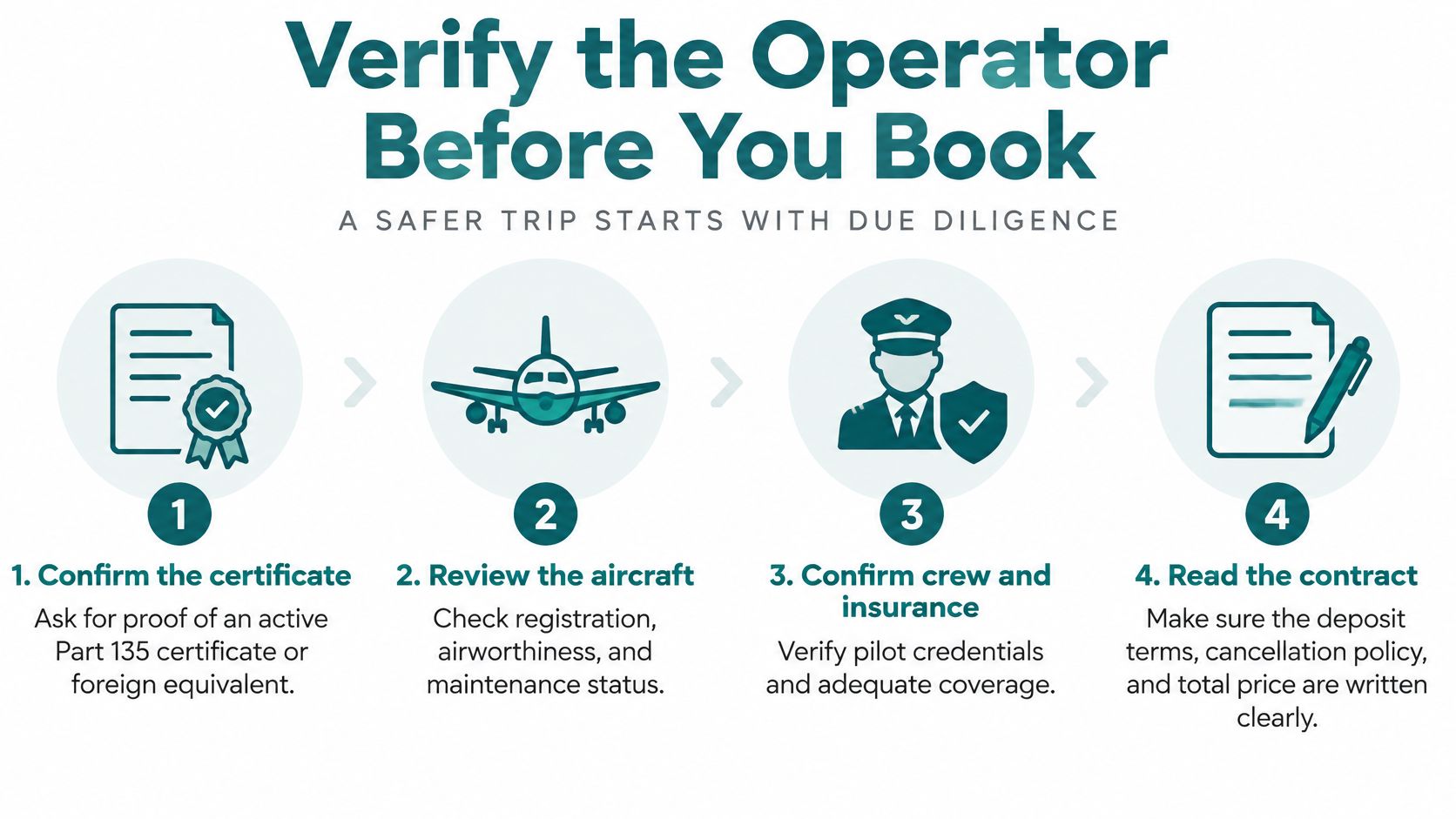
- Confirm the operating company. Get its legal name and active Part 135 certificate details, or the applicable foreign equivalent, and confirm that it is authorized to conduct the flight.
- Identify the broker and operator separately in the paperwork. Arranging the charter and exercising operational control are different responsibilities.
- Review the assigned aircraft and crew. Request the aircraft registration and inspection-status summary, along with confirmation of the pilots' qualifications and training relevant to the mission.
- Ask who makes operational decisions about weather, airport suitability, and flight release. Clarify the operator's dispatch or operational-control process.
- Confirm how the load will be checked. Passenger and baggage details should feed into the operational weight-and-balance calculation.
- Check the scope and currency of any independent safety audit. Third-party credentials add context, but do not replace regulatory authorization or checks specific to the aircraft and trip.
Approved Jets is an Air Charter Broker under DOT Part 295 and operates exclusively as a charter broker. It does not own, operate, lease, or maintain aircraft. Flights are conducted by registered Part 135 Operators or foreign equivalents.
Read evidence in context
An accident total alone cannot establish the risk of a particular flight. Compare multi-year rates within the right operating category, and consider the operation and route rather than relying on the aircraft class as a safety proxy.
For insurance questions, ABS Insurance Brokers aircraft insurance advice provides context on hull and liability coverage. Ask for confirmation of the actual operator's insurance and check that it applies to the planned charter.
The private jet safety guide offers further context. Before releasing a deposit, confirm the operator's certificate details, aircraft inspection status, trip manifest, crew credentials, insurance, and contract terms.
Match Your Mission and Request Quotes
Mission | Best-fit class | Why it fits | Watch for |
|---|---|---|---|
Remote business site visit on short strips | Suitable turboprop | Access to approved short or unpaved fields | Fuel and payload trade-offs on long legs |
Executive same-day regional hop | Very light jet | Efficient jet travel for a small group | Baggage space and total billable time |
Family with luggage on a longer sector | Light jet | Additional cabin space and potential nonstop capability | Loaded range and all-in cost |
Medical transport needing equipment aboard | Turboprop or medically configured jet | Mission-specific cabin access and installation | Clinical layout and hazardous-material documentation |
Solo, time-critical regional flight | Very light jet | Suitable for a small passenger load | Availability, crew readiness, and positioning time |
Treat these as shortlisting choices, not aircraft assignments. The actual operator must validate the aircraft, load, airports, weather, and crew before the trip can be accepted.
Choose the constraint you can't compromise
For a remote business visit, the essential factor might be arriving close enough to reach the site that morning. A slower aircraft landing nearby can serve that objective better than a faster jet requiring a long drive.
For an executive itinerary, arrival time may matter more than cabin size. Compare when the aircraft can realistically depart, not just how fast it cruises once airborne. An available turboprop can beat a jet that must reposition from elsewhere.
For a family, nonstop capability and baggage acceptance often matter more than the advertised seat count. Ask whether the proposed aircraft can carry the stroller, rigid suitcases, sports equipment, and any pets in the configuration being sold. A larger class can be sensible if it removes a fuel stop or an unacceptable baggage restriction.
Medical transport needs a different starting point. Establish the patient's clinical needs, stretcher or seating requirements, equipment, accompanying personnel, and access arrangements before selecting the aircraft.
The FAA's charter guidance emphasizes the distinction between authorized charter and ordinary private operations. For an airport-dependent mission, have the operator assess runway suitability, weather access, fueling, and destination services rather than treating a nearby airfield as automatically available.
Choose the smallest aircraft that clears every hard requirement, not the smallest aircraft that can technically fit the group.
Write a quote brief an operator can use
Send every bidder the same operational brief. If one quote assumes light bags, another assumes a fuel stop, and another uses a different arrival airport, you haven't received comparable offers.
Include these details:
- Passengers: Names, count, and the weight information needed for the operator's approved planning process.
- Baggage: Bag count, approximate weights and dimensions, plus photographs of awkward equipment where useful.
- Airports: Preferred departure and arrival fields, acceptable alternatives, and any runway or surface constraints already known.
- Timing: Desired departure and arrival windows, meeting deadlines, return timing, and flexibility.
- Special requirements: Mobility assistance, pets, medical equipment, batteries, sensitive cargo, or other items needing advance acceptance.
- Operational evidence: A written manifest, confirmation of weight-and-balance compliance, and aircraft-specific performance assessment.
- Commercial terms: An all-in price, exclusions, payment schedule, cancellation terms, and aircraft-substitution provisions.
Don't write “normal luggage” or “flexible departure” if either could change the aircraft selection. Give the planner a usable description, such as rigid cases that can't be compressed or a departure window constrained by a hospital discharge.
Also state whether a fuel stop is acceptable. That single preference can change the shortlist, the passenger capacity available, and the value of paying for a larger aircraft.
Compare complete missions, not attractive line items
Obtain competing quotes from certificated operators, directly or through a broker, and normalize them before choosing. Use three comparable offers as a practical buying method, rather than treating the first available aircraft as the benchmark.
Check that every proposal identifies the operating company, aircraft type or assigned aircraft, planned airports, passenger load, baggage acceptance, and expected itinerary. Review whether positioning, taxes, fees, crew expenses, and cancellation exposure are included or still open.
Then test the alternatives against the trip's actual purpose. Does the cheaper offer arrive too late? Does the faster aircraft require a distant airport? Does a proposed substitution preserve the cabin and baggage capability you need?
Our process is to receive the travel requirements, source aircraft and operators, and present charter options, pricing, and itinerary details. A personalized proposal can be requested through our flight advisors or the Get a Quote button; we're one option to include in your comparison.
The verdict by situation
For a small executive group on a paved-airport regional trip, start with a very light jet. For a longer sector or a group carrying substantial luggage, investigate a light jet and verify its loaded nonstop capability.
For remote access, cargo, or equipment-heavy travel, begin with an appropriate turboprop. For medical movements, choose the clinical configuration first and the aircraft class second.
Write your mission brief this week, before committing to a class. You can contact our advisors at +1 (866) 678-1411 or charter@approved-jets.com, then compare the resulting proposal against other complete offers.
Approved Jets arranges charter options through certificated operators, matching the trip requirements to available aircraft rather than selling you on seat count alone. Visit Approved Jets with your airports, travel window, passenger list, and baggage details to request a personalized proposal and compare the aircraft that can perform your mission.