Aircraft Management Services: A Practical Owner's Guide
Learn what aircraft management services cover, what they cost, and which questions to ask before you hire a manager for your private jet in 2026.
14 min read
Your jet is sitting in a hangar, the invoices keep arriving, and you're booking an airline ticket because nobody can confirm when a maintenance issue will be cleared. The frustrating part isn't just the expense. It's that you own an aircraft without having a dependable answer about when you can use it.
That's the standard aircraft management services should be judged against: can the manager demonstrate that the aircraft is ready, properly documented, and available for your mission? Start with records integrity, grounding exposure, and control of operational data. Compare fees only after those controls stand up to scrutiny.
Table of Contents
- What Aircraft Management Services Actually Cover
- Separate the parties before discussing service
- The Six Service Components and Who Carries Each
- Coordination isn't unlimited authority
- Maintenance and Compliance Rules Behind the Contract
- Maintenance program by passenger seat count
- Follow the complete record chain
- Control the instructions as well as the records
- Downtime, Data Control and Cyber Exposure
- Test the grounding response
- Assign digital responsibility
- Whether Management Pays Off for Your Aircraft
- Compare net contribution, not charter sales
- Decide what you're willing to exchange
- What Drives Aircraft Management Costs
- Build an aircraft-specific budget
- Find the fee-structure trap
- Choosing and Vetting a Manager Before You Sign
- Follow an evidence-led selection process
- Put the unresolved questions in writing
What Aircraft Management Services Actually Cover
Think of an aircraft owner as a landlord and the aircraft manager as the property manager. The manager coordinates repairs, inspections, suppliers, and paperwork. If the asset is offered commercially, the manager also helps find customers and administer the income.
The analogy has limits. An aircraft manager can't promise availability by overriding a maintenance restriction, crew limitation, or operating rule.
Aircraft management services are contractual arrangements under which a specialist company runs an aircraft owned by someone else. The scope typically includes maintenance tracking, crew staffing, regulatory compliance, insurance administration, financial reporting, and optional charter sales.
Separate the parties before discussing service
The arrangement usually involves distinct roles:
- Owner: Holds the asset, funds the operation, and sets travel priorities within the agreement.
- Manager: Coordinates the people, vendors, schedules, records, and reporting.
- Operator: Exercises operational control under the applicable operating structure. For charter, this is the certificate holder, which may be the manager's own company.
This distinction matters when a salesperson says the company handles everything. Ask which legal entity performs each function.
The property-management comparison makes the coordination role easier to visualize.

Buyers include owners of light, midsize, and heavy jets, corporate flight departments, high-net-worth families, and investor-owned fleets. According to DataIntelo's aircraft management services market report, the global market reached USD 29.4 billion in 2024.
Scale doesn't establish suitability. Your decision is whether you need full management, charter-only access without ownership responsibilities, or no additional outsourced service because your existing flight department already performs the work.
The Six Service Components and Who Carries Each
Aircraft management components and risk ownership
Component | What the manager does | Owner task removed | Who carries the risk |
|---|---|---|---|
Maintenance tracking | Schedules inspections, orders parts, manages work orders and technical records | Calendar and hour-limit tracking, shop coordination | Manager runs the process; certificate holder remains accountable for charter operations |
Crew staffing | Recruits, trains, schedules, and checks pilot qualifications | Hiring, training, and rotation of pilots | Certificate holder for charter operations, with manager oversight; owner/operator for private operations |
Regulatory compliance | Maintains applicable manuals, records, audit readiness, and operating authority | Audit preparation and rule tracking | Certificate holder for charter operations; owner/operator retains applicable responsibilities |
Charter revenue | Coordinates third-party sales under the operator's certificate and allocates proceeds | Booking, marketing, and sales administration | Shared commercial exposure; revenue split defined in contract |
Trip and hangar logistics | Books hangar, fuel, catering, ground transport, and crew hotels | Daily operational coordination | Owner pays agreed operating costs |
Insurance and financial administration | Arranges hull and liability cover, pays vendors, issues reports | Bookkeeping and insurance renewals | Owner retains financial exposure, with manager as administrator |
A management agreement can support Part 91 private operations, where the aircraft serves the owner's travel, or Part 135 charter operations, where a certificate holder sells flights. Charter income can offset ownership costs, but it introduces commercial operating obligations and insurance conditions that don't apply in the same way to private use.
Coordination isn't unlimited authority
For a corporate owner, the critical distinction is between approving a business trip and authorizing a flight. Your assistant can request departure; the operator and flight crew must still determine whether the aircraft, crew, weather, and destination permit it.
The same separation belongs in purchasing authority. A manager might approve routine consumables within an agreed budget while seeking owner authorization for a cabin refurbishment. Emergency expenditure needs its own escalation process so an unreachable owner doesn't leave the maintenance team without instructions.
A practical corporate flight management overview can help you distinguish flight-department coordination from individual trip booking. Neither replaces a written responsibility matrix.
For contract structure, By Design Law Firm's SLA guide, from By Design Law Firm & Legal Consultancy, PLLC, is useful background on translating service promises into defined obligations. Apply that discipline to reporting deadlines, escalation contacts, approval limits, and remedies, with aviation counsel reviewing the operating responsibilities.
Practical rule: Every recurring task needs a named performer, a named approver, and evidence that it was completed.
Check every table row against each proposal. Mark what's included, what's excluded, and what attracts an additional charge, especially after-hours support, replacement crew, international handling, and transition work.
Maintenance and Compliance Rules Behind the Contract
Maintenance program by passenger seat count
The inspection basis determines what the manager must schedule and what the maintenance budget should cover. Part 135 requirements distinguish aircraft type-certificated for nine or fewer passenger seats from those with 10 or more, as set out in the FAA's general certification requirements.
Aircraft or situation | Permitted maintenance basis | What the manager must track |
|---|---|---|
Nine or fewer passenger seats | Manufacturer's maintenance program, approved aircraft inspection program, or applicable annual, 100-hour, or progressive inspections | Calendar limits, flight hours, cycles, life-limited parts, and deferred defects against the chosen program |
Ten or more passenger seats | Continuous Airworthiness Maintenance Program, generally required | Inspection scheduling, corrective action, records, and technical procedures |
Any seat count, outsourced work | Applicable certificate-holder maintenance manual; operator remains directly in charge of covered work | Scope of work, provider sign-off, return-to-service entry, and retained evidence |
Before accepting a maintenance budget, confirm the aircraft's actual inspection basis. A generic forecast of shop visits won't show whether the proposed schedule matches the aircraft's required program.
For every scheduled event, ask for the controlling limit, remaining time, planned maintenance location, parts status, and likely effect on availability. Track calendar limits, flight hours, and cycles separately. An aircraft can reach a deadline even when it has flown very little.
Follow the complete record chain
The FAA's maintenance-record guidance covers the records owners and operators must retain under section 91.417 and the work entries maintenance performers make under section 43.9. The owner or operator must also ensure that return-to-service approval is recorded. Treat that entry as part of the closeout, not as an assumption based on the aircraft leaving the shop.
An engine inspection is not administratively complete when the shop sends an invoice. Reconcile the documents before accepting the work package:
- Work performed: Inspection results, discrepancies, corrective action, and relevant component identification.
- Authorization: The technician's or repair station's credentials and required release entries.
- Permanent history: Updated aircraft records, tracking-system status, and supporting documents.
Incomplete time- or cycle-limited component history can force restoration to zero-time status under the FAA framework. The manager should not assume that unsubstantiated remaining life can be carried forward.
Control the instructions as well as the records
EASA's continuing-airworthiness guidance addresses the use and availability of current maintenance data, including customer-supplied data during maintenance. Require each task package to identify aircraft effectivity and configuration, publication revision, applicable airworthiness directives, service bulletins, component manuals, and approved repair data where relevant. A service bulletin's existence does not by itself make it mandatory for every aircraft.
The wrong revision can undermine otherwise careful work. The manager's process should catch a mismatch before sign-off, while the aircraft is still at the maintenance facility, rather than during a later records review.
Use a reliable jet maintenance checklist to structure the operational discussion, then request a completed work package. For outsourced work, confirm that the certificate holder directs covered maintenance and that the provider follows its manual. The repair station may do the hands-on work, but the operator remains responsible for oversight.
Downtime, Data Control and Cyber Exposure
A records problem becomes an availability problem when nobody can establish whether a component remains eligible for service. Software alone won't prevent that. Someone must reconcile the source documents, investigate exceptions, and own the decision to escalate.
The Veryon Aviation Maintenance Benchmark Report 2025, covering more than 800 aviation professionals, found that 78% reported complex regulatory-management challenges, with respondents connecting manual processes and outdated data to slower work, error exposure, and downtime.
Test the grounding response
Ask how many days comparable managed aircraft were grounded away from base during the previous reporting year. Then ask what caused the interruptions and which delays the manager could influence.
Illustrative example: A jet waits two weeks while the team resolves a missing entry in a time-limited component's history. If eligibility can't be established, a zero-time replacement and parts order may be necessary. The delay is hypothetical, not a normal overhaul turnaround estimate.
A green dashboard is useful only when the manager can produce the documents behind it.
Assign digital responsibility
In May 2025, the FAA established a civil-aviation cybersecurity rulemaking advisory charter addressing risks across aircraft operation, maintenance, and support. That charter isn't itself a new owner compliance mandate, but it makes the contract question immediate: who handles interconnected operational systems?
Require written answers covering:
- Access and incidents: Who approves accounts, removes departing staff, and notifies the owner of an intrusion?
- Recovery and vendors: Who maintains backups, tests restoration, authorizes software changes, and manages supplier access?
- Environmental records: For flights subject to EU monitoring requirements, who determines applicability and supplies aircraft, route, mass, and engine data?
- Exit rights: Who exports complete records, attachments, and audit histories in a usable electronic format?
RNC Group service level agreement guidance offers useful general structure for defining measurable service obligations. Translate that structure into aviation-specific response, recovery, and records-transfer commitments rather than borrowing an office-IT agreement unchanged.
Whether Management Pays Off for Your Aircraft
Management doesn't automatically make aircraft ownership cheaper. It buys operating capability, administrative relief, and access to resources you would otherwise need to organize yourself. Whether it reduces your net expenditure requires a separate calculation.
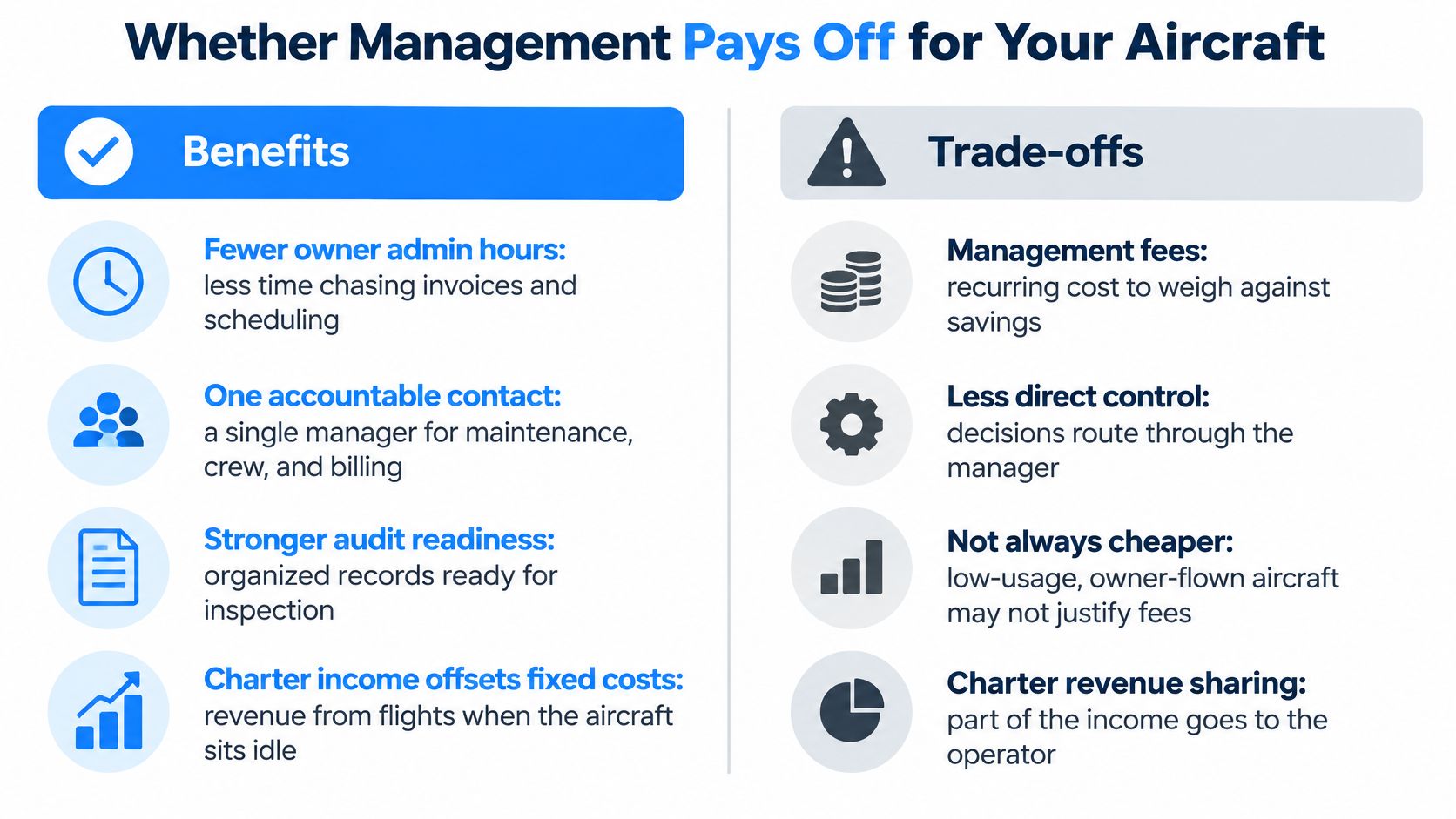
The benefits and concessions belong in the same decision.
Compare net contribution, not charter sales
Hypothetical example: An owner flies a midsize jet for 150 hours a year and makes its remaining usable availability available for charter. Compare that arrangement with keeping the same aircraft predominantly idle, not with an imaginary aircraft that incurs no expense between trips.
Hangar rent, insurance, and calendar-driven maintenance continue while the aircraft sits. Charter can contribute toward those costs, but additional flying introduces fuel, crew travel, maintenance consumption, cleaning, and potential repositioning expenses.
Ask the manager to show the owner's contribution after those incremental expenses and the operator's share. Gross charter revenue isn't the owner's savings.
The federal Part 135 operating requirements require the certificate holder to remain directly in charge of covered outsourced maintenance and require providers to follow its maintenance manual. That retained responsibility is part of the management infrastructure you're paying for, even when an outside shop performs the technical work.
Decide what you're willing to exchange
The commercial calculation has benefits and costs:
- Lower owner workload: A single contact coordinates maintenance, crew, billing, and trip execution instead of your office chasing separate vendors.
- Stronger audit readiness: Organized records make it easier to demonstrate aircraft status and investigate discrepancies.
- Potential charter offset: Marketable availability can produce a contribution toward fixed ownership expenses.
- Fees and shared proceeds: Management charges and the charter revenue split reduce the amount retained by the owner.
- Scheduling constraints: Owner priority must be defined, including notice periods, confirmed charter commitments, and replacement-lift arrangements.
- Shared use: Other passengers use the cabin, and additional activity can create maintenance and refurbishment needs.
For the broader financial comparison, include the categories in this private jet ownership cost guide, rather than comparing charter receipts with management fees alone.
As a commercial rule of thumb, management with charter has a stronger case when owner flying is irregular and the aircraft attracts demand during genuinely available periods. It rarely delivers charter-led savings for a lightly used aircraft with little market demand, although professional oversight may still justify its cost.
What Drives Aircraft Management Costs
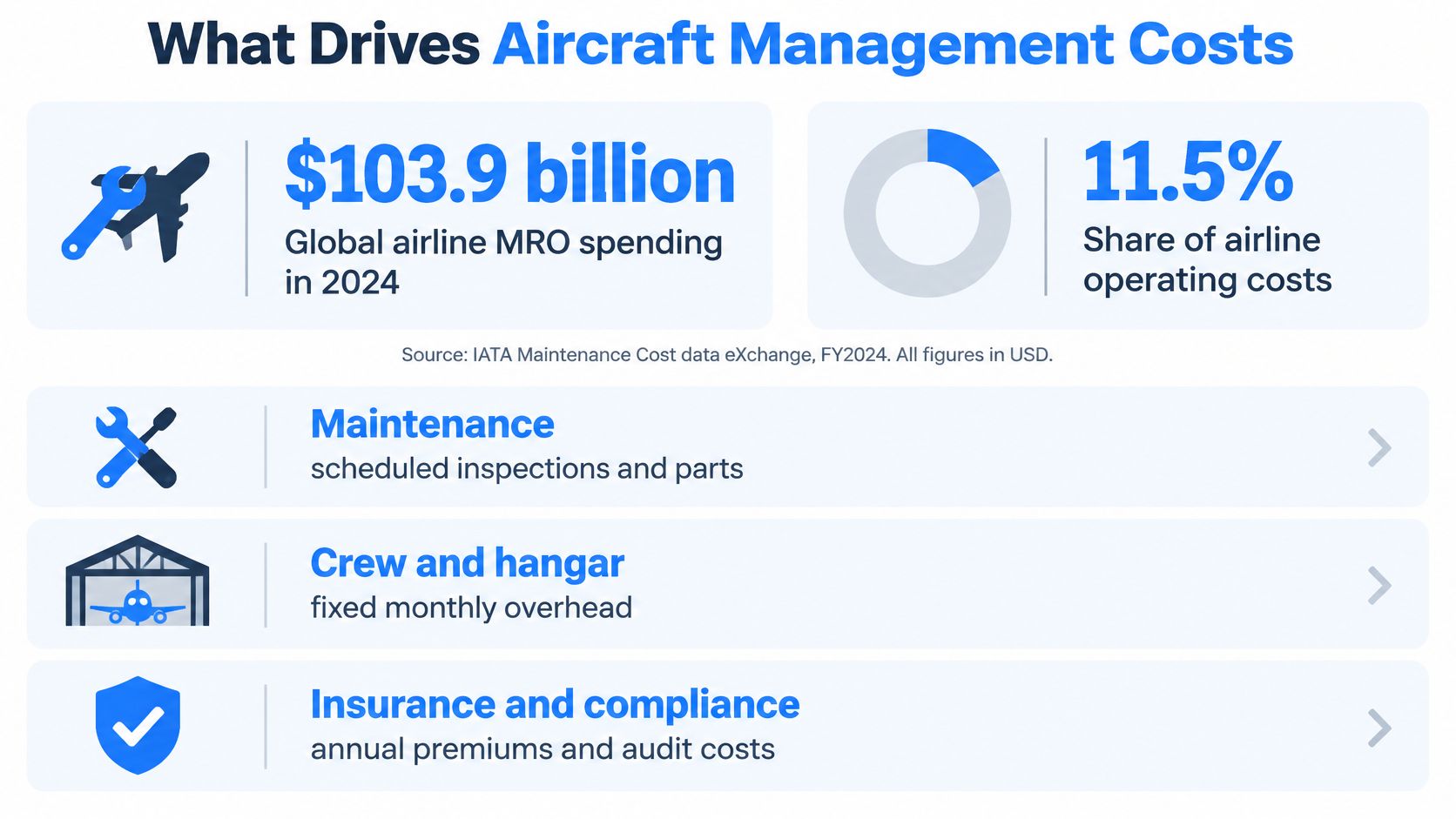
The IATA FY2024 Maintenance Cost data eXchange report estimated global airline MRO spending at $103.9 billion in 2024, approximately 11.5% of airline operating costs, and reported maintenance costs of $1,522 per flight hour, an average fleet age of 10.6 years, and utilization of 9.06 hours per day.
Those are airline figures, not business-jet quotes. They demonstrate the financial importance of maintenance governance, not what your aircraft should cost.
This visual summarizes that airline-scale benchmark.
Build an aircraft-specific budget
Aircraft management cost drivers
Cost driver | How it moves the bill | Reference value |
|---|---|---|
Aircraft age and utilization | Age, condition, hours, and cycles affect inspection exposure and unscheduled repairs | Request aircraft-specific history and projected utilization |
Aircraft type and seat count | Cabin, systems, crew needs, and maintenance-program requirements affect expenditure | Identify the applicable inspection program |
Maintenance cost per flight hour | Allocates inspections, parts, labor, and program payments across activity | Request a model-specific estimate with exclusions |
Maintenance exposure | Engine, avionics, interior, and landing-gear shop delays extend downtime | Request confirmed shop slots and current parts lead times |
Crew | Salaries, benefits, training, leave coverage, and rotation affect overhead | Request a fully burdened crew budget |
Hangar and base location | Airport, aircraft dimensions, and lease terms affect storage charges | Request the actual base quote |
Insurance | Aircraft value, use, limits, and operating history affect premiums | Request coverage terms, deductibles, and premium |
Management fee model | Flat fees, charter participation, and invoice markups change total charges | Request the complete fee schedule |
Don't treat older aircraft as automatically uneconomic. An aircraft with complete records, predictable maintenance exposure, and established parts support can be easier to budget than a newer aircraft approaching a significant event.
The budget should distinguish cash due, maintenance reserves, and expenses already covered by programs. Otherwise, a reserve contribution and a later shop invoice can appear as separate ownership costs without showing how they reconcile.
Find the fee-structure trap
A flat monthly management fee buys a defined scope regardless of charter performance. A percentage of charter revenue ties compensation to sales, but the agreement must define the revenue base, deductions, cancellations, and treatment of positioning flights.
Third-party invoice markups deserve equal attention. A modest administration charge applied across substantial vendor spending can matter more than a difference in the headline management fee.
Budget test: Ask the manager to trace a vendor invoice from original charge through owner statement, including discounts, rebates, credits, and administrative fees.
Use the following video as a discussion prompt alongside the written budget, not as a substitute for aircraft-specific quotations.
Before comparing totals, establish which expenses pass through at cost, which carry a markup, and what remains billable while the aircraft is idle or grounded. Require the proposal to identify exclusions explicitly, including unscheduled repairs and replacement transportation.
Choosing and Vetting a Manager Before You Sign
A familiar brand isn't enough. You need to know which entity controls the operation, which people manage your aircraft, and what evidence they'll provide when something goes wrong.
The FAA's historical Part 135 operator study counted 2,030 certified operators and 10,668 authorized aircraft as of February 2016. Those aren't current fleet counts, but they illustrate why the operator behind a management proposal deserves independent scrutiny.
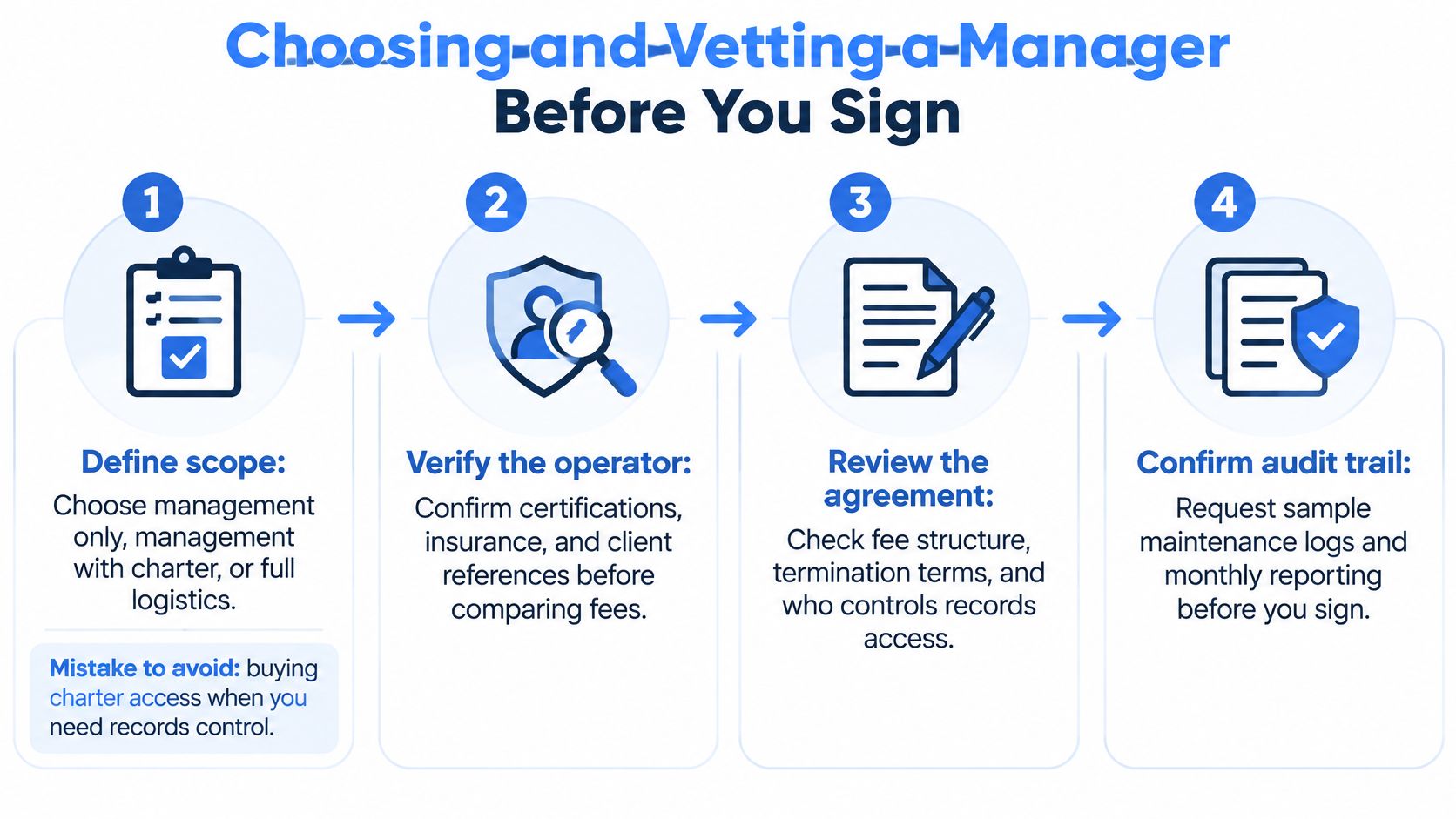
Use this process as a screening sequence.
Follow an evidence-led selection process
- Define the scope. Choose management only, management with charter, or full operational logistics. The reason is simple: the service must solve your actual workload. Avoid buying sales access when your main problem is incomplete technical records.
- Verify the operator. Confirm the Part 135 certificate where applicable, authorized aircraft count, your aircraft's eligibility, insurance, and any claimed ARGUS or Wyvern credentials. Check their current scope. Don't substitute the marketing brand for the legal operating entity.
- Inspect a sample reporting package. Request a redacted owner report containing maintenance status, inspection forecasts, open discrepancies, and parts lead times. You need decision-ready detail, not a summary slide showing everything green.
- Request written availability evidence. Ask for dispatch reliability and grounded days over the last twelve months, including definitions and planned-maintenance exclusions. Avoid accepting a percentage without its denominator or an explanation of cancelled missions.
- Normalize the proposals. Compare at least three on the same aircraft, utilization assumptions, base, owner-priority terms, and exclusions. The mistake is comparing a narrow administration fee with a fully staffed operating proposal.
- Speak with comparable owners. Check two or three current references operating similar aircraft. Ask about a disruption, a disputed invoice, and communication during maintenance, rather than whether they like the manager.
- Negotiate the exit before entry. Define termination rights, outstanding commitments, transition assistance, and records delivery. Don't let access depend on a departing account manager's goodwill.
Put the unresolved questions in writing
Group the final questions so operational gaps don't disappear inside commercial negotiations:
- Maintenance and downtime: How are airworthiness directives tracked, and who verifies return-to-service authority?
- Controlled technical data: How does the team confirm configuration and revision applicability before work is released?
- Cyber and ownership: Who controls accounts, incident notification, backups, and usable data at exit?
- Emissions records: Who determines reporting applicability and supplies aircraft, route, mass, and engine information?
- Fees: Which costs pass through, which attract markups, and what remains payable during inactivity?
For the digital-service portion, tekRESCUE's questions to compare managed IT providers with confidence provide a useful vendor-interview model. Apply them to the manager's technology support chain, not as a replacement for aviation diligence.
Get every answer in writing and obtain a sample owner report before signing. If the manager can't demonstrate how it controls exceptions, don't assume the contract will make those controls appear.
Approved Jets offers aircraft management coordination covering maintenance tracking, crew staffing, regulatory compliance, and charter revenue generation, alongside on-demand charter and trip logistics. Visit Approved Jets to discuss your aircraft, travel priorities, and the reporting and records controls you want included in a management proposal.
Updated