24/7 Concierge Service in Private Aviation: What to Expect
Learn what a 24/7 concierge service does in private aviation: trip coordination, response times, security checks and last-minute changes.
14 min read

It's 11 p.m., a board meeting has just moved, and tomorrow's flight needs to leave four hours earlier. You don't need another app, another hold queue, or three vendors pointing at each other. You need one person who answers, owns the change, and confirms the aircraft, cars, and catering before you sleep. This is the true test of a 24/7 concierge service. Not whether a phone rings at night, but whether a named team can act at night.
Table of Contents
- What a 24/7 Concierge Service Means in Private Aviation
- Why the hours are not a luxury extra
- What a Concierge Covers Across a Private Trip
- Coordinator, not operator
- How a Request Moves From First Call to Wheels-Up
- Why step 3 can't be rushed
- Response Times and Service Levels to Expect
- The metrics that matter more than pickup speed
- Last-Minute Changes and Disruptions in Practice
- What a 24/7 Concierge Costs and How to Judge Value
- How to read an itemized quote
- Who Gets the Most Value and When It Pays Off
- Four decision criteria
- Verify Responsibilities, Privacy and Terms Before You Book
- The pre-booking checklist
- Privacy is a governance issue, not a courtesy
What a 24/7 Concierge Service Means in Private Aviation
At 11 p.m., a CEO's assistant learns the departure must move up by four hours. With a proper concierge desk, she makes one call. The team re-times the aircraft and crew, moves the cars, updates catering, and sends one revised itinerary. She doesn't chase three vendors or repeat passenger details to each one.
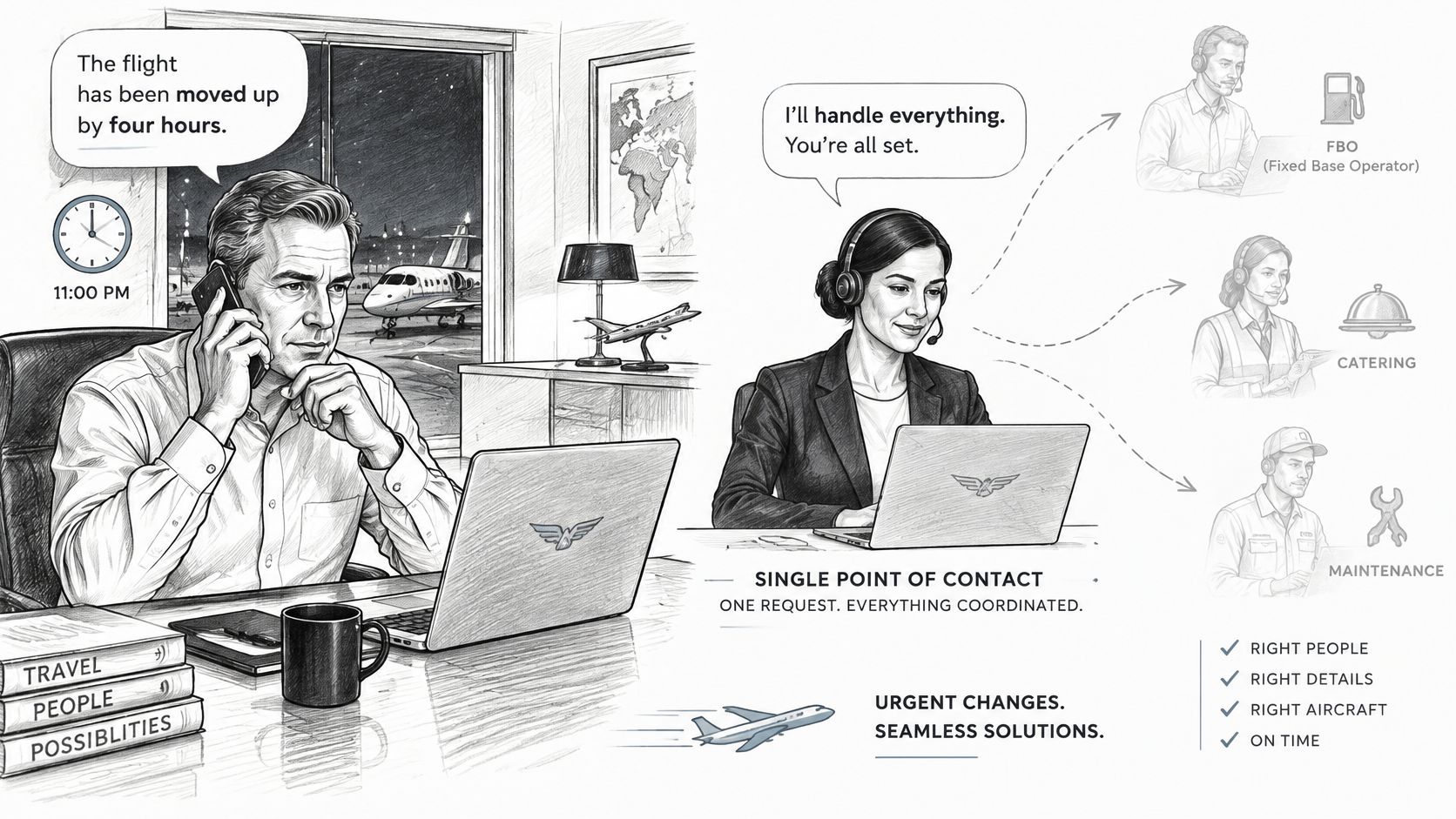
Think of it as a hotel concierge who works shifts that never end, paired with a flight dispatcher who can also book the aircraft. The service gives you a single accountable point of contact, a coordinated team behind that person, and an owner for every trip from request to arrival. We offer 24/7 concierge access on exactly that basis, because departures, medical moves, and cross-time-zone handoffs rarely fit a nine-to-five window.
Why the hours are not a luxury extra
Customer expectations have shifted in measurable ways. A compilation citing Zendesk's 2026 customer-experience research, surveyed in June 2025 among 6,182 consumers and 5,115 business respondents, reports that 74% of consumers expect service to be available 24/7 because of AI-enabled customer support, while 88% say they expect faster response times than they did one year earlier. Treat those as expectation figures, not proof that every client needs a human at every minute.
The working definition is simple. A 24/7 concierge service is continuous ownership of your trip, staffed by people who can make decisions, not a booking site or a listing marketplace. Apply one test to any provider. Does a named team own your trip after hours, or does voicemail take the call?
What a Concierge Covers Across a Private Trip
Scope matters more than slogans, so check coverage item by item. The table below sets out what a 24/7 concierge service should coordinate on a private trip, with a concrete example for each line.
Capability | What the concierge arranges | Concrete example |
|---|---|---|
Aircraft sourcing | Matches cabin size, range and luggage to the mission | Midsize or super midsize jet for six travelers with bags |
Operator and crew verification | Confirms certificate authority, crew qualification and aircraft status | Checks operator authority before confirming the flight |
Ground transport | Airport, FBO and hotel transfers | Car waiting at the FBO on arrival |
Catering and onboard service | Dietary needs and custom meals | Hot meal from the client's favorite restaurant on a midsize jet |
Security coordination | Private check-in and secure bag handling | Private check-in, arriving 15 to 30 minutes before departure |
Customs and documentation | Passenger manifests and cross-border paperwork | Documents cleared before an international departure |
Medical and repatriation | Aircraft with medical team and hospital-to-hospital logistics | Urgent transfer with clearances arranged end to end |
Pets and special cargo | Operator matching and documentation guidance | Pet travel with compliant paperwork |
Coordinator, not operator
The concierge coordinates across these items. It doesn't fly the aircraft. We coordinate ground transport, catering, security, and special requests for each journey and manage the complete trip, while facilitating communication between you and the selected operator and assisting with payment processing and booking logistics. That distinction protects you, because the operator's legal duties stay with the operator while your itinerary stays in one pair of hands.
Good coordination also extends beyond the ramp. If your trip ends with a hotel stay, the same logic applies at destination, where smaller properties often deliver more personal Tulum hotel stays through staff who know guests by name. For the ground legs between home, FBO, and hotel, our door-to-door transport coordination keeps pickups and drop-offs on the same itinerary as the flight.
Scope test: If a provider can't tell you who handles each row above at 2 a.m., you don't have coverage. You have a brochure.
How a Request Moves From First Call to Wheels-Up
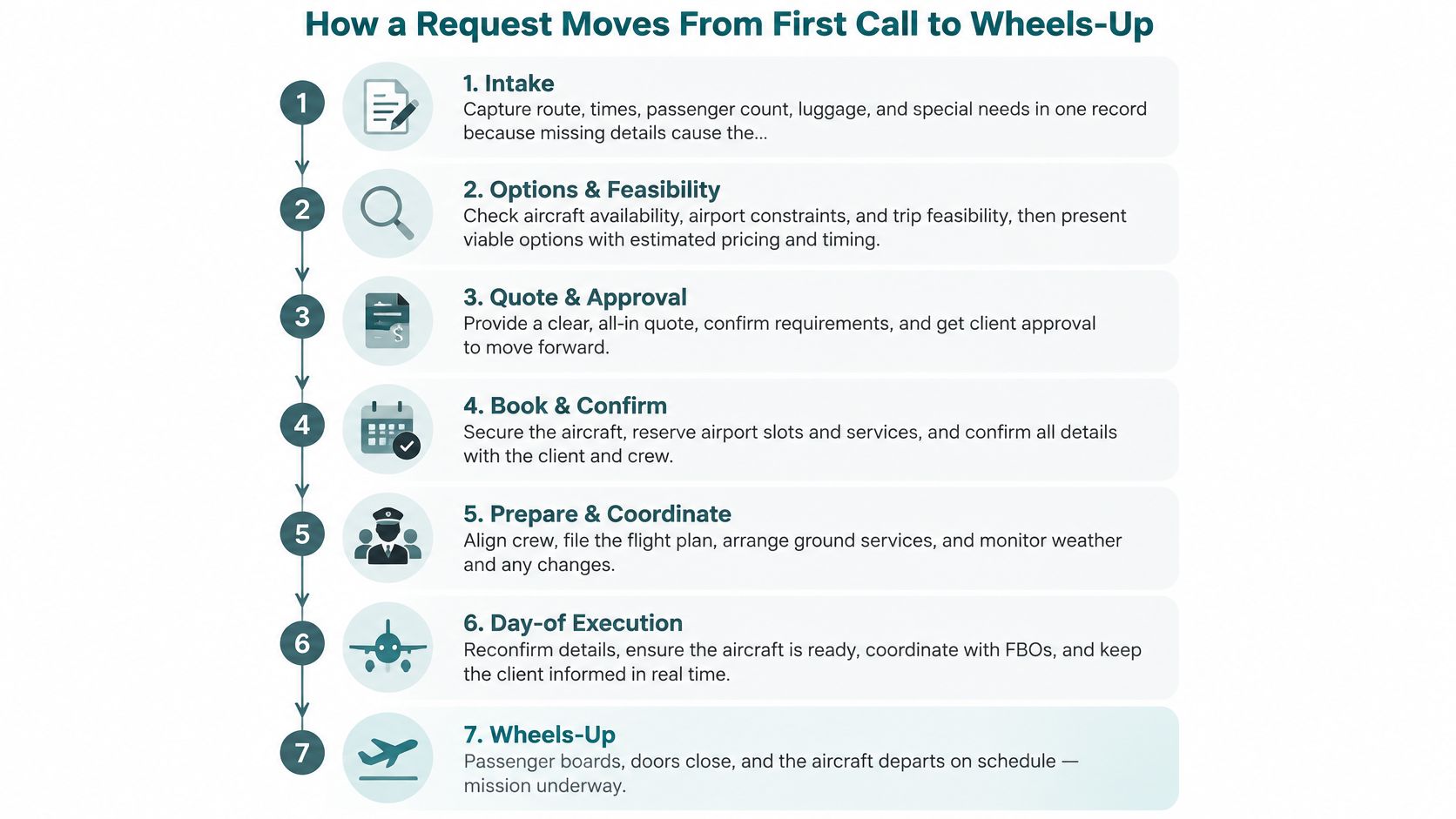
A 2 a.m. call for a 6 a.m. departure still follows the same sequence. Ownership is what keeps it from falling apart between steps. Our flight advisors are available 24/7 for immediate charters at +1 (866) 678-1411.
- Intake. The advisor captures route, times, passenger count, luggage, and special needs in one record, because missing details cause most re-quoting. A flight advisor verifies your luggage requirements before the aircraft is finalized.
- Quote. You receive options with a target turnaround of about 2 hours. The quote holds for its stated period, or 48 hours if none is stated, because aircraft availability moves.
- Match. The team pairs aircraft and operator together, then checks authority, crew duty, and aircraft status before anything is confirmed.
- Confirm. Written confirmation locks the plan. Payment moves through the stated channel, so everyone works from the same booking.
- Coordinate. Ground transport, catering, security, and customs go onto one timed itinerary. Each piece is set to the flight, with handoffs assigned by name.
- Pre-departure. Plan to arrive at the FBO 15 to 30 minutes early for private check-in. Bags are checked against the aircraft a final time.
- Oversight. One contact monitors the flight from departure through arrival and pushes updates. You do not chase status.
- Close-out. The desk logs handoffs, confirms arrival, and records feedback while details are fresh.
Why step 3 can't be rushed
Speed does not remove regulation. The FAA's Part 135 guidance on commuter and on-demand operations sets higher levels of pilot training and certification, maintenance procedures, and operational safety controls than private flying under Part 91. A fast departure is matching the mission to an authorized operator, qualified crew, and compliant aircraft under that operator's operational control.
Take a corporate group needing Miami to New York on short notice. Operator authorization comes first. Then aircraft status and crew qualification. Then confirmation. Skip that order and an urgent trip fails at the ramp, when recovery options are fewest.
Response Times and Service Levels to Expect
A Tuesday night request tests who actually owns the trip. Targets on paper mean little without a named owner, a written update rhythm, and a record of every handoff.
Service step | Published target | What it means in practice |
|---|---|---|
Email acknowledgment | 15 minutes | Reply to the charter inbox within the target window |
Quote turnaround | About 2 hours | Price and aircraft options after intake |
Aircraft mobilization | Approximately 2 to 4 hours | Subject to mission and availability |
Lead time for widest choice | 24 to 48 hours | More aircraft and room for specific catering or logistics |
Time to named owner | Not published | Ask for this in writing before booking |
Quote validity | Stated period, or 48 hours if none | Pricing and availability must be reconfirmed after expiry |
In-flight oversight | Departure through arrival | Active monitoring by one coordinating team |
We aim to respond to emails within 15 minutes at charter@approved-jets.com, target quotes within a 2-hour turnaround, and note that booking with 24 to 48 hours of notice gives the widest aircraft selection and allows highly specific catering or logistical requests.
The metrics that matter more than pickup speed
A fast pickup proves little. I judge a desk on time to acknowledgment, time to owner assignment, time to first viable option, update cadence during disruption, and closure confirmation.
The IATA emergency-response handbook supports that view, calling for a continuously available communication structure linking operations control, flight dispatch, the emergency-response director, arrival stations, and affected passengers or families, plus telephone enquiry centers, crisis communications, "go teams," family-assistance plans, and recurring emergency drills. That translates to one incident owner, predefined escalation trees, and every handoff recorded.
For medical and other time-critical missions, request flight following by analogy to the FAA's helicopter emergency medical services guidance, which recommends communications or flight following throughout each mission, with intervals no longer than 15 minutes in flight and 45 minutes on the ground, plus a designated communications specialist linking medical personnel, crew, hospitals, and ground personnel. Ask for an equivalent mission-control record holding aircraft identity, route, departure time, and estimated arrival for every movement. The same discretion standard applies on the ground at home, which is why families also look for discreet staffing for VIP families when support staff work around private itineraries.
Last-Minute Changes and Disruptions in Practice
A six-person executive team is booked Miami to New York on a 4 p.m. departure. At 9 a.m. the client wants noon instead. What happens next is the real test of whether a concierge is staffed or just advertised.
The advisor checks aircraft positioning and crew duty availability against the new time first, because moving up four hours can breach duty limits even when the jet is already sitting on the ramp. Ground transport and the FBO arrival slot get re-timed next. Catering is confirmed for what is achievable in three hours rather than what was ordered a week ago. A route change pulls fresh customs paperwork with it. Then the change goes out in writing, since cancellations and modification requests have to be submitted by email and are handled case by case. That written trail is what settles the argument later about who approved the earlier slot and who eats the cost of the catering that never flew.
The return leg is where the model either holds or breaks. Thunderstorms close the destination and the flight diverts. Because the desk provides active oversight from departure through arrival, the same owner notifies the receiving ground team, arranges a transfer from the alternate airport, and sends one update thread to the executive assistant instead of five partial ones from five different vendors. Your side does not coordinate the coordinators. That is the job you are paying for.
Disruption at this scale is routine, not exceptional. Zurich's 2026 business-travel research, covering 4,000 international travelers across eight countries and five continents, found that 80% experienced at least one disruption in 2025, while more than one-quarter did not know what to do in an overseas emergency. Keep that figure in mind when a provider describes its after-hours coverage as an answering service.
Ask about escalation before you need it. Three questions separate a staffed desk from a call center: who has authority to reroute an aircraft at 2 a.m. without waking a director, how many minutes pass before you reach that person, and whether aircraft, cars, and customs documents are run as one incident or four separate tickets. The third question matters most, because a diversion touches all of them at once and a provider that logs them separately will hand the coordination back to you.
For anything time-critical, add one more: what record do you keep of the mission? A desk that can produce a timeline covering aircraft identity, route, departure time, and estimated arrival for each movement is running a process. One that cannot is improvising.
What a 24/7 Concierge Costs and How to Judge Value
Charter pricing is quote-based, so there's no honest per-trip rate to publish here. What you can compare is the structure of the quote and the wider market context.
Benchmark | Value | Source |
|---|---|---|
Global concierge services market, 2022 | USD 647.3 million | Allied Market Research |
Global concierge services market, 2032 (estimate) | USD 1.1 billion | Allied Market Research |
Corporate concierge adoption, Fortune 1000, 2025 | 67% | Dataintelo |
Typical annual corporate concierge contract | USD 50,000 to 300,000 | Dataintelo |
Per-flight charter price | Itemized quote required | Operator and mission specific |
For context, Allied Market Research figures value the global concierge services market at USD 647.3 million in 2022, estimated to reach USD 1.1 billion by 2032. Separately, Dataintelo's luxury concierge report puts corporate concierge adoption among Fortune 1000 companies at 67% in 2025, with typical annual contracts ranging from USD 50,000 to USD 300,000. Both describe concierge services generally, not per-flight charter prices, so use them for budgeting shape, not trip quotes.
How to read an itemized quote
Break any quote into aircraft category and positioning, crew and operator fees, ground transport, catering, security and customs handling, and medical or pet-related requirements. Pet logistics are a good example of a small line that causes big delays when mishandled, and owners who can't fly with an animal sometimes arrange local care instead, through resources such as Global Pet Sitter's Cheyenne listings. For the flight itself, our guide to how private jet charter prices are built walks through the components line by line.
Then apply one test. Compare the quoted cost against the nearest commercial routing, including lost hours and missed commitments, not just the ticket price. If the gap is small and the schedule risk is high, the concierge-backed charter usually wins. If timing is flexible and the route is simple, it may not.
Who Gets the Most Value and When It Pays Off
The clients below share one trait. A late or fragmented trip costs them more than the flight. The illustration here shows the four groups a concierge desk typically serves.

Executives lose hours between commercial connections, so direct routing and one contact protect the working day. High-net-worth families value discretion and a single coordinator across multi-stop trips, villas, and ground staff. Sports teams and entertainment talent need group logistics that hold together when schedules shift after a game or show. Medical and cargo users need an urgent aircraft with documented handling, where reliability outranks price.
Consider a clearly hypothetical example. An executive's commercial itinerary takes a full day with connections. Direct routing returns most of that day, so the honest comparison is quote versus value of the recovered day, not quote versus airfare. Corporate travel programs formalize that logic, providing on-demand global access for key personnel with strict confidentiality, and enterprise solutions can extend into employee retention travel perks, executive incentives, brand loyalty programs, and strategic activations.
This short video shows how that coordination looks from the traveler's side.
Four decision criteria
- Frequency: Weekly or monthly trips justify a standing arrangement. One flexible trip a year may not.
- Complexity: Multi-stop, cross-border, or multi-vendor itineraries benefit most from one owner.
- Traveler count: Groups multiply documents, bags, and ground movements, which raises coordination value.
- Cost of lateness: If a missed arrival cancels a deal, a match, or a procedure, round-the-clock coverage pays for itself.
I would skip the full concierge layer for a simple, flexible, single-leg trip. I'd insist on it for anything time-critical, medical, or multi-stop.
Verify Responsibilities, Privacy and Terms Before You Book
A 24/7 number answers the phone. Responsibility decides what happens next. Many travel-management failures start with fuzzy ownership rather than aircraft problems, so pin down who owns what before money moves.
Party | Main responsibility | Concierge's role |
|---|---|---|
Concierge or broker | Sourcing, coordination, communications and client data | Owns the client relationship and the incident record |
Certificate-holding operator | Operational control and Part 135 authority | Confirms authority and records which operator was selected before confirmation |
Pilots and crew | Certificated for compensated passenger flights | Obtains the operator's attestation on crew certification and duty limits |
Ground security and FBO | Screening, access control and ramp safety | Coordinates arrival times and secure handling |
Client or employer | Authorized requesters, contacts and approval thresholds | Records who may change the trip and how they are verified |
That split is the core of how aircraft charter brokerage works. The broker coordinates, communicates and manages payment logistics. The operator flies and holds operational control. Confusing the two is where accountability disappears, usually on the night an aircraft goes technical and nobody on the chain can authorize a replacement.
The pre-booking checklist
Confirm each item in writing before you book:
- Operator authority: The operator's Part 135 authority and each crew member's qualification for compensated flights, plus which named person attests to both.
- Named contact: Who owns your trip, which hours they cover, and how handoffs work across time zones.
- Response targets: Acknowledgment, quote and mobilization times, plus the time to reach a named owner rather than a general line.
- Change policy: How changes and cancellations are submitted, and who approves urgent ones at night. Written email requests assessed case by case are the norm; a phone approval with no follow-up email is not.
- Privacy rules: Who receives live-location data, how long records are kept, how urgent authorizations are verified, what happens if a traveler's phone is compromised, and how family or corporate contacts are authenticated. Ask specifically how long quote and contact submissions are retained when no booking results.
- Quote validity: The period stated in the quote, or 48 hours from issuance if no period is stated, after which pricing and availability must be reconfirmed. Confirm where funds are sent and that wire details arrive with the booking confirmation.
- Escalation path: The exact steps and phone tree when a flight diverts, delays or goes technical.
Privacy is a governance issue, not a courtesy
A concierge desk holds itineraries, passenger identities, medical information and payment details, then shares selected extracts with operators, drivers and hotels. That requires role-based access, identity verification, explicit consent, audit trails and secure communications, with emergency exceptions written down before they are needed, not improvised at 2 a.m. Travelers already notice the gap. The Zurich Business Travel Outlook 2026 reports that 26% of surveyed business travelers were unsure how to respond to an emergency abroad.
Governance rule: Don't ask whether a desk is discreet. Ask who can see your manifest, for how long, and how you would find out if that access changed.
When you're ready, call +1 (866) 678-1411 or email charter@approved-jets.com. Request the response targets, named-owner arrangement and change policy in writing. Then make your booking decision inside the quote window, while the aircraft and price are still real.
If your next trip can't absorb a missed connection, a silent phone or a fragmented vendor chain, put one accountable desk on it. Approved Jets coordinates on-demand charter flights with 24/7 concierge oversight from first call through arrival, including ground transport, catering, security and disruption handling under one named owner. Visit Approved Jets to request a quote and get the response targets and terms in writing before you commit.