Light Private Jet Explained: Range, Cabin and Trip Fit
Light private jet explained: typical range, passengers, baggage and runway limits, plus how to match an aircraft to your trip profile with real data.
12 min read
The advice you'll hear most often about a light private jet is to count the seats you need, look up the range, and book the smallest aircraft that clears both numbers. It's tidy, it's easy to quote, and it's how groups end up with a fuel stop nobody planned or a bag left at the FBO.
Seat count and headline range are the two softest figures in the transaction. Both assume a load and a day you probably won't get: a light cabin, a cool morning, a sea-level runway, and no allowance for golf bags, hard cases or sample trunks that turn up on the ramp. A light jet carries one tank of fuel and one maximum takeoff weight. People, luggage and fuel all draw on the same allowance, so every extra passenger or extra bag costs either distance or a stop.
Judge the aircraft by your heaviest realistic day, not your average one, and the category starts to make sense.
Table of Contents
- Light Private Jet Specs and Definition
- What each column actually measures
- The label is not a specification
- Range That Holds Up With Real Passengers
- What a range claim is really assuming
- Four executives or six golfers on the same route
- Runway, Altitude and Which Airports Work
- Where Light Jets Win and Where They Fall Short
- How to Match a Light Jet to Your Trip
- Send a Written Trip Brief for Your Quote
Light Private Jet Specs and Definition
Four rows cover most of what matters before you open a single aircraft listing. Advertised range is the manufacturer's maximum. Range with real load is what is left once passengers, NBAA IFR reserves and a 100-nautical-mile alternate sit inside the fuel plan.
Aircraft | Passengers | Advertised range | Range with real load | Baggage |
|---|---|---|---|---|
Cessna Citation CJ4 Gen 2 | 8 on an NBAA IFR mission | 2,165 nm maximum | 1,926 nm with 8 passengers and a 100 nm alternate | Bags come out of the 1,122 lb payload at full fuel |
Cessna Citation V | Full cabin, roughly 6 to 8 seats | 1,920 nm | About 1,220 nm fully occupied with IFR reserves | Soft-sided only; plan around 4 to 5 standard bags |
Pilatus PC-24 | Set by payload rather than seat count | Around 2,000 nm | Falls sharply when the payload allowance is filled | Generous payload for the class; bags count against it |
Light jet class overview | 6 to 7 | About 1,500 to 2,000+ nm | Drops with load, weather and reserves | Soft-sided luggage; hard cases and golf bags eat into payload |
What each column actually measures
The first range column is a marketing figure produced under the lightest sensible load. The second is a dispatch figure: the distance you can file with fuel still held back for instrument contingencies and a diversion. The gap between the two is the number to plan around.
Read the first row and the drop is 239 nautical miles, and that is with eight passengers already assumed. Read the Citation V row and the gap is far wider: 1,920 nautical miles advertised against roughly 1,220 fully occupied with IFR reserves, as the Icarus Jet light jet aircraft guide sets out. The PC-24 works on a different trade. It is built around a payload allowance that is unusually generous for the class, so the closer you get to filling it, the more range you give back.
The label is not a specification
"Light jet" doesn't carry a legal definition you can rely on. A U.S. Government Accountability Office review found that "very light jet" was a marketing term with no single definition, and that specialists described the segment instead by a maximum takeoff weight of 10,000 pounds or less, single-pilot certification, advanced avionics and a lower purchase price than larger business jets. The same review named the Cessna Citation Mustang, Eclipse 500, Embraer Phenom 100 and HondaJet as examples, with indicative prices of roughly $1 million to $4 million at the time.
That's why a six-passenger request can't be answered by a category name. The certified maximum takeoff weight, the crew requirement, the baggage volume and the fuel reserves your mission needs determine what lifts.
What the class does deliver consistently is a defined band of performance: six to seven passengers, roughly 1,500 to more than 2,000 nautical miles nonstop depending on model, load, weather and reserves, and trips of about one to three hours, according to the AvBuyer light jet directory. It is a mature segment with established families that have run through multiple generations, and two jets sitting inside that same band can finish a trip very differently once you load them.
Before you read another row: write down your passenger count, your realistic bag load, your route distance and the runway you will actually use. If the route exceeds the real-load column, the aircraft in front of you is not a nonstop answer, whatever the brochure says.
Range That Holds Up With Real Passengers
A quoted range is a fuel-plan outcome, not a distance guarantee. The NBAA IFR mission profile keeps fuel in reserve for instrument-flight contingencies and a 100-nautical-mile alternate, which is why the nonstop distance you can file is always shorter than the maximum printed in the brochure.
The CJ4 Gen 2 shows the mechanics cleanly. Its listed maximum is 2,165 nautical miles; its NBAA IFR mission range is 1,926 nautical miles with eight passengers and a 100-nautical-mile alternate, and its payload with full fuel is 1,122 lb, per the GlobalAir Citation CJ4 Gen 2 specification page. Sit with that for a moment. Full fuel leaves 1,122 lb for people and bags. Eight adults at 190 lb each weigh 1,520 lb. Full fuel and a full cabin don't coexist, so something has to give: fuel, passengers or the nonstop leg.
What a range claim is really assuming
An AIAA light business jet design paper sets a minimum range of 2,500 nautical miles at long-range cruise, and the profile behind that figure assumes an NBAA IFR reserve, a 100-nautical-mile alternate, one pilot and two passengers. It then describes six- and eight-passenger variants with 30 and 60 cubic feet of cargo space and 500 and 1,000 lb of cargo capacity. A range number belongs to a specific load, and the load here is two people.
The FAA treats payload, range, speed, fuel economy and takeoff and landing distance as interdependent variables. Improve one and something else pays.
Four executives or six golfers on the same route
Say the route is 1,800 nautical miles and the aircraft is a light jet with a real-load range in the low 1,900s.
Four executives with carry-ons weigh maybe 900 lb with bags. Reserve and alternate are covered, the winds are ordinary, and the flight goes nonstop.
Six passengers with golf bags change the arithmetic. Six adults plus six club-and-shoe bags can approach 1,600 lb of payload, and a long, bulky bag eats hold volume as well as weight. That group either trades fuel for payload and accepts a stop, or moves up an aircraft class. Neither outcome is a failure of the aircraft. It's the load talking.
Test to run on every quote: ask whether the quoted range includes passengers, bags, reserves and the alternate. An operator who answers with a number and a load is telling you something useful.
For the class-level picture on how far private jets can fly before a stop is required, the general figures help with route screening, but run your own manifest through them before you accept a nonstop promise.
Runway, Altitude and Which Airports Work
A light jet's published takeoff distance is a laboratory number, and treating it as a promise is the fastest way to pick the wrong airport. Pilatus publishes a 3,090-foot balanced field length for the PC-24 at maximum takeoff weight, on a dry, paved, sea-level runway under International Standard Atmosphere conditions. At 5,000 feet elevation with the temperature 20°C above standard, the same aircraft needs 5,440 feet, according to the Pilatus PC-24 fact sheet.
The aircraft didn't change between those figures. The air did. Warm air at a high field is thinner, so the engine takes in less air mass and the wing produces less lift at a given speed. Acceleration slows, and the takeoff roll stretches. A strip that was comfortable on a February dawn can turn marginal on a July afternoon.
Short-field performance widens the list of airports a light jet can consider, but it never guarantees a specific one. Take a desert or mountain strip with 4,000 feet of runway. Two passengers departing on a cool morning may leave with margin to spare. Six passengers with heavy luggage on a hot afternoon may need a longer runway, a lighter fuel load, or a different airport entirely. I'd plan around the hottest, heaviest day you could realistically see on that route, then check whether the pavement still works at that weight.
Performance charts typically assume paved, level, smooth, dry surfaces. Runway condition, slope, wind, elevation, obstacles and dispatch reserves all have to be evaluated before a destination airport goes on the itinerary. Wet grass eats into the effective length, an upslope extends the roll, and a displaced threshold shortens what you can use.
Airport check, three questions: What is the field elevation? What is the hottest temperature you might see there on your dates? How long is the runway at your planned load? If dispatch can't answer all three, the routing isn't settled.
Mountain and coastal fields with short runways and awkward approaches are where these calculations decide whether a trip is possible at all. The guide to difficult airports to land covers the fields that demand exactly this kind of honest math.
Where Light Jets Win and Where They Fall Short
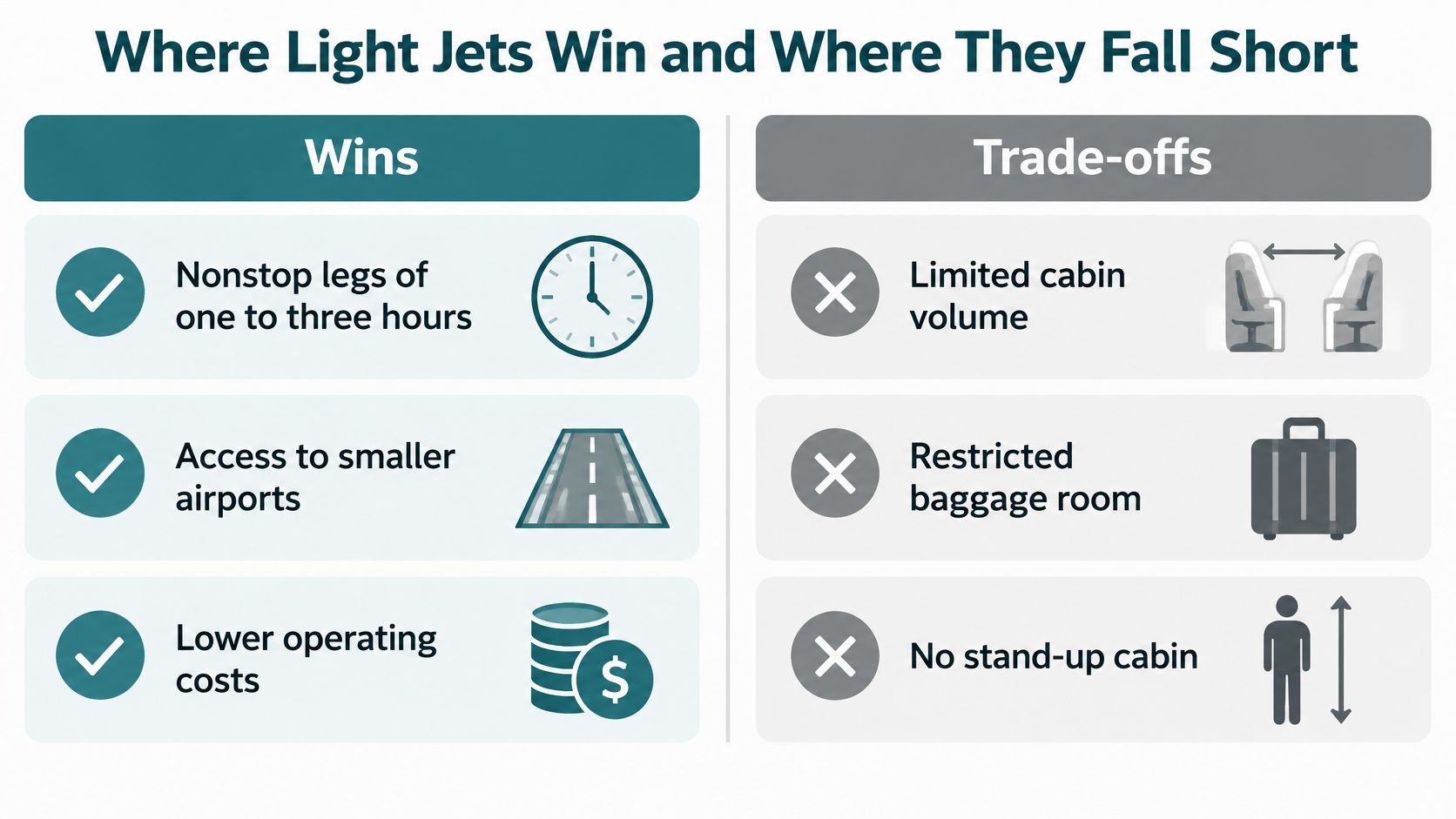
This is a trade, not a ranking. You gain nonstop reach on short sectors and access to smaller fields. You give up cabin volume and baggage room.
Wins
- Nonstop legs of one to three hours, which covers most regional business itineraries without a connection.
- Access to secondary and regional airports that larger jets can't comfortably use, often closer to where the meeting is.
- Faster trips for four to six people, with simpler handling at both ends.
- Lower operating demands on crew and airport infrastructure than a midsize aircraft.
Limits
- Less headroom than a midsize cabin, and no stand-up aisle on most models.
- Smaller bag volume, which bites on sports equipment, sample cases and long trips.
- A lower passenger ceiling, so a group of eight fills the cabin and the hold at once.
- Tighter payload margins on hot days and long sectors, where fuel and people compete.
The segment isn't shrinking, either. McKinsey's analysis of the state of business aviation reports the very-light-jet fleet growing from 42 aircraft in 2000 to 2,160 by 2025, with that category expanding 6.7% a year between 2019 and 2025 against 0.2% for midsize jets. Manufacturers keep building here because buyers keep choosing efficiency over cabin size. Embraer delivered 155 executive aircraft in 2025 across its Phenom and Praetor families, per IBA's business jet delivery outlook.
Put two travelers side by side and the trade becomes obvious. A regional executive flying three short hops in a week fits a light jet perfectly: quick turns, small airports, one bag. A family of five with large suitcases on a long leg doesn't, because payload and cabin fill before the route does. Same aircraft, opposite verdicts.
The decision belongs to your heaviest realistic day. Average days flatter every aircraft.
How to Match a Light Jet to Your Trip
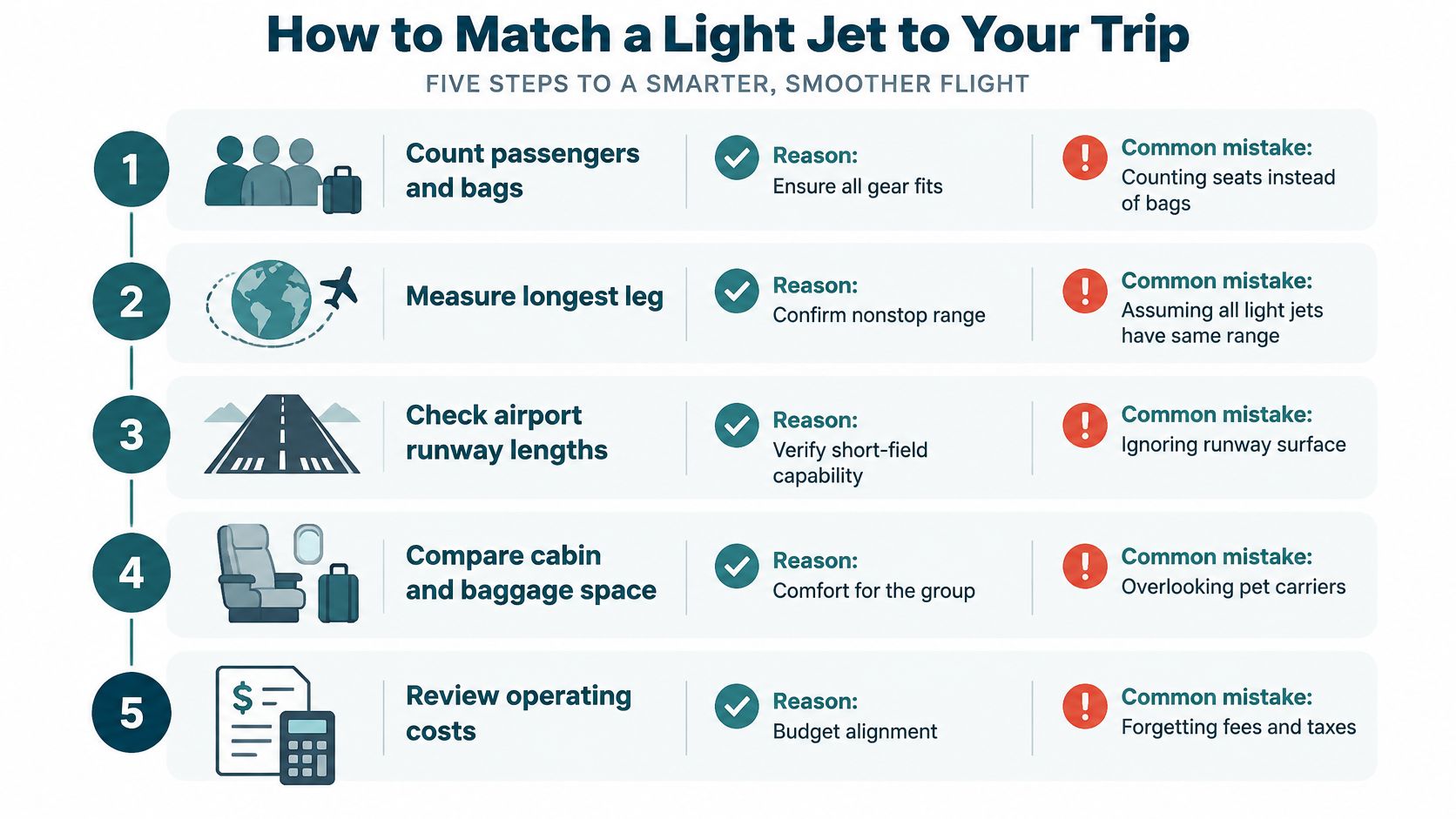
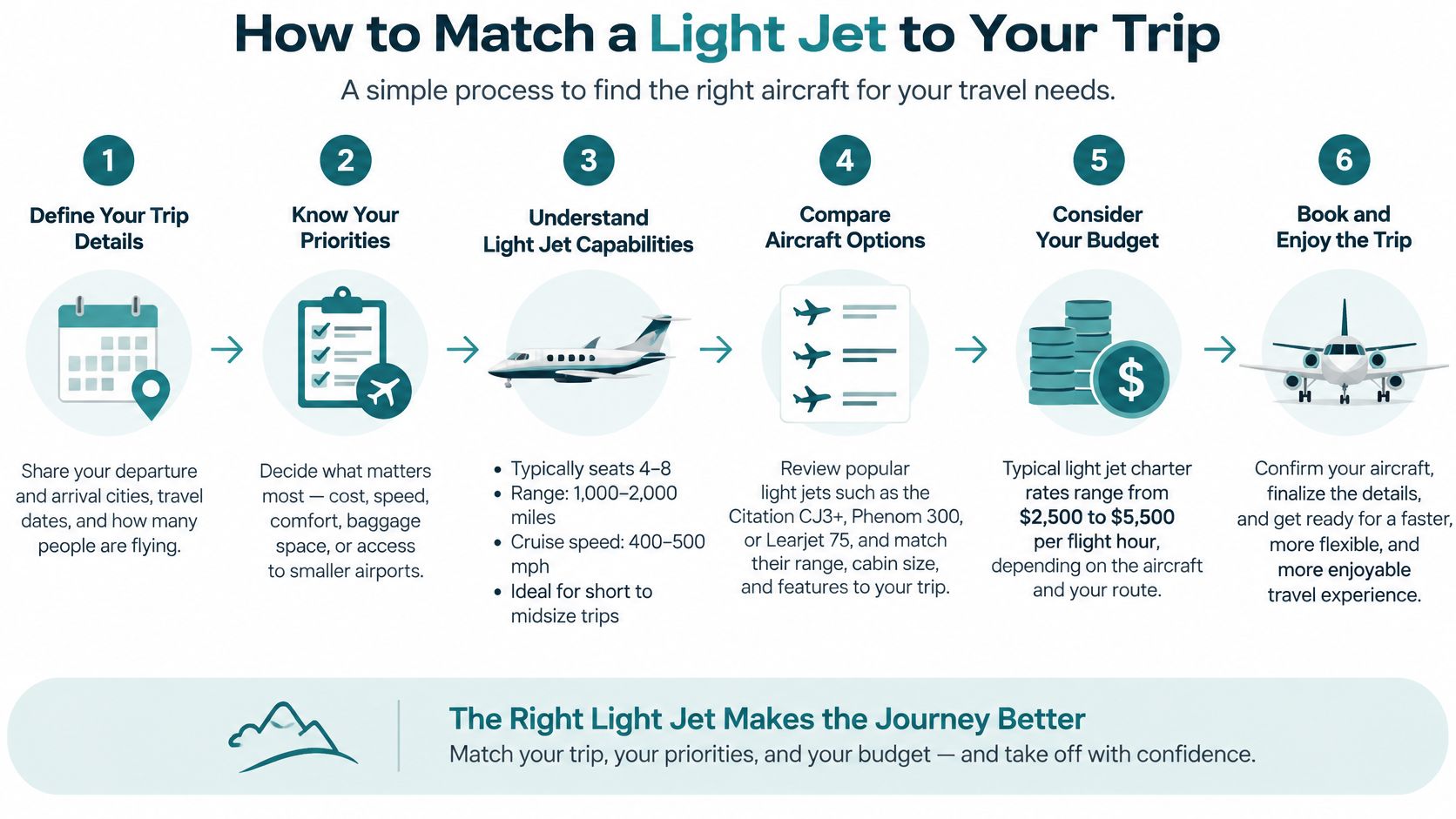
A light jet fails a trip in three places: payload, distance and pavement. The five checks below run in that order, and each one starts from the realistic-load column in the spec table rather than the brochure maximum. Each check has a reason, and each has a mistake that shows up often enough to name.
- Count passengers and bags by type, size and weight. Reason: the cabin and the hold fill separately, and a golf bag takes space that soft-sided bags don't. Mistake: counting seats instead of bags.
- Add reserves and an alternate to the route distance, then compare against real-load range. Reason: the reserve profile is what makes a range figure dispatchable. Mistake: quoting the headline maximum as if it were a plan.
- Check departure and arrival runways at the temperature and elevation you expect. Reason: density altitude stretches the required takeoff distance well past the sea-level figure. Mistake: using a mild-season temperature for a midsummer trip. The FAA's takeoff and landing performance guidance requires runway length to come from the approved flight manual for a specific combination of ambient conditions and aircraft weight.
- Compare certified maximum takeoff weight, crew requirement and baggage volume against your manifest. Reason: seat count alone says nothing about usable load. Mistake: assuming a six-seat cabin carries six adults with their luggage and full fuel.
- Confirm who holds the certificate and who flies the aircraft. Reason: the operating certificate, not the broker's logo, governs the safety standard. Mistake: never asking. Approved Jets operates strictly as a charter broker and does not own, operate, lease or maintain any aircraft, and every flight uses aircraft and crews that meet or exceed FAA Part 135 regulations.
Cabin layout deserves a second look at this stage, because six seats in a private jet seating configuration can mean a club four plus two forward-facing seats, which changes how a working group of six sits together.
Trip profile | Passengers and bags | Check before booking | Light jet fit |
|---|---|---|---|
Short regional hop of 1 to 3 hours | 4 executives with carry-on bags | Runway at departure temperature and reserves | Strong fit |
Long nonstop over 1,500 nm | 6 passengers with luggage | Payload with full fuel, alternate and winds | Often needs a fuel stop; verify the routing |
Sports party with equipment | 6 people with golf or sports bags | Bag volume of the candidate cabin | Fits only if the bags fit; otherwise choose a larger cabin |
High, hot airport | 4 to 6 passengers | Takeoff distance at density altitude | Confirm with dispatch before accepting |
Ground transport belongs in the same conversation, since the vehicle at each end is part of the trip. For larger delegations, book it alongside the flight rather than after landing: a provider with right-sized vehicles for business groups covers the leg between the FBO and the venue without a scramble on arrival.
The rule after all five checks is simple: a light jet is the right answer when realistic load, route distance and runway performance all pass. One failure is enough to mean a different aircraft or a different plan.
Send a Written Trip Brief for Your Quote
The fastest way to get comparable quotes is to stop describing the trip in a phone call and start sending it in writing. A brief settles the variables before pricing starts moving.
Put five things in it: the passenger count, each bag type and size including hard cases and golf bags, the route with a preferred alternate, your travel dates, and any airport constraint such as a short runway or a high-elevation field. Bag type matters more than bag count. A light jet holds 4 to 5 standard soft-sided bags, while a heavy jet takes 15 or more, so "six bags" can mean two very different aircraft.
A complete brief lets an operator check payload, range and runway in one pass, which is how you get a quote that survives contact with the actual manifest. Ask, in the same message, whether the quoted range includes passengers, bags, reserves and the alternate.
Three actions close this out.
- Write the brief using the trip profile table above as your template.
- Request a quote for the class of aircraft that passed your checks, not the cheapest listing that appears. You can get a personalized charter proposal from Approved Jets' flight advisors or by using the Get a Quote button.
- Confirm the specifics before booking: range at your manifest, bag fit in the candidate cabin, and runway performance at the planned departure. If the schedule is tight, note that Approved Jets can typically have a customer airborne in as little as 2 to 4 hours, subject to mission and aircraft availability.
Approved Jets arranges light jet charters around your manifest, matching aircraft to passenger count, bag volume, route distance and runway performance rather than a brochure headline. If your group outgrows the cabin, the same request can be moved up to midsize, super midsize or heavy jets through a network of more than 1,000 aircraft. Visit Approved Jets to send your trip brief and get a quote back.