Private Jet Management: Costs, Services and How to Choose
Private jet management explained: what it covers, what owners pay, and when to hand off maintenance, crew and compliance to a manager.
13 min read

87% of surveyed U.S. corporations that owned or leased a business jet reported investing more in fleet-management technology to optimize routes and reduce fuel burn, according to a 2025 Airbus Corporate Jets survey conducted by Pureprofile among 100 senior executives. That's a useful way to frame private jet management: ownership requires an operating system, not just an aircraft and someone to arrange flights.
But technology and a management contract don't transfer every risk away from the owner. The key test is whether the arrangement makes crew availability, maintenance status, spending authority and charter economics visible enough to verify.
Table of Contents
- What Private Jet Management Covers
- Delegation needs an escalation rule
- What Owners Really Pay for Management
- Test the fee basis before the price
- Maintenance Tracking and Airworthiness Control
- Make records a dispatch condition
- Request evidence that can be reconciled
- Crew Staffing, Compliance and Safety Monitoring
- Verify coverage, not just headcount
- Turn flight data into corrective action
- Charter Revenue Programs in Practice
- Follow the trip through settlement
- Revenue needs an independent safety boundary
- Choose the Model and Verify the Contract
- Choose by mission and continuity
- Verify the contract's failure provisions
- Keep brokerage and operation distinct
What Private Jet Management Covers
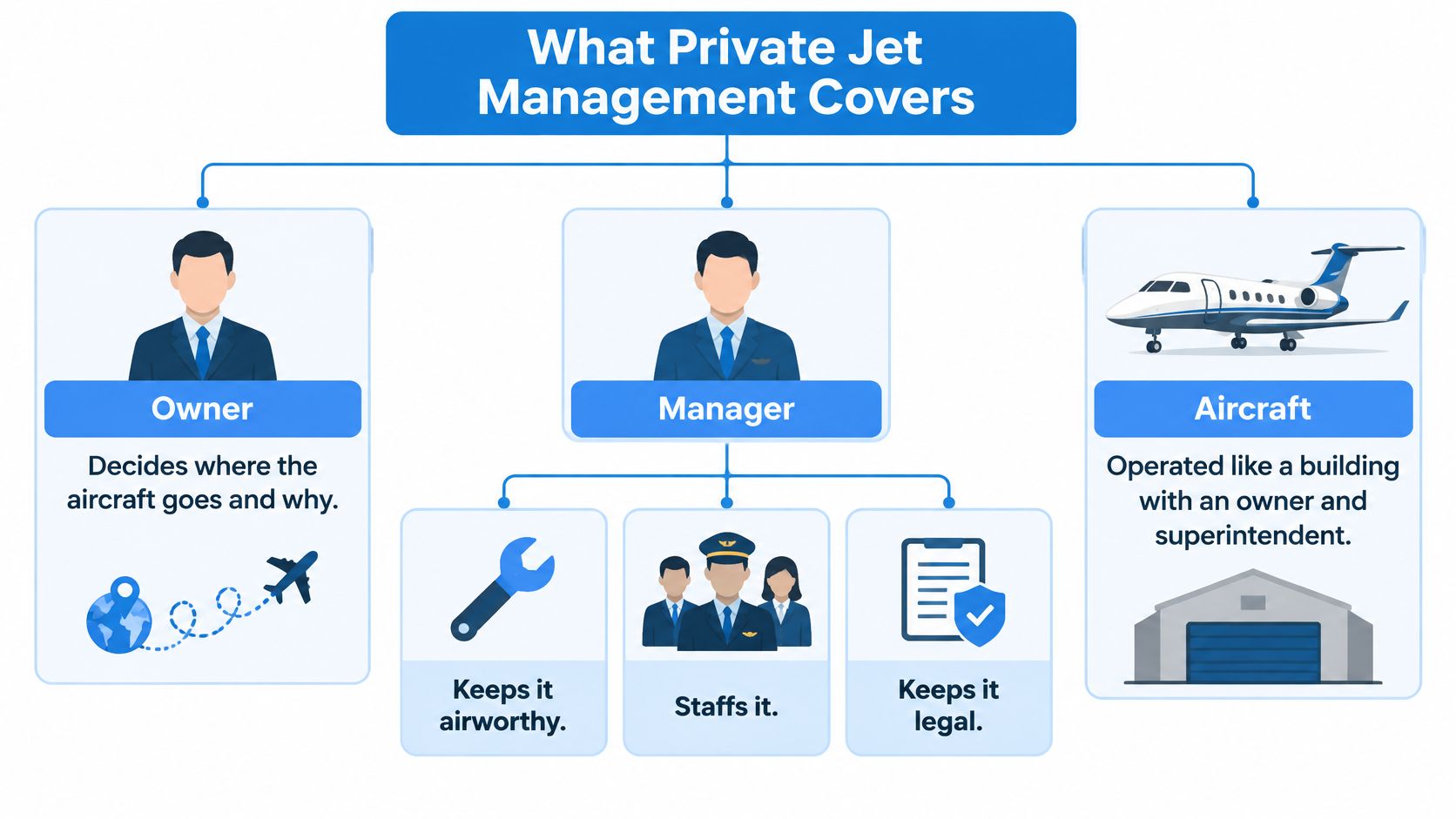
An aircraft owner decides where the jet goes and why. The manager keeps it airworthy, staffed and legal, much as a building superintendent runs a property whose owner rarely visits. The analogy has a limit, though: commercial operating authority and safety decisions must remain with the legally responsible operator, not whoever pays the bills.
The FAA's aerospace forecast estimates 213,756 active U.S. general-aviation aircraft in 2024 and projects 242,722 by 2046. That's the broader fleet, not a private-jet count, but it establishes the scale of the ecosystem supporting specialized maintenance, crews and compliance.
Private jet management service scope
Service area | Typical tasks | Owner decision |
|---|---|---|
Maintenance tracking | Inspection calendars, component life records, shop selection | Approve major overhauls and budget reserves |
Crew staffing | Recruit, qualify, schedule and train pilots | Set crew standards and approve hires |
Regulatory compliance | Part 135 or Part 91 records, operations manuals, audits | Confirm the operating model and accountable officer |
Charter revenue | Booking, pricing, scheduling and settlement of charter flights | Decide how many hours the aircraft is available for charter |
Trip logistics | Flight planning, catering, ground transport, permits | Approve trip requests and destinations |
Cost reporting | Monthly invoices, fuel and maintenance statements, budget variance | Review variances and set spending limits |
These responsibilities concern a substantial capital asset. Manufacturers delivered 764 business jets worldwide in 2024, with business-jet billings of approximately $22.8 billion, according to GAMA's aircraft shipment and billing report. Managing that asset means protecting its records and condition, not just keeping its calendar busy.
Delegation needs an escalation rule
Suppose a midsize-jet owner approves a major overhaul but delegates the inspection calendar. The manager misses an inspection deadline while waiting for a shop slot. Approval of the overhaul hasn't resolved who should have escalated the scheduling problem or stopped accepting trips.
The contract should distinguish budget approval, maintenance coordination and release-to-service authority. Those aren't interchangeable responsibilities.
Contract test: For every delegated task, identify the person who performs it, the evidence that proves completion and the person notified when it slips.
Before signing, answer four questions: What's covered? Who signs off? What's billed separately? Who's accountable if a deadline slips? A service list without those answers describes activities, not a controlled management arrangement.
What Owners Really Pay for Management
Annual management fees by aircraft class
Aircraft class | Annual management fee (market estimate) | Usually billed separately |
|---|---|---|
Light jet | $75,000 to $130,000 | Fuel, maintenance, crew and hangar |
Midsize jet | $130,000 to $220,000 | Fuel, maintenance, crew and hangar |
Large-cabin jet | $120,000 to $350,000 | Fuel, maintenance, crew and hangar |
The planning ranges above come from the Dataintelo aircraft-management market report, which also presents an alternative estimate of approximately 4–8% of total aircraft operating expenses. These are market estimates, not official statistics or binding quotations.
The difference between the methods matters more than the apparent precision. A fixed management fee and a percentage-based charge aren't comparable until both proposals define the services and expense base. Insurance, taxes and other ownership expenses also need their own budget lines, whether the manager arranges them or not.
Test the fee basis before the price
Consider a deliberately hypothetical midsize jet with $900,000 in direct annual costs. Applying the percentage estimate produces $36,000 to $72,000, well below the midsize fixed-fee planning range. This arithmetic doesn't establish a bargain: direct costs may not equal the proposal's definition of total operating expenses, and the service packages may differ.
Ask whether the percentage applies to fuel, overhaul invoices, taxes, outside contractors or only selected expenses. Check for minimum charges, procurement markups and separate administrative fees. A small percentage applied to a broad expense base can create a very different bill from the one an owner expects.
Build the operating budget around identifiable cost centers:
- Fuel and positioning: Include flights needed to collect passengers or move the aircraft to maintenance.
- Scheduled maintenance and reserves: Separate expected shop invoices from money reserved for future work.
- Engine and avionics events: Identify program coverage, exclusions and owner-funded exposure.
- Crew salaries and travel: Include training, benefits, relief crew, accommodation and transport.
- Hangar and insurance: Match the assumptions to the actual base and intended operation.
- Taxes and capital: Obtain tax advice and recognize the opportunity cost of ownership.
Aircraft configuration and access to maintenance capacity also affect the ownership calculation. An attractive acquisition specification isn't enough if the proposed operating budget ignores the equipment it must support.
Compare total owner cash requirements, not management-fee quotations.
Use a 12-month budget with reserves, then separate cash expenditure from depreciation and capital opportunity cost. The broader private jet ownership cost guide helps frame that comparison. For lightly used aircraft, include on-demand charter and fractional access as alternatives rather than assuming ownership must continue.
Maintenance Tracking and Airworthiness Control
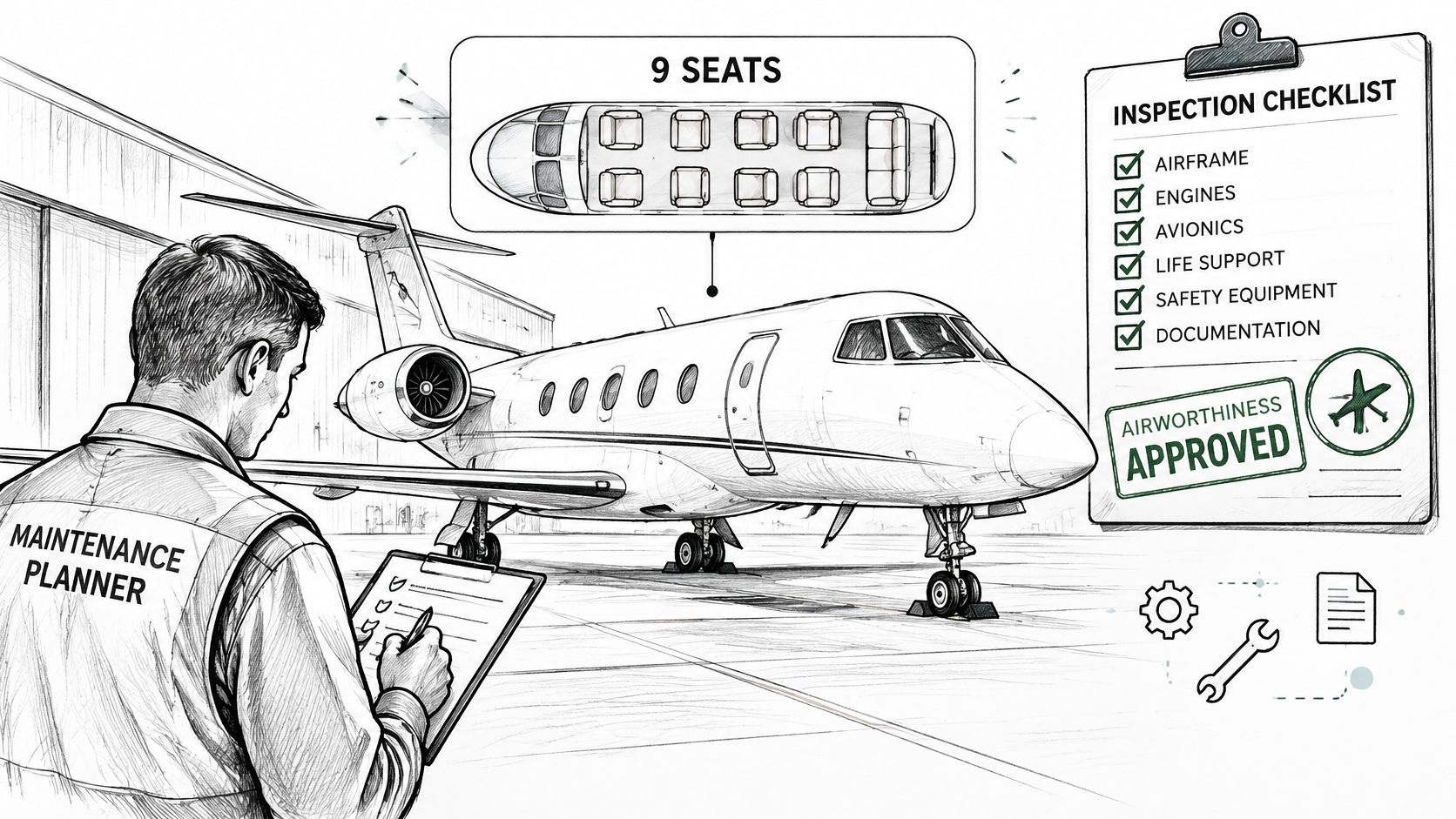
For U.S. commercial operations, start with the aircraft's certificated passenger-seat configuration, not the number of passengers expected on a trip. The FAA's Part 135 general requirements distinguish aircraft with nine or fewer passenger seats from those with 10 or more, with the inspection-program and component-history requirements summarized below.
Part 135 maintenance program by passenger seat count
Passenger seats | Maintenance program | Key requirement |
|---|---|---|
9 or fewer | Approved aircraft inspection program | May combine annual and 100-hour inspections |
10 or more | Continuous airworthiness maintenance program (CAMP) | Generally required |
Any seat count | Manufacturer time-between-overhaul limits | Complete component history needed; gaps can force zero-time restoration |
This is a commercial-operation framework, not a universal maintenance prescription for every privately operated jet. The operator must establish the applicable program and control compliance with it.
Make records a dispatch condition
A component's physical condition isn't a substitute for documented eligibility. Suppose an engine component arrives with an incomplete life history. If the missing evidence prevents verification of its remaining approved life, the operator may face restoration to zero-time status or replacement exposure, rather than filing a corrected spreadsheet.
Don't assume every missing entry triggers the same remedy. Require maintenance control to identify the affected requirement, the acceptable evidence and the authorized resolution before the aircraft returns to service.
The manager should maintain one auditable register covering the aircraft, engines, applicable propellers, appliances and component limits. Each entry should connect calendar, hour and cycle thresholds to the supporting record, responsible person and planned maintenance action.
Dispatch personnel should see an explicit release status. Incomplete required evidence should block dispatch, rather than appear as an unresolved note on a report that nobody checks before departure.
Request evidence that can be reconciled
An owner's document package should include:
- Current register extract: Show due status and the underlying record references.
- Next 90 days of inspections: Include planned shop access, parts requirements and scheduling conflicts.
- Life-limited-parts status: Identify remaining life and any unresolved history gaps.
- Approved shop list: Include relevant certifications and the work each facility is authorized to perform.
Use the business jet maintenance guide to frame the technical review, but reconcile the documents against the actual aircraft records.
A grounded aircraft cannot perform charter trips, yet ownership expenses don't automatically stop. The economic purpose of maintenance tracking is therefore broader than avoiding overdue work: it gives the owner time to arrange parts, shop capacity and replacement travel before an interruption becomes urgent.
Crew Staffing, Compliance and Safety Monitoring
Fully managed doesn't mean fully insulated from labor risk. A service contract can assign recruitment and scheduling, but it can't make an unavailable qualified pilot or technician appear when a trip depends on one.
The FAA's Aviation Safety Workforce Plan treats workforce planning as an ongoing safety priority. It isn't proof that a particular aircraft manager is understaffed. It is a reason to examine staffing continuity rather than accept a list of job titles as evidence of operational resilience.
Verify coverage, not just headcount
A crew plan should connect pilot qualifications, recurrent training, rest, leave and relief coverage to the owner's expected missions. Maintenance staffing deserves the same scrutiny, including the authority to approve work and the availability of specialists.
Request evidence of:
- Technician qualifications: Confirm relevant aircraft experience and authorization for assigned work.
- Maintenance-control structure: Identify who reviews discrepancies and who covers that person's absence.
- Contractor oversight: Establish how outside work is accepted and records are checked.
- Succession and fatigue planning: Examine leave coverage, handovers and workload escalation.
- Specialist contingencies: Identify the response when a required inspector or technical specialist is unavailable.
For international missions, test the plan against a breakdown away from the home base. A vendor contact list isn't enough without a process for confirming approvals, obtaining parts and accepting the completed work.
Turn flight data into corrective action
Applicable Part 135 maintenance requirements include continuous analysis and surveillance of inspection-program performance and retention of airframe, engine, overhaul and life-limited-part records. Alongside those controls, NBAA's safety-data guidance identifies flight-data monitoring, also called flight operations quality assurance, as a way to detect hazards and trends before incidents occur.
The owner doesn't need unrestricted access to identifiable pilot data. The owner needs evidence that the operator reviews findings, assigns corrective actions and checks whether those actions worked.
A useful dashboard tracks exceedance rates, maintenance deferrals, unscheduled removals and corrective-action closure time. Define each measure consistently so changes reflect operational performance rather than reporting changes.
A safety dashboard without named corrective-action owners is a reporting product, not a closed-loop safety process.
Suppose unstable approaches become more frequent at a particular base. The operator should examine approach procedures, weather, scheduling and crew preparation, then assign targeted training or procedural changes and review subsequent results.
The corporate flight-management guide provides additional organizational context. The decisive evidence remains the operator's completed follow-up, not its assurance that safety is a priority.
Charter Revenue Programs in Practice
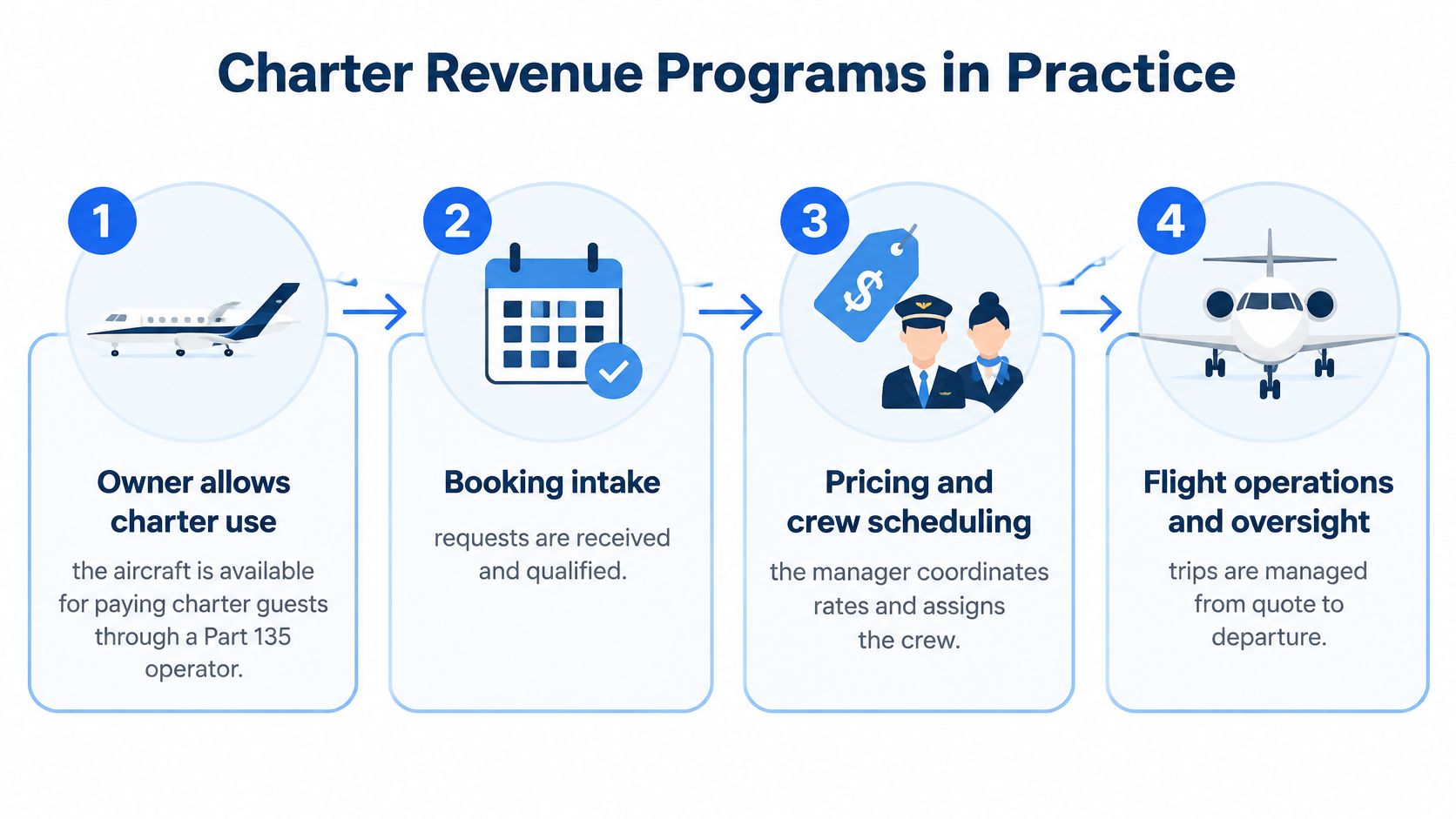
Charter revenue can offset ownership costs, but gross receipts aren't owner earnings. When an owner makes an aircraft available to paying guests through a Part 135 operator, the management arrangement must connect booking, pricing, crew scheduling, insurance, documentation and financial settlement.
Consider a hypothetical midsize jet flying 150 charter hours at an assumed $3,000 in gross revenue per hour. Gross receipts would be $450,000. If charter-driven fuel, crew, wear and positioning costs total an assumed $1,800 per hour, those costs would be $270,000, leaving $180,000 to offset fixed ownership expenses, before any additional contractual deductions or taxes.
Those are illustrative assumptions, not market rates or a revenue forecast. Calling the hourly receipt “net” before deducting the costs would materially overstate the benefit.
Follow the trip through settlement
The owner should be able to trace a charter through the complete process:
- Booking intake: Confirm availability, passenger requirements and owner-use restrictions.
- Flight planning: Price the mission with routing, positioning and operational constraints.
- Operation: The authorized operator controls the flight and coordinates qualified crew.
- Post-flight review: Reconcile flight time, discrepancies and relevant safety information.
- Settlement: Match customer receipts, commissions, expenses and the owner's credit.
Empty legs and repositioning consume resources without necessarily producing corresponding passenger revenue. Owner use also competes with charter availability, while additional utilization brings both receipts and maintenance consumption.
Revenue needs an independent safety boundary
The FAA's Safety Management System guidance says Part 135 charter and commuter operators authorized before May 28, 2024, must implement a compliant SMS and submit a declaration of compliance by May 28, 2027; applications submitted on or after May 28, 2024, require implementation upon certification.
An SMS should provide hazard reporting, risk assessment, mitigation tracking and documented follow-up. For example, repeated weather-related disruptions may reveal pressure to accept marginal schedules. Accountable management should assess the associated operational hazard, assign mitigation and verify completion, rather than treating every delay as an isolated commercial inconvenience.
Stress-test the hypothetical program at half the planned hours. With unchanged assumed hourly economics, the owner's contribution would fall to $90,000, while fixed obligations would remain. Actual results could deteriorate further if lower utilization brings less efficient positioning.
Approve charter participation because the conservative net contribution is useful, not because the gross revenue sounds large.
Choose the Model and Verify the Contract
Self-managed versus third-party managed aircraft
Criterion | Self-managed | Third-party managed |
|---|---|---|
Maintenance oversight | Owner hires and supervises every shop | Manager runs the register and selects shops under owner approval |
Crew | Owner recruits, trains and schedules crews | Manager staffs and qualifies crews, with a vacancy plan |
Compliance | Owner builds and funds the compliance system | Manager runs the system; owner retains applicable responsibilities |
Cost structure | Fixed staff costs plus direct costs | Management fee plus direct costs |
Charter revenue | Owner must build a program from scratch | Program often built into the contract |
Best fit | High annual hours and in-house aviation staff | Moderate hours, multiple bases, hard-to-hire crews |
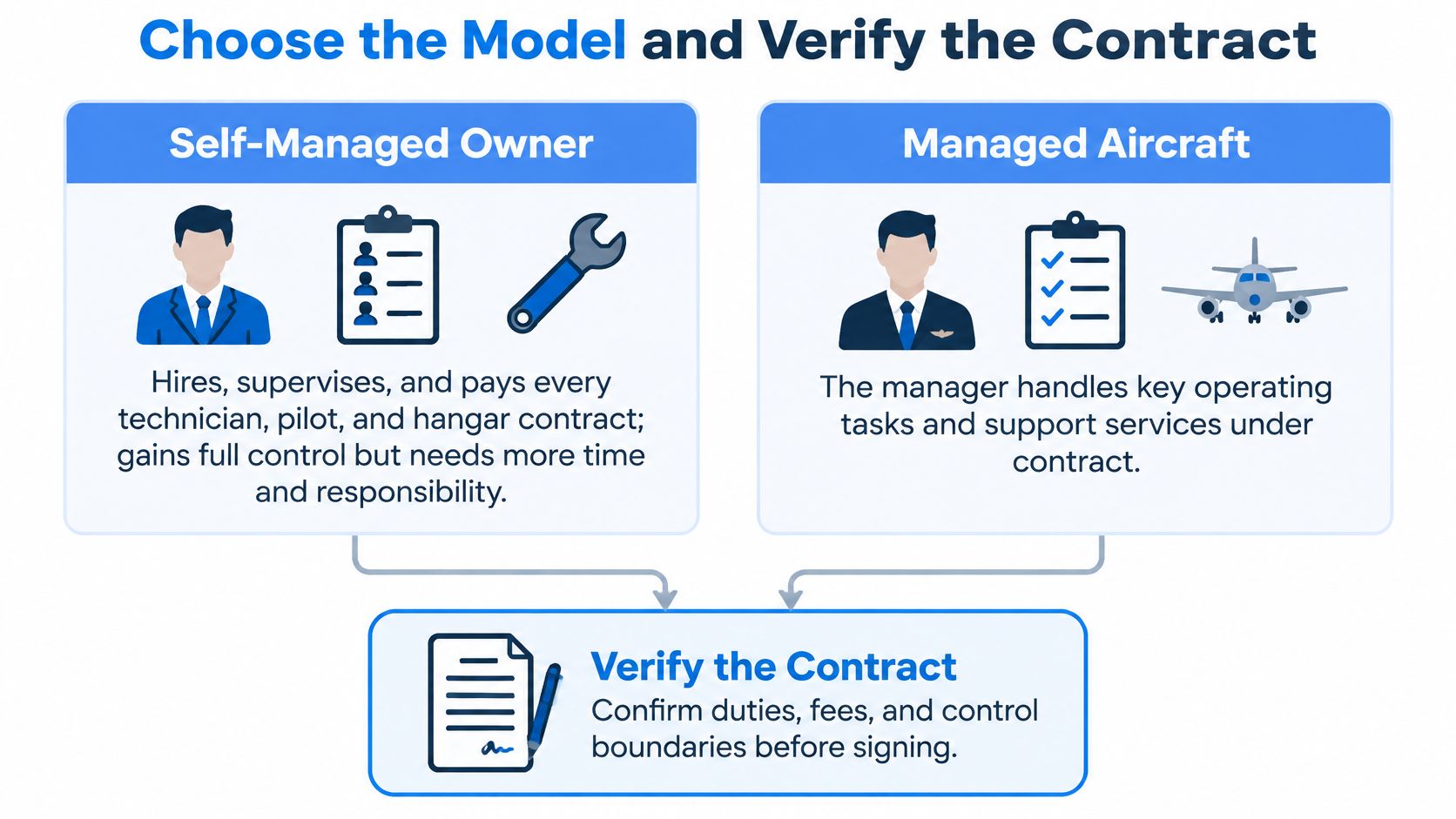
Neither arrangement eliminates the need for an accountable owner representative. The distinction is whether the owner builds the operating organization or purchases defined services from another organization. Legal responsibility still follows the applicable operating rules and actual authority, not a table or marketing label.
Choose by mission and continuity
Consider two hypothetical owners. One flies 50 hours annually and would otherwise employ a full-time pilot plus a maintenance coordinator. Another flies 400 hours across two bases, with frequent schedule changes. These aren't break-even thresholds: they illustrate why annual hours alone don't determine staffing requirements.
The lightly used aircraft may carry disproportionate fixed staffing costs. The busier aircraft may need a dedicated team under either model, particularly if simultaneous demands, leave and international missions stretch shared resources.
Self-management is a stronger candidate when the owner already has capable aviation leadership, predictable missions and a concentrated base structure. Third-party management deserves consideration when shared infrastructure, multiple locations or recruitment challenges would be difficult to address internally. Low-utilization owners should price on-demand charter alongside continued ownership.
A well-run management contract can still support the wrong ownership decision. Include the cost of replacement travel during downtime and the value of capital tied up in the aircraft, rather than evaluating only the next operating invoice.
Verify the contract's failure provisions
For a general explanation of how service contracts define scope and obligations, the Coto & Waddington service agreement guide from Coto & Waddington, Attorneys at Law, is useful background. Aviation counsel should then examine the specific agreement, operating structure and allocation of authority.
Before signing, complete these checks:
- Obtain the written scope. Name every service, the legal entity performing it and the responsible role. Identify subcontracted work and whether the owner can inspect supporting records.
- Request a 12-month budget. Include management charges, direct operating costs, reserves and exclusions. Require explanations for spending above approval limits and distinguish emergency authority from routine purchasing authority.
- Confirm the operating entity. For charter use, verify the operator's Part 135 status and the aircraft's authorization for the intended operation. Don't confuse the broker, management coordinator, certificate holder and maintenance organization.
- Test personnel continuity. Walk through a captain's departure, a maintenance-controller vacancy and an overseas technical interruption. Obtain the escalation path and contractual treatment of substitute staffing costs.
- Assign charter decision authority. Establish who controls availability, approves pricing exceptions and accepts cancellations. Require a settlement format that exposes deductions rather than showing only a final credit.
The overlooked provisions often concern exit and handover. Specify access to original records, exportable maintenance data, vendor invoices, outstanding work orders and financial balances. Also establish how unfinished corrective actions transfer when the relationship ends.
Exit safeguard: Don't let the ability to leave depend on the outgoing manager's willingness to reconstruct your aircraft's records.
Keep brokerage and operation distinct
At Approved Jets, we operate exclusively as a charter broker. We don't own, operate, lease or maintain aircraft; flights are operated by registered Part 135 operators or foreign equivalents. We use aircraft and crews that meet or exceed FAA Part 135 regulations, prioritizing operators with Argus Platinum and Wyvern Wingman third-party safety ratings.
We also offer aircraft-management programs covering maintenance tracking, crew staffing, regulatory compliance and charter revenue generation. A proposal should identify which responsibilities sit with us, which sit with the selected operator or maintenance provider, and which remain with the owner.
Before deciding, obtain written scopes and comparable annual budgets from at least two providers. Resolve differences in authority, exclusions and evidence access before negotiating the headline fee.
Approved Jets offers aircraft-management programs and on-demand charter coordination, allowing owners to evaluate operating support alongside alternative access to private aviation. Visit Approved Jets to discuss your mission profile and request a written proposal identifying the service scope, responsible parties and budget assumptions.
Updated