Private Jet Charter vs First Class: Cost and Time Compared
Private jet charter vs first class compared on cost per passenger, time saved, privacy, luggage, security and emissions, with a clear rule for choosing.
15 min read

Private aviation can save roughly 120 to 130 minutes per leg, largely through shorter terminal processing, direct routing, and access to smaller airports rather than higher cruise speed, according to estimates summarized in a private jet versus commercial guide for modern travelers. That same summary cites a survey in which 90% of private aviation users also use airlines and 90% identified time savings as their motivation. Those two figures reframe Private Jet Charter vs First Class correctly. It's rarely a permanent substitution. It's a route by route calculation involving group size, airport access, the value of recovered hours, and emissions per traveler. When you run your own numbers, the private option sometimes wins clearly, and sometimes it doesn't come close.
Table of Contents
- Private Charter and First Class Side by Side
- What the Rows Actually Mean
- Who Controls the Itinerary
- How Much Time a Charter Really Saves
- Where the Saving Comes From
- When the Gap Narrows or Widens
- Cost Per Passenger and the Break-Even Point
- Run the Division Yourself
- What Moves a Quote
- Security, Luggage and Privacy in Practice
- Screening Without the Airline Terminal
- Luggage Is an Aircraft Constraint
- Emissions per Passenger Most Comparisons Skip
- Why Occupancy Dominates the Result
- When the Charter Case Improves
- Which Option Fits Your Trip
- Six Steps Before You Decide
- Verdict by Situation
Private Charter and First Class Side by Side
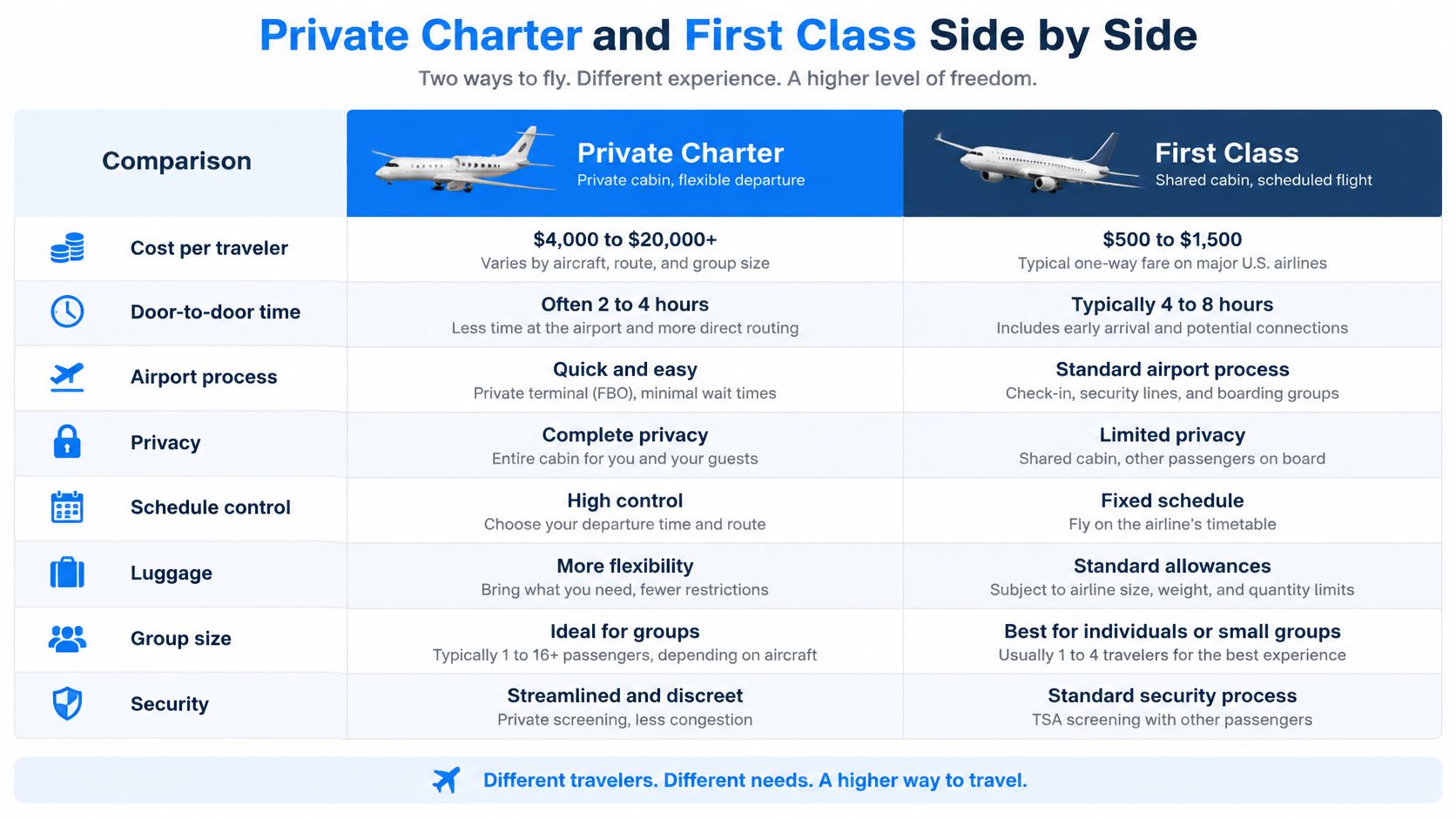
Start with the structure of what you're buying. The values below use $300 to $1,500 per first class seat and $14,000 to $22,000 for a whole light jet, figures detailed in the cost comparison later in this article.
Criterion | Private Jet Charter | First-Class Commercial |
|---|---|---|
Cost per traveler | Whole aircraft price divided by travelers, about $14,000 to $22,000 total for a light jet | About $300 to $1,500 per seat |
Door-to-door time | About 2.25 hours saved on the New York to Miami example | Scheduled flight plus terminal, security and baggage time |
Airport process | Fixed-base operator with about 20 minutes before departure in that example | Commercial terminal, check-in, security and boarding |
Privacy | Private cabin and FBO processing | Shared cabin and shared terminal |
Schedule control | Departure set around the traveler, subject to crew limits and weather | Fixed airline schedule and published routes |
Luggage | Matched to the aircraft, confirm volume and hard-case size in the quote | Set by airline fare allowance |
Group size | Per-person cost falls as more travelers share the aircraft | Per-person cost stays the same for each added seat |
Security | Screening of passengers and bags before boarding still applies | Airline security checkpoint and gate process |
What the Rows Actually Mean
Read the cost row first, because it changes with group size. One traveler bears the entire aircraft price. Six or eight travelers divide it, while each additional first class seat repeats the fare.
Read the time row second. It turns mainly on airport process and routing, not cruise speed. A charter can depart from a general aviation facility near your origin and land closer to your final meeting, while first class still uses the airline's terminal and network.
The scale of that alternate airport system is easy to underestimate. The U.S. Federal Aviation Administration 2012 asset report reported that approximately three out of every four takeoffs and landings at U.S. airports were conducted by general aviation aircraft. That report also identified corporate flights as about 12% of total private flying in the United States.
Who Controls the Itinerary
First class buys a premium seat inside a scheduled network. You get a wider seat, enhanced meals, priority boarding, and lounge access, but the airline still sets the route, departure time, hubs, and connections. A charter buys an aircraft and itinerary built around one trip, which is why it can serve destinations without convenient nonstop airline service.
Three criteria usually decide the choice. Count the travelers, check whether the route has convenient nonstop commercial service, and put a defensible value on an hour of executive time. Treat this table as a starting point, because every row changes with aircraft type, route, repositioning, and fare timing.
How Much Time a Charter Really Saves
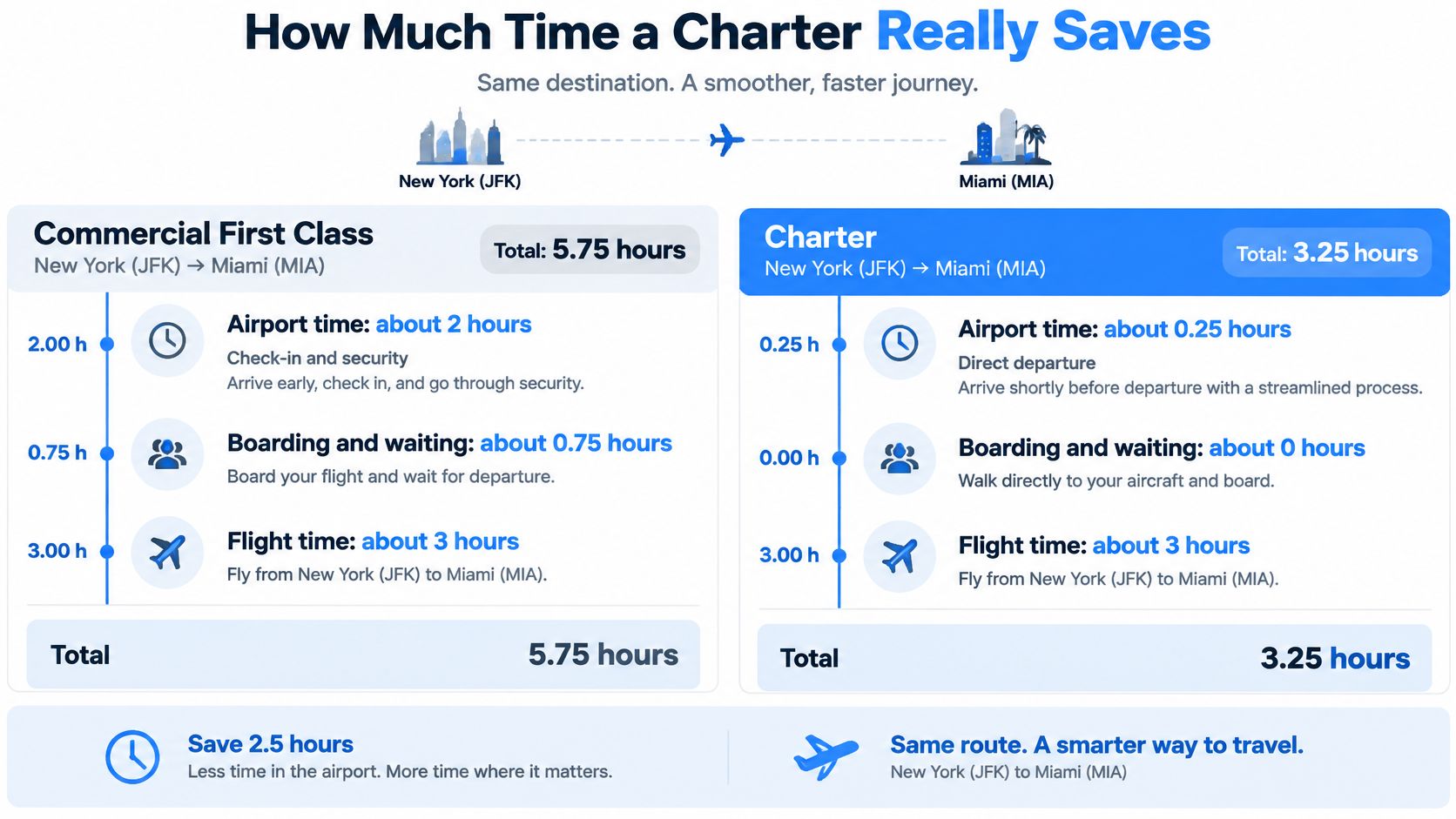
A New York to Miami comparison estimates a door-to-door trip at about 5.75 hours by commercial first class and 3.5 hours by private charter using Teterboro and Opa-locka. That puts the estimated saving at 2.25 hours, subject to the route and ground arrangements.
Stage | Commercial First Class | Private Charter |
|---|---|---|
Before departure | About 2 hours at the airport | About 20 minutes at the FBO |
Flight time | About 3 hours | About 3 hours |
Arrival and baggage | About 45 minutes | About 5 minutes to deplane to a waiting vehicle |
Total door to door | About 5.75 hours | About 3.5 hours |
Time saved per traveler | Baseline | About 2.25 hours saved |
Where the Saving Comes From
Flight time is the same in this example. The estimated advantage comes from the ground stages: shorter processing, simpler boarding, faster baggage access, and a car waiting at arrival. The aircraft does not need to cruise dramatically faster for the full itinerary to take less time.
Block time alone can obscure that difference. For a commercial trip, count ground transfer, arrival buffer, check-in, security, boarding, flight, connections, deplaning, baggage recovery, and the final transfer. For a charter, count the trip to the FBO, passenger processing, flight, deplaning, and onward ground transport. Comparing the complete sequence is more useful than comparing flight durations.
Approved Jets coordinates ground transport, catering, security, and special requests, and manages the complete trip. A realistic itinerary should include a door-to-door transport service, not treat airport transfers as incidental. A waiting car saves time only when its location, timing, passenger count, and luggage capacity have been arranged before landing.
When the Gap Narrows or Widens
The 2.25-hour saving is specific to the New York to Miami example, not a fixed benefit on every route. A solo traveler with carry-on luggage, expedited screening, and a convenient nonstop from a nearby airport may spend less time on the ground already. In that case, charter may chiefly buy privacy and schedule control, with less time recovered.
The gap can widen when a commercial itinerary requires a connection, uses a distant hub, or leaves a long drive after landing. On a multi-stop day, a missed connection can also disrupt later meetings. The same New York comparison cites other published estimates of about three to five hours saved when check-in, security, boarding, baggage claim, and ground access are included. Those estimates should not be treated as a prediction for a different route.
Before valuing the hours, ask for the full charter itinerary, including repositioning, crew duty limits, weather exposure, and air traffic restrictions. Schedule control does not remove operating limits, and route conditions can change the result.
Practical rule: Compare origin door to destination door. A quote that lists flight time without ground transfers and processing buffers is not yet a time comparison.
Then put a value on the time recovered. At an illustrative $500 per hour, 2.25 hours represent about $1,125 per traveler in time value, before assigning value to privacy or schedule control. That estimate comes from the New York comparison and is useful only when set against the actual per-person charter premium for the trip.
Cost Per Passenger and the Break-Even Point
The arithmetic is simple, but people often run it against the wrong denominator. A published route comparison of private jet charter and first class reports a light-jet charter at roughly $14,000 to $22,000 for the whole aircraft, while first-class fares run approximately $300 to $1,500 per passenger, with peak pricing commonly shown at $900 to $1,500.
Travelers | Light-Jet Charter per Person | First-Class Fare per Person |
|---|---|---|
1 | $14,000 to $22,000 for the whole aircraft | $300 to $1,500 |
6 | $2,300 to $3,700 | $300 to $1,500 (peak $900 to $1,500) |
8 | $1,750 to $2,750 | $300 to $1,500 (peak $900 to $1,500) |
10 | $1,400 to $2,200 | $300 to $1,500 (peak $900 to $1,500) |
15 | $930 to $1,470 | $300 to $1,500 (peak $900 to $1,500) |
Run the Division Yourself
Divide the total charter quote by the number of travelers. Then multiply the actual first class fare by that same number. Compare totals, not a whole aircraft against one seat.
At six travelers, the table gives $2,300 to $3,700 per person for the light jet, using the division reported in the route comparison linked above. Against a $1,500 peak fare, the remaining premium is $800 to $2,200 per person. Time value might cover the low end of that premium. It won't automatically cover the high end.
At ten travelers, the computed range falls to $1,400 to $2,200 per person. Only the bottom of that range sits below a $1,500 peak fare, and a larger group may also require a larger aircraft than the light jet used in the example. At fifteen, the arithmetic produces about $930 to $1,470, but you shouldn't assume the same aircraft, baggage capacity, or quote still applies.
That caution explains an apparent contradiction. Another route analysis summarized in the comparison above reports a crossover around six or more travelers on short European routes and roughly 10 to 12 travelers on transatlantic routes. A six-person crossover under this table would require different aircraft, fare, or route assumptions, so verify those inputs before using the rule.
What Moves a Quote
Aircraft type and repositioning usually move the price first. Taxes, airport and landing fees, fuel, catering, ground transport, overnight charges, and de-icing can then change the total. Our quotes are estimates only and can change based on aircraft availability, fuel costs, positioning fees, landing fees, overnight charges, de-icing, catering, and ground transportation.
Ask for the expiry in writing. Our quotes are valid for the period stated in them, or for 48 hours from issuance if no period is stated. After expiration, pricing and availability must be reconfirmed.
Before you compare totals, read a clear breakdown of how much it costs to charter a private jet and then test your own quote line by line. Include required commercial connections and ground transport on the airline side, and include every variable charter fee on the private side.
A solo executive normally pays far less in first class. A charter doesn't become cost-competitive through luxury. It becomes competitive, if at all, through shared cost and recovered time.
Security, Luggage and Privacy in Practice
The claim that private aviation means no screening is too broad. FAA guidance for air-taxi commercial operators recommends screening 100% of passengers and baggage before boarding, using procedures, facilities, and equipment comparable to those used by scheduled airlines. The setting feels different. The obligation to control who and what boards doesn't disappear.
Screening Without the Airline Terminal
An executive charter departing a general aviation terminal may avoid the conventional airline checkpoint and gate process. That traveler still complies with applicable FBO and operator security controls, and the exact process depends on the airport, operation, route, and security program.
Some locations impose more explicit duties. Rules governing certain operations at Ronald Reagan Washington National Airport require the FBO to support screening of people and property and searches of aircraft under its approved security program, as described in the FAA guidance linked above. Don't promise travelers a walk-on experience until the departure airport and operator confirm the procedure.
Privacy is separate from screening. A private cabin and FBO lounge keep executives, public figures, and sports teams out of crowded shared terminals and away from a public gate area. That can protect confidential conversations and reduce unwanted attention, but it doesn't change identity checks, baggage controls, or restricted-item rules.
Luggage Is an Aircraft Constraint
An airline sets a fare-based baggage allowance. A charter matches bags to a specific aircraft's baggage volume, door dimensions, cabin storage, payload, and route. Passenger count alone won't tell you whether golf clubs, instrument cases, presentation equipment, or several hard suitcases fit.
Confirm the number, dimensions, and weight of large items during quoting, not after the contract is signed. Soft-sided luggage often uses irregular baggage space more efficiently than rigid cases, and travelers comparing carry options can use this men's travel duffle bag guide to judge capacity and construction before choosing a bag for a space-sensitive cabin. Send photographs or measurements for unusual items so the operator can confirm loading, not merely total weight.
Responsibility also follows the operation. We are a broker and not a carrier, so claims about air transportation, aircraft safety, crew conduct, baggage handling, or onboard experience must be directed to the applicable Operator. We use aircraft and crews that meet or exceed FAA Part 135 regulations, prioritizing operators with Argus Platinum and Wyvern Wingman third-party safety ratings.
For a leadership team, connect those checks to the broader planning in a corporate aircraft charter, especially passenger manifests, confidentiality, ground access, and who has authority to approve an aircraft substitution. A polished cabin photograph answers none of those questions.
Before booking, ask three direct questions:
- Screening process: How will passengers and bags be screened at this departure airport?
- Operating carrier: Which operator is flying the trip, and what current safety credentials can you inspect?
- Baggage limit: What volume, weight, and hard-case dimensions has the operator approved for this aircraft and route?
Emissions per Passenger Most Comparisons Skip
A solo traveler on a well-served nonstop route may have a smaller carbon footprint in first class than in a private jet, even though first class uses more cabin space than economy.
That conclusion follows from occupancy. Available estimates summarized in reporting on the private jet boom indicate private jets can generate approximately 10 to 14 times more direct carbon per passenger than commercial aviation. The disparity becomes especially pronounced when a charter carries only one to three people.

Why Occupancy Dominates the Result
A full airliner spreads one aircraft's fuel burn across many seats. A lightly loaded private jet spreads a smaller total fuel burn across very few travelers, so the per-person result can still be far higher.
Scale also explains why commercial aviation dominates total sector emissions while performing better per passenger. The National Academies chapter on commercial aircraft emissions classifies large commercial aircraft as single-aisle or twin-aisle aircraft carrying more than 100 passengers and reports that they generate more than 90% of global commercial-aircraft CO2 emissions. It also notes that aviation emissions are dominated by jet-fuel combustion rather than airport operations.
Don't mix those measures. Total trip emissions answer how much the movement adds overall. Emissions per traveler answer how efficiently the aircraft carried the group. A sustainability review needs both, because a fuller charter can improve the second figure while increasing the first if it induces a flight that wouldn't otherwise occur.
When the Charter Case Improves
The comparison changes when one aircraft replaces several first class tickets, carries a larger group, avoids multiple commercial connections, or enables a mission-critical itinerary that scheduled service can't support. It doesn't reverse automatically at a magic passenger count. Aircraft size, route length, passenger load, routing, and empty-leg repositioning all move the estimate.
Say two executives consider a transatlantic charter. If only those two board, each carries roughly half of the aircraft's trip footprint before any repositioning allocation, based on simple division of the total. Ask whether they'd otherwise occupy two seats on an efficient nonstop, or whether the commercial alternative requires separate itineraries, connections, and long ground transfers. Those are materially different counterfactuals.
Request a per-passenger estimate with the aircraft type, expected load, fuel-burn or emissions methodology, route, and repositioning legs stated in writing. Compare it with the commercial estimate for the same origin, destination, cabin, and connection pattern. If the operator can't explain the assumptions, don't use the number in a procurement decision.
Which Option Fits Your Trip
The choice turns on three variables: passenger count, route, and the value of time recovered. Use the light-jet and first class ranges from the cost analysis as a starting point, then compare the actual itinerary and written quote.
Traveler Situation | Likely Better Option | Deciding Factor |
|---|---|---|
Solo traveler on a well-served nonstop, carry-on only | First class | The fare is a small fraction of the charter cost |
Team of six on a short route | Private charter only if the time value covers the premium | Per-person charter cost is about $2,300 to $3,700 against a $300 to $1,500 fare |
Group of 10 or more | Compare the written quote with first class | At ten travelers, the light-jet range is $1,400 to $2,200 per person. Charter is competitive against a $1,500 peak fare only near the bottom of that range. Otherwise, first class remains cheaper |
Group of 20 or more, such as a sports team | Airliner or heavy-jet group charter | Match aircraft size to the party |
Traveler needing a regional airport or multi-stop itinerary | Private charter | Direct routing can avoid connections and extra ground time |
Time-critical movement with no scheduled service that fits | Private charter | Timing depends on aircraft availability, so confirm mobilization time in writing |
Family of four with heavy luggage to a destination without nonstop service | Get a written quote before deciding | Baggage volume and routing determine the result |
Six Steps Before You Decide
- Count every traveler. Multiply the actual first class fare by the group size, including taxes, seat fees, baggage charges, and ground transport. Compare the same number of travelers on both options.
- Divide the charter total. Use the written whole-aircraft quote, not an hourly estimate that may omit repositioning or airport charges. A per-person figure makes the group-size break-even visible.
- Test the commercial route. A convenient nonstop at a suitable time strengthens the first class case. A connection, remote hub, or overnight stay can make the charter's direct routing more valuable.
- Value recovered hours. At six travelers, the premium over a $1,500 peak fare is $800 to $2,200 per person, based on the cost comparison. An illustrative $1,125 time value covers only the lower part of that range. The remaining premium needs another reason, such as a missed connection avoided or a work schedule preserved.
- Check airport and itinerary fit. A regional destination or several stops in one day may justify a premium that a simple hub-to-hub route cannot. Compare door-to-door plans, not just time in the air.
- Compare emissions per traveler. If sustainability affects the decision, ask for the aircraft, passenger load, routing, and repositioning assumptions. A lower per-person estimate depends on who flies and what commercial journey the charter replaces.
Verdict by Situation
A solo traveler on a well-served nonstop should normally choose first class. The fare is far lower, the time gap is likely narrowest, and the per-passenger emissions case also favors the airline seat.
A charter becomes rational when the group approaches a defensible break-even, executive time has a documented value, or scheduled service does not reach the destination at a workable time. Privacy and schedule control may still justify the cost, but treat them as benefits being purchased rather than as reductions in the invoice.
A family of four with heavy luggage sits in the uncertain middle. Passenger count alone does not settle the comparison. Confirm the baggage dimensions, compare the exact commercial routing, and include ground transfers at both ends before choosing.
For 20 or more travelers, compare group aircraft rather than forcing the trip into a light-jet calculation. Approved Jets sources appropriately sized airliners and heavy jets for large parties, sports teams, corporate retreats, and destination weddings. Its services also include luxury charter, corporate travel, cargo and logistics, aircraft management, and medical evacuation and repatriation, allowing the aircraft choice to reflect the trip's actual purpose.
Request one written proposal with the aircraft category, operator, passenger count, approved luggage, variable fees, repositioning leg, departure and arrival airports, and quote expiry date. Call +1 (866) 678-1411 or email charter@approved-jets.com to contact Approved Jets' flight advisors, or use the Get a Quote button for a personalized charter proposal.
Run the comparison with actual passenger numbers, airports, luggage, and timing. Visit Approved Jets to request a written charter proposal and compare its cost, door-to-door time, and aircraft fit with the first class itinerary.