Private Jet Charter Chicago: Costs and Airport Choices
Plan a Private Jet Charter Chicago trip with jet sizes, hourly cost drivers, O'Hare vs Midway vs Chicago Executive airport options, and operator vetting.
13 min read

About 39.5% of flights handled in the FAA's FY2024 national traffic statistics were unscheduled, according to the FAA's general aviation data summary. That isn't a measure of private jet demand alone, but it reframes the decision: aviation extends well beyond airline schedules and major terminals. For a private jet charter in Chicago, the useful question isn't which aircraft flies fastest. It's which combination of aircraft, airport and ground transfer gets your party to the actual destination on time.
A jet can give you control over departure timing without giving you control over Chicago traffic, airspace restrictions or weather. Start with the address and the meeting deadline, then work backward to the airport and aircraft. That approach also makes quotes easier to compare because you're pricing the same journey, not merely similar flight legs.
Table of Contents
- Which Jet Fits Your Chicago Trip
- Match the cabin to the load
- Choosing Between O'Hare, Midway and Reliever Airports
- Work backward from the meeting
- What Drives the Final Price of a Charter
- Read the cost lines separately
- Vetting the Operator Behind Your Quote
- Verify the carrier and the aircraft
- Use ratings as another check
- How to Book and Prepare Your Chicago Charter
- Declare unusual items before aircraft selection
- Matching the Charter to Your Trip Type
- Executive and team itineraries
- Group and specialist movements
- Confirm the Operator and Airport Before You Book
- Make the proposal decision-ready
Which Jet Fits Your Chicago Trip
Chicago charter jet categories by trip size
Aircraft category | Typical passengers | Approximate range for initial screening | Indicative hourly rate |
|---|---|---|---|
Light jet | Illustrative party of 6 to 8 | Request aircraft-specific range with your payload | Confirm in the written quote |
Midsize jet | Illustrative party of 7 to 9 | Request aircraft-specific nonstop feasibility | Confirm in the written quote |
Super midsize jet | Illustrative party of 8 to 10 | Check range with luggage and required reserves | Confirm in the written quote |
Heavy jet | Illustrative party of 10 to 16 | Confirm route, winds and fuel-stop requirements | Confirm in the written quote |
Large-cabin or airliner | Illustrative group of 20 or more | Configuration and mission assessment required | Configuration-specific group quote |
These passenger bands are planning examples, not certified seating guarantees. Aircraft categories don't establish a reliable hourly price or usable range on their own. The actual model, cabin layout, payload and operating conditions determine whether the proposed aircraft works.
For a short Chicago-to-Milwaukee, Detroit or Indianapolis mission, a light jet is a sensible starting point for a small party. But compare the complete journey against driving, especially when the destination is far from the arrival airport. Charter isn't automatically the faster option on a short regional trip.
A midsize jet is worth testing for a small executive team carrying ordinary carry-ons. Don't assume that an empty passenger seat solves a luggage problem: bags still need suitable storage, and the operator must approve their loading.
Match the cabin to the load
For a sales team heading from Chicago to Dallas or Denver, compare super midsize cabins against both passenger comfort and baggage dimensions. Presentation cases, golf clubs and exhibition equipment can eliminate an otherwise attractive aircraft.
Heavy jets deserve consideration when cabin space or a longer mission justifies them. A Las Vegas flight and a Western Europe itinerary require different performance assessments, so don't treat a category label as a nonstop guarantee. For larger groups, distinguish an airliner configuration from an executive large-cabin layout before discussing seating.
The Part 135 operating requirements make aircraft authorization, current registration and airworthiness, required equipment, and the operator's control of operation and maintenance substantive checks, not marketing details. Ask for the actual aircraft configuration and authorization, particularly when medical equipment or international travel is involved.
Use our aircraft selection guide to narrow the cabin types, then compare the proposed aircraft rather than category names alone.
Cabin-fit test: Count passengers, list checked luggage with dimensions, and confirm that both fit before comparing rates.
Choosing Between O'Hare, Midway and Reliever Airports
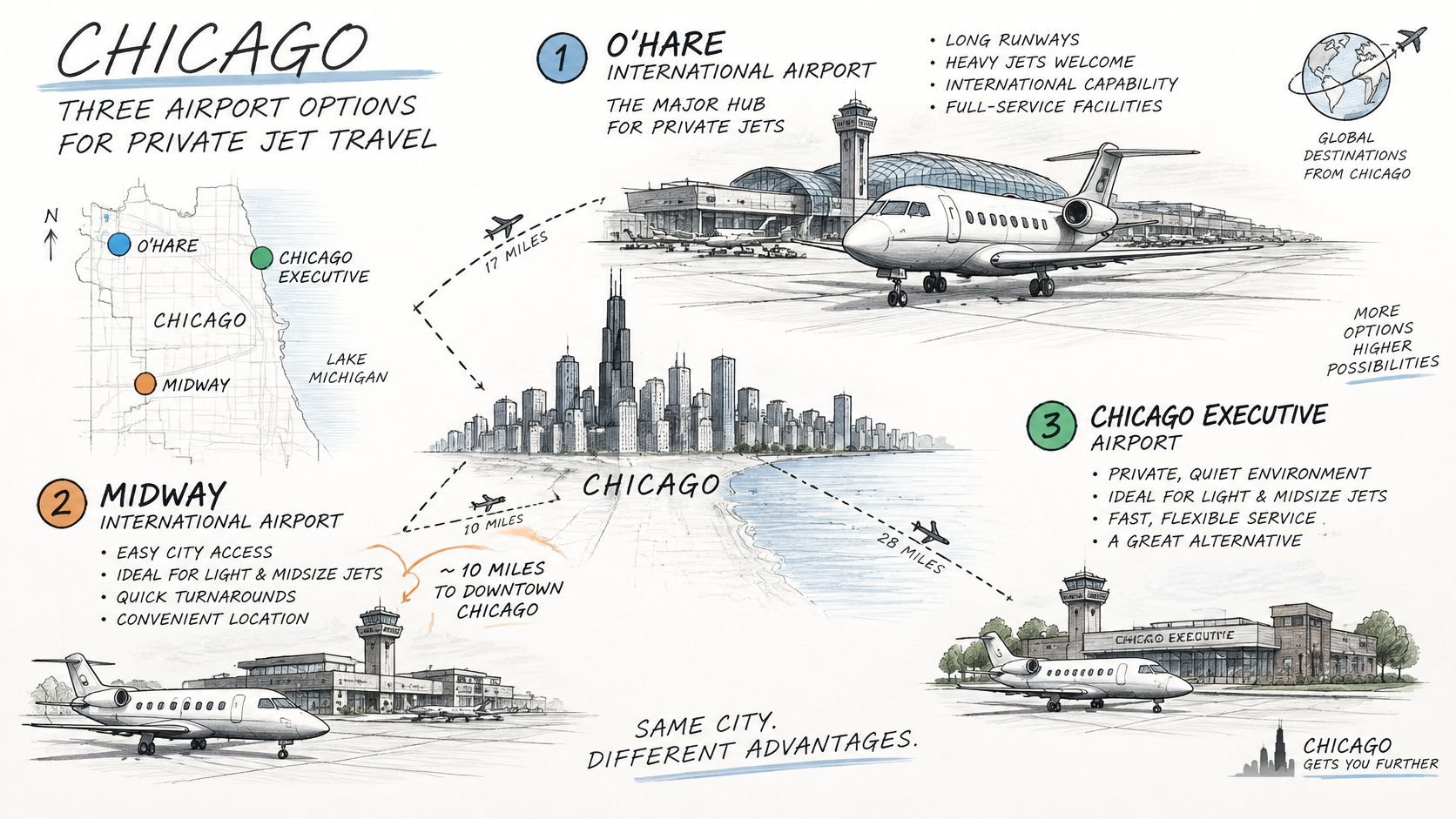
A private jet removes the airline terminal experience. The airspace around a congested hub remains. Airline traffic and capacity limits at O'Hare still influence when your wheels leave the ground, so a private departure from a major hub carries no guarantee of immediate takeoff. The sharper question is which airport produces the shortest complete journey for your passengers, from actual address to actual destination.
Treat the comparison below as a shortlist rather than a ranking.
Chicago airports for private charter missions
Airport | Location | Best for | Watch for |
|---|---|---|---|
Chicago O'Hare (ORD) | Northwest side, major airline hub | Heavy-jet and international missions requiring confirmed customs arrangements | Airline-hub congestion and ground access |
Chicago Midway (MDW) | Southwest side | Light and midsize missions where city access works | Confirm runway suitability, handling and road conditions |
Chicago Executive (PWK) | North of O'Hare | Business missions seeking an alternative to the main hub | Check the final road transfer and aircraft performance |
DuPage (DPA) | West of O'Hare | General and business aviation, particularly western-suburban itineraries | Class D airspace beneath Class B |
Chicago Executive functions as a dedicated reliever for business aviation, as described in the FAA's Chicago Executive airport context. DuPage sits approximately 16 miles west of O'Hare and operates as a general- and business-aviation reliever in Class D airspace beneath Chicago's Class B, according to the FAA's DuPage airport guidance. Both are genuine operational alternatives, and each still has to match the traveler's ground destination. Which side of the city your passengers start on often decides more than any runway statistic.
Work backward from the meeting
Take a 9 a.m. meeting in the Loop followed by an outbound flight. Compare a PWK departure against an ORD departure using a hypothetical 60-minute ORD drive, then add the handling facility's required arrival allowance and a road buffer. Run the same math for Midway before assuming the reliever wins, because a departure-time-specific road estimate can flip the answer by an hour or more.
The relevant clock starts when the meeting finishes, not when the aircraft leaves the runway. A shorter taxi or easier boarding process will not recover a badly chosen ground transfer.
For a visual companion to the airport comparison, use the video below.
Before choosing the airport, settle these questions:
- Total journey: Which option gets passengers between their actual addresses fastest?
- Aircraft suitability: Can the proposed aircraft use the runway under the expected conditions?
- International processing: Are customs arrangements available and confirmed for the itinerary?
- Ground handoff: Which private terminal or fixed-base operator, known as an FBO, will the driver use?
What Drives the Final Price of a Charter
Hourly rate multiplied by billable flight time is the starting calculation, not necessarily the final invoice. A low hourly figure can produce the more expensive trip when the aircraft must reposition before pickup or remain away from its base.
For a Chicago-to-Atlanta comparison, ask whether the quoted aircraft is already available near Chicago. A locally positioned aircraft with a higher hourly rate may cost less overall than a cheaper aircraft arriving empty from another city. The useful comparison is the complete itinerary price under matching assumptions.
Read the cost lines separately
Request a breakdown that identifies:
- Occupied flying: The passenger-carrying legs and the billing basis.
- Positioning: Empty flights needed to reach pickup or complete the aircraft's schedule.
- Airport charges: Landing, ramp and handling costs at the selected airports.
- Crew stays: Overnight accommodation and related away-from-base charges.
- Winter treatment: Whether de-icing is included, estimated or charged after use.
- Passenger services: Catering, requested bar stock and ground transfers.
For a worked comparison without misleading market-rate assumptions, call the occupied-flight subtotal A. Add positioning B, crew overnight costs C, and airport and service charges D. Compare A + B + C + D with the competing quote's complete total, not with its headline hourly figure.
Our private jet charter pricing guide provides context for that comparison. The important distinction is between an included charge, a provisional allowance and a charge that will be passed through after the flight.
A quote that leaves winter treatment unpriced isn't directly comparable with a quote that includes an explicit allowance.
Approved Jets quotes are estimates only and can change with aircraft availability, fuel costs, positioning, landing fees, overnight charges, de-icing, catering and ground transportation. Before paying, confirm the aircraft, dates, inclusions, cancellation terms, substitution provisions and treatment of variable charges in writing.
Don't negotiate away the airport that makes the itinerary work just to reduce a visible fee. A lower invoice is poor value if the party loses the time the charter was meant to protect.
Vetting the Operator Behind Your Quote
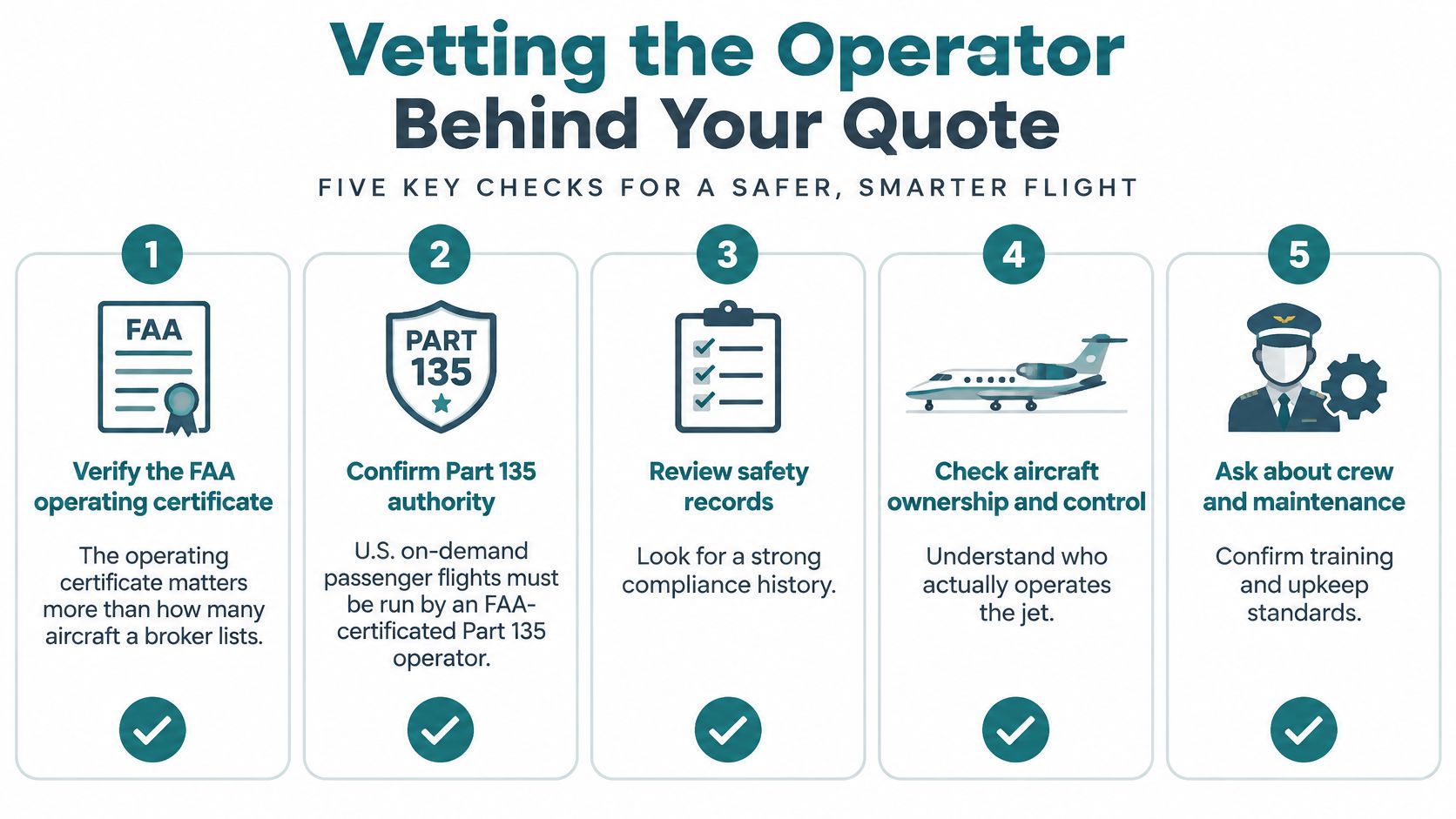
The operating certificate matters more than the number of aircraft a broker advertises. A broker arranges the flight; the operating carrier exercises operational control. Under the FAA's safe charter guidance, U.S. on-demand passenger charter requires an appropriately certificated Part 135 operator, and a private pilot cannot act as pilot in command for hire.
Approved Jets is an Air Charter Broker under DOT Regulations, operating under Part 295. We operate exclusively as a charter broker and do not own, operate, lease or maintain aircraft. Our aircraft charter brokerage explanation helps distinguish that arranging role from the carrier's responsibilities.
Use the following visual as a screening reminder, then request the underlying details.
Verify the carrier and the aircraft
Start with the carrier's legal name and certificate details. Then match the proposed aircraft registration to the documentation for that flight. Aircraft ownership alone doesn't tell you who dispatches it, approves the crew or makes the weather decision.
The FAA guidance also addresses aircraft conformity, airworthiness, required equipment and maintenance accountability, including records for time- and cycle-limited components. A passenger doesn't need to conduct a maintenance audit, but the carrier should provide a credible explanation of its compliance and respond to documentation questions.
Ask how any aircraft substitution will be communicated. A replacement can change baggage capacity, onboard equipment and the identity of the operating carrier, even if the cabin category sounds equivalent.
Use ratings as another check
Argus Platinum and Wyvern Wingman are third-party safety credentials used to assess operators against their respective program standards. Request current evidence, confirm which operating entity it covers, and clarify its scope rather than treating a logo as a blanket guarantee.
Neither rating replaces the operating certificate or aircraft-specific checks. For medical transport, sensitive cargo or an unusual itinerary, verify the mission-specific authorization as well.
Send this checklist with the acceptance email:
- Carrier identity: Provide the operating carrier's legal name and certificate details.
- Operational control: Confirm which carrier controls dispatch, crew and safety decisions.
- Aircraft identity: Provide the registration and confirmation of authorization for this operation.
- Airworthiness and maintenance: Confirm current status and compliance with the applicable maintenance program.
- Crew arrangement: Identify the planned crew arrangement and relevant qualifications.
- Third-party credentials: Provide current rating evidence where represented.
- Substitutions: Explain how changes will be disclosed before departure.
A professional response should identify the responsible carrier clearly. An attractive cabin photograph isn't an answer to an operational-control question.
How to Book and Prepare Your Chicago Charter
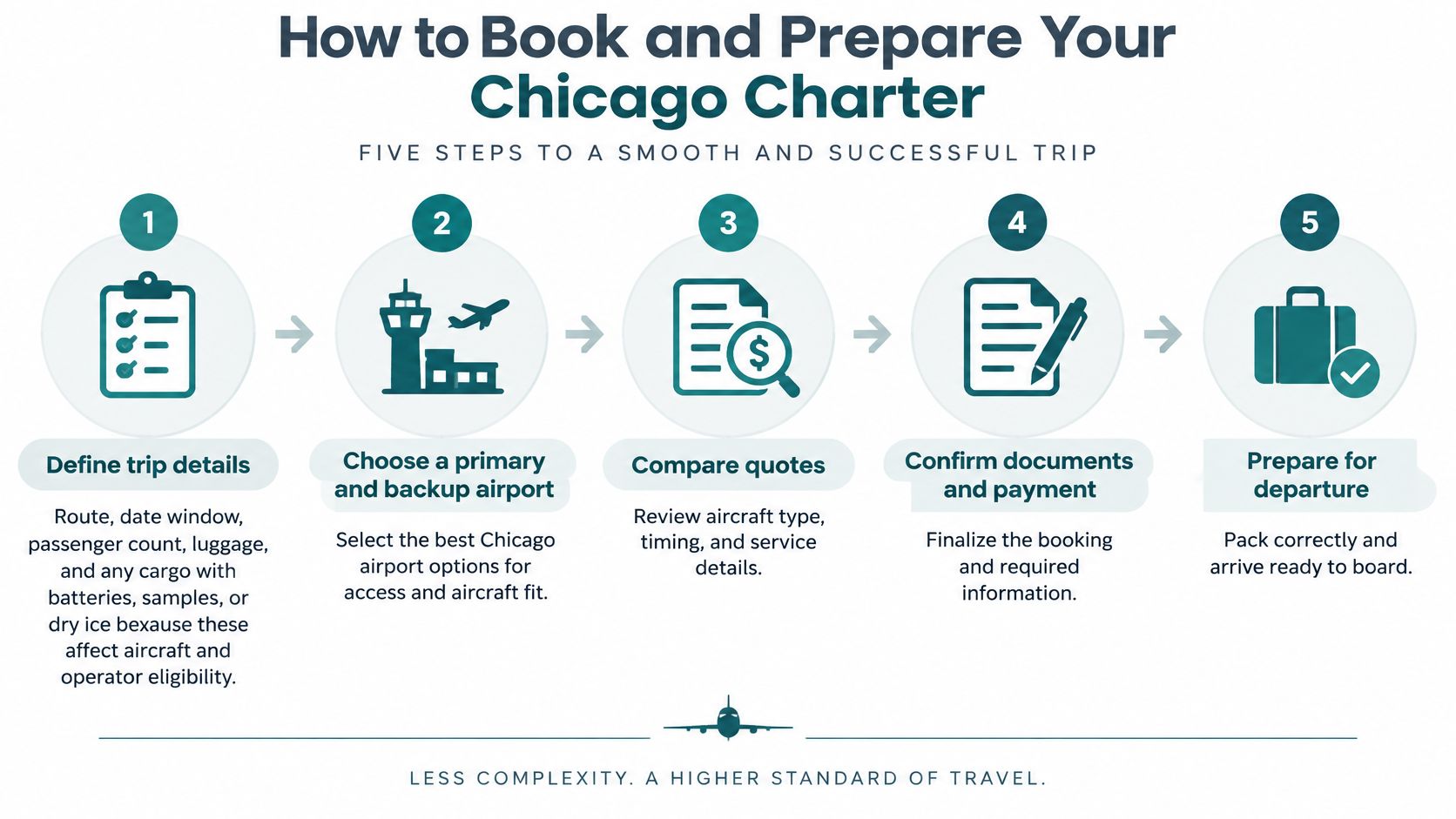
Build the booking around complete information rather than the fastest possible acceptance. The details that seem minor at inquiry stage, such as a battery-powered equipment case or an oversized bag, can determine which aircraft remains eligible.
- Define the mission completely. Send the route, date window, passenger count, luggage dimensions and any pets or unusual cargo. The common slip is describing production cases or medical samples as ordinary bags without explaining their contents.
- Choose a primary and backup airport. Use the passengers' starting and finishing addresses, then have the operator assess aircraft suitability at both ends. The mistake is choosing a familiar airport code before checking the destination runway or final transfer.
- Compare matching proposals. Request competing quotes for the same dates, passenger load, airport assumptions and aircraft category, with a line-item breakdown. A cheaper proposal isn't equivalent if it excludes positioning or uses a less suitable airport.
- Verify before accepting. Resolve the operating-carrier identity, aircraft documentation, payment terms and change provisions before committing. Don't let an urgent schedule turn an unanswered compliance question into an assumption.
- Confirm the ground handoffs. We coordinate ground transport, catering, security and special requests, so send the destination address and service needs with the flight details. The frequent avoidable error is giving a driver the airline terminal instead of the assigned FBO.
- Submit the manifest and cargo information early. Follow the operator's document deadline, and make advance submission the default rather than a departure-day task. Incomplete names, missing travel documents or vague cargo descriptions can prevent the carrier from finishing its checks.
- Follow the flight-specific arrival instructions. Have identification and required paperwork ready, and use the confirmed private-terminal address. Don't assume every domestic, international, group or medical departure uses the same arrival allowance.
The process is easier to manage when each handoff has a named owner.
Declare unusual items before aircraft selection
The FAA's Part 135 hazardous-materials guidance explains that operators need an approved hazardous-materials training program even when they don't intend to carry dangerous goods. Operators accepting those materials have additional handling, documentation and transport responsibilities.
For batteries, dry ice or biological samples, send the precise item description, quantity, dimensions, weight and relevant technical information. Include any chain-of-custody requirements. The carrier must classify the shipment and determine whether its authorizations and the selected aircraft support the movement.
Preparation rule: Disclose the item first. Let the operator determine whether it is baggage, regulated cargo or hazardous material.
Matching the Charter to Your Trip Type
Chicago charter setups by trip type
Trip type | Aircraft to start with | Airport to test first | Check before booking |
|---|---|---|---|
Single executive day trip | Light or midsize jet | Chicago Executive or Midway | Door-to-door time against the airline schedule |
Team with substantial luggage | Super midsize or heavy jet | O'Hare or Midway | Baggage capacity and loading dimensions |
Large group | Airliner or suitable group configuration | O'Hare | Handling access and ground transfers |
Medical evacuation | Medically equipped jet | O'Hare or Midway | Crew and equipment authorization |
Cargo with batteries or samples | Cargo-compatible midsize or heavy aircraft | Airport with suitable cargo handling | Classification and paperwork |
These are starting points for evaluation, not airport or aircraft approvals. The best setup changes when you introduce a patient's needs, unusually large cases, a remote destination or a tightly constrained arrival time.
Executive and team itineraries
More than half of business-aircraft passengers said their schedules couldn't be met efficiently using commercial airlines, according to the NBAA Business Aviation Fact Book. The publication describes how business aviation can support same-day returns and multiple stops, including destinations without commercial service. That is the useful productivity argument, rather than a claim that every private flight saves time.
For an executive visiting smaller-market facilities, test the whole sequence of meetings against destination-airport access and crew availability. A workable outbound flight is insufficient if the final meeting pushes the return beyond the approved operating plan.
For a team traveling with presentation equipment, ask for baggage-door dimensions and storage confirmation. Comfortable seating doesn't establish that the cases will load.
Group and specialist movements
Large-group planning needs a coordinated boarding location, baggage plan and vehicle plan. If passengers arrive at separate terminals or the ground convoy isn't ready, an efficient flight can still produce a disorganized arrival.
Medical evacuation starts with the patient's clinical requirements, medical team and approved equipment. Cabin luxury is secondary to whether the transport team and aircraft can support the patient throughout the mission.
For batteries or samples, the shipment's classification can eliminate aircraft or operators before price becomes meaningful. Don't select an attractive passenger aircraft and try to solve cargo acceptance afterward.
If corporate procurement also requires an emissions estimate, request an itinerary-level method that identifies aircraft, routing, passenger load and repositioning. A 2025 private and business aviation lifecycle study found that the operational flight phase dominates lifecycle emissions, making those operating choices more informative than a broad sustainability label.
Start with the trip type, not the cheapest jet. Identify the requirement most likely to block the mission and resolve it before refining the cabin choice.
Confirm the Operator and Airport Before You Book
Book only when the carrier, aircraft and airport plan all support the same itinerary. The final decision should establish that the carrier holds the required authority, the aircraft is authorized and suitable for the load, and the airport choice works for the actual ground journey.
Private flying can remove dependence on fixed airline departures and avoid some terminal processes. It doesn't remove air-traffic constraints, winter weather or the road between the airport and your destination. A credible proposal should preserve room for those realities rather than promise uninterrupted movement.
Make the proposal decision-ready
Use the Get a Quote button or contact our flight advisors to request a personalized proposal. We receive and process the travel requirements, source aircraft and operators through our network, and present charter options, pricing and itinerary details. Include the operator-document request at the beginning so it isn't left until payment.
We use aircraft and crews that meet or exceed FAA Part 135 regulations, prioritizing operators with Argus Platinum and Wyvern Wingman third-party safety ratings. Approved Jets remains the broker, so verify the actual carrier named for your flight rather than assuming the arranging company operates the aircraft.
Send a compact request that contains:
- Journey: Departure and destination addresses, preferred airports and acceptable alternatives.
- Timing: Travel dates, flexibility, meeting deadlines and required return.
- Load: Passenger count, luggage dimensions, pets and unusual items.
- Proposal: Aircraft registration, operating-carrier details and complete price assumptions.
- Conditions: Variable charges, cancellation terms and substitution arrangements.
- Arrival: Ground transfer, customs, security and special-assistance needs.
The best proposal is the one you can evaluate without filling gaps yourself. If the lower-priced option requires an inconvenient airport, uncertain baggage fit or unresolved operating details, it hasn't yet earned the booking.
Approved Jets arranges Chicago charter options and coordinates the ground transfers, catering and itinerary details that make the flight useful. Visit Approved Jets to request a personalized proposal, and include your destination address, passenger and luggage details, preferred timing and a request for the operating carrier's certificate information.