Private Jet Catering: Menus, Safety, Timing and Costs
Private jet catering explained: typical menus by flight length, allergy handling, cold-chain timing, safety rules and cost drivers for trip planners.
13 min read
You've confirmed the passenger list, the departure time has shifted, and someone has just asked whether lunch can come from their favorite restaurant. Before approving the menu, there's a more important question: where will that food stay cold between the kitchen and the aircraft?
Private jet catering is a safety and logistics task before it's a menu choice. A well-prepared meal can still fail at the FBO handoff, inside an undersized refrigerator, or during a ground delay. Good coordination connects the kitchen, ground handler and crew so passengers receive food that's safe, practical to serve and worth eating.
Table of Contents
- Typical Private Jet Menus by Flight Length and Aircraft
- Match the meal to the usable equipment
- Give the caterer dimensions, not assumptions
- How Meals Reach the Cabin Safely and On Time
- Control temperature through every transfer
- Separate cooking benchmarks from hot holding
- Allergy, Dietary and Religious Meals Handled Safely
- Use a documented preflight protocol
- Reverify international orders
- Aviation Rules That Govern Onboard Food
- Convert the rule into operator decisions
- Know who controls the aircraft
- What Drives Private Jet Catering Costs and Waste
- Forecast consumption before adding extras
- Read market estimates cautiously
- Plan and Confirm Your Catering Before Booking
- Work backward from departure
- Treat the return as its own order
Typical Private Jet Menus by Flight Length and Aircraft
Private jet catering is food ordered for a specific flight, prepared by a caterer near the departure airport and delivered to the fixed-base operator, or FBO, before boarding. Flight length, the aircraft's galley and passenger needs determine the menu.
Typical menus by flight length and aircraft class
These are planning formats, not guarantees of equipment or service on a particular aircraft.
Flight length | Light jet | Midsize and super midsize | Heavy jet |
|---|---|---|---|
Under 2 hours | Cold entrée, portioned sides, fruit, sealed drinks | Cold entrée or light reheat, snacks, sealed drinks | Snacks and a plated meal with galley reheating |
2 to 5 hours | Pre-chilled meal with sealed sides, no oven-dependent dishes | Plated lunch or dinner with galley reheating | Multi-course hot service with dessert |
Over 5 hours | Limited pre-chilled meals in insulated stowage | Full meal service, breakfast or dinner option, bar snacks | Multi-course hot service, chef-prepared dishes, full bar |
Typical galley | Small or no oven, limited refrigerator | Small oven or microwave and refrigerator | Full galley with oven, refrigerator and room for trays |
Match the meal to the usable equipment
For a hypothetical 90-minute light-jet hop with four passengers, a cold entrée, individual sides, fruit and sealed drinks make a practical starting order. A chilled chicken salad with dressing packed separately avoids an oven requirement and reduces the handling needed in a cramped cabin. Cold food still needs controlled storage, not just a convenient shelf.
For a hypothetical midsize flight lasting between two and five hours, a plated lunch can work if the actual galley supports reheating. Uniform portions of braised meat or a vegetable entrée are easier to handle than a large shared casserole. A model overview, such as the Bombardier Challenger 350 guide, helps with aircraft selection, but the assigned aircraft's equipment determines the final order.
On a hypothetical six-hour heavy-jet crossing, a multi-course hot meal with dessert may be feasible. That doesn't mean the crew can prepare every course simultaneously. Storage space, oven capacity, plating surfaces and available cabin-service personnel still shape the sequence.
Give the caterer dimensions, not assumptions
Aerospace Global News' private-jet catering overview identifies the equipment information caterers need: usable oven or microwave dimensions, approved containers, refrigerator capacity, and trolley or drawer constraints.
A dish fitting through the cabin door doesn't mean it fits the galley. Oversized platters can block storage, and deep containers may prevent the crew from closing an oven properly. Ask for individual oven-compatible portions, secure lids and separate sauces where appropriate.
The operator has final authority over what can be accepted and served. Send the tail number and galley specifications to the caterer before choosing any dish.
How Meals Reach the Cabin Safely and On Time
A meal can leave the kitchen at a safe temperature and arrive at the cabin outside its safe holding window. The risk sits in the handoffs: cooking and chilling, delivery to the FBO, waiting for the aircraft, then loading and service. The Airline Catering Association's back-catering guidance says delivery commonly happens two to four hours before departure, when refrigeration at the FBO or aircraft may be limited.
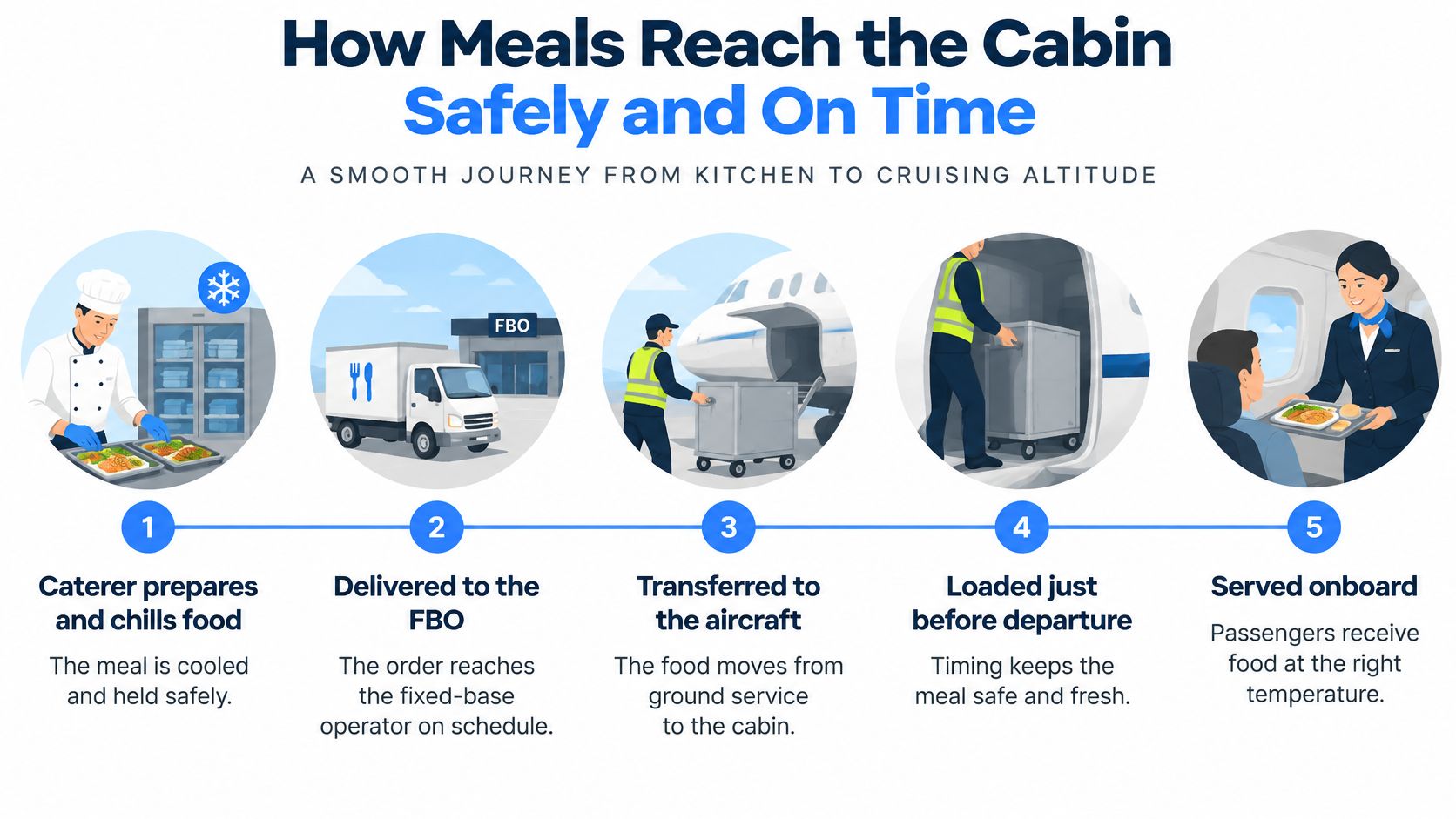
Control temperature through every transfer
USDA food-safety guidance identifies 40°F to 140°F, or 4.4°C to 60°C, as the danger zone, where bacteria can double in as little as 20 minutes. Keep cold perishables at or below 40°F and hot food at or above 140°F. If neither temperature can be maintained, limit exposure to two hours, or one hour above 90°F ambient temperature.
For a hypothetical 10:00 a.m. departure, delivery between 6:00 and 8:00 a.m. works only if confirmed cold storage covers the wait. Record the temperature when food leaves the kitchen, reaches the FBO and is transferred to the aircraft. Magellan Jets' catering guidance describes cook-chill preparation and temperature monitoring across these handoffs.
Handoff timeline and temperature controls
Stage | Timing | Temperature control | Failure point |
|---|---|---|---|
Kitchen chill | After cooking, before delivery | At or below 40°F (4.4°C) | Food held at room temperature before chilling |
FBO delivery | Two to four hours before departure | At or below 40°F for cold items | Ramp delay uses up the holding window |
Loading and stowage | Time-stamped dispatch at pickup and loading | Temperature check recorded at each handoff | Food left unchilled or uncovered in the cabin |
Onboard reheating | Before service | Hot holding at or above 140°F; preparation benchmarks below | Uneven heating in compact ovens |
Holding limit | When neither control can be held | Two hours maximum, or one hour above 90°F ambient | Food past the limit must be discarded |
Separate cooking benchmarks from hot holding
USDA's cooking guidance specifies minimum internal preparation temperatures of 165°F for poultry, 160°F for ground meat, and 145°F for whole cuts followed by a three-minute rest. Those cooking temperatures are different from hot holding and do not provide a universal reheating instruction.
Compact aircraft ovens may heat dense dishes unevenly. Ask the caterer for uniform portions, sauces that resist drying and containers approved for the aircraft. The operator should confirm reheating instructions and thermometer use. A browned surface does not show that the center is hot enough.
Booking with 24 to 48 hours of notice gives Approved Jets clients the widest aircraft selection and more room for specific catering or logistical requests. Accurate timing helps prevent food waiting without refrigeration, while confirming the aircraft's galley and the FBO handoff reduces the chance of a meal arriving late or unusable. For a separate passenger comfort checklist, HYDAWAY's guide to packable essentials for your in-flight comfort zone covers items to bring aboard.
Practical rule: A delay requires a holding decision, not just a revised delivery text. Food can look acceptable after its safe handling window has expired.
Allergy, Dietary and Religious Meals Handled Safely
A peanut-free label isn't an allergen-control protocol. Gluten-free, vegan, kosher and keto describe different requirements, and none tells the crew how ingredients were sourced, utensils were separated or substitutions were approved.
A useful example comes from dnata's sports-team catering operation, which uses peanut-free facilities, segregates 14 other allergens and substitutes almond butter where appropriate. Almond is itself a major allergen. Replacing an ingredient safely for one passenger can create a problem for another.
Use a documented preflight protocol
- Collect medical requirements. Record the actual allergy and its severity separately from dislikes, fitness preferences and general dietary choices.
- Establish cross-contact controls. Request complete ingredients and facility disclosures, including shared preparation areas and equipment.
- Protect the identified meal. Confirm sealed handling and passenger-specific labeling through transport and loading.
- Brief the crew and traveler. Make sure both understand the verified meal, any limitations and the approved service arrangement.
- Agree a fallback. If the caterer can't verify the requested dish, substitute a verified option or remove it.
For initial menu ideas, Gym Snack's guide can help travelers find foods without the top nine allergens. It's an idea resource, not evidence that a particular caterer's version is suitable.
Dietary requirements and what to verify before boarding
Requirement | What to request | Verify before boarding | Fallback if unverified |
|---|---|---|---|
Medical allergy, including nuts, shellfish or sesame | Full ingredient list and facility disclosure | Caterer confirms cross-contact controls in writing | Substitute a verified cold item or remove the dish |
Celiac disease or gluten-related disorder | Certified gluten-free sourcing and sealed packaging | Label check at handoff and crew briefing | Pre-packed certified item from a dedicated supplier |
Religious diet, including kosher or halal | Certified supplier and documentation | Certificate on file and separate transport | Certified packaged meal if the caterer cannot verify |
Vegan or vegetarian preference | Recipe list excluding animal-derived ingredients as applicable, including sauces and stocks | Traveler signs off on the menu | Plant-based cold dish from a verified list |
Infant or child meal | Age-appropriate portions and reheating limits | Temperature check at handoff | Pre-sealed, age-appropriate ready-to-serve item |
Reverify international orders
Ingredient names, labeling rules and supplier capabilities differ across countries. Treat a replacement caterer on a later leg as a new verification task, not an extension of the original approval.
Religious meals also need the appropriate certification on file and separate transport arrangements consistent with the traveler's requirements. Don't open certified packaging merely to improve presentation without prior agreement.
An expansive menu isn't safer than a short one. A smaller set of verified meals beats unlimited customization without traceability.
Aviation Rules That Govern Onboard Food
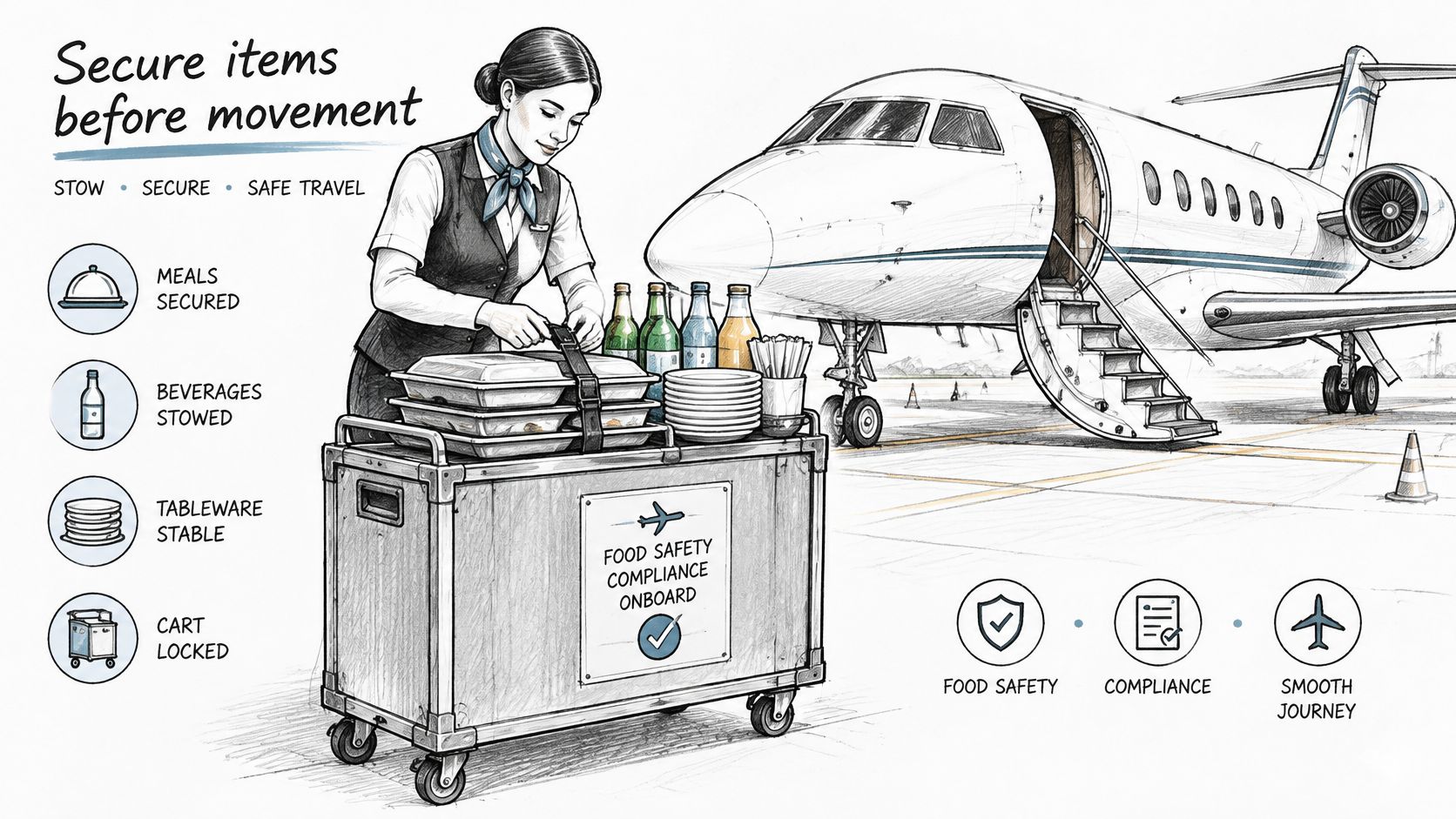
In the United States, 14 CFR §135.122 requires applicable operators to secure food, beverages, tableware and serving equipment during surface movement, takeoff and landing. Food and tableware can't remain at passenger seats during those phases, and trays, tray tables and service carts must be stowed; the parallel commercial requirement appears under 14 CFR §121.577.
Securing the service equipment is part of preparing the cabin, not an optional presentation choice.
Convert the rule into operator decisions
Small cabins, movable tables and limited galley space make secure stowage especially important. A beautifully arranged platter is unsuitable if the crew has nowhere to restrain it before taxi.
- Confirm service timing. Coordinate delivery early enough for acceptance and stowage, rather than asking the crew to solve a late order during departure preparation.
- Specify secure packaging. Use containers that fit approved storage and remain closed during handling.
- Obtain written acceptance. Have the operator approve the catering arrangement, including equipment and service limitations.
- Declare cooling materials. If a supplier proposes dry ice, obtain prior operator clearance because it's treated as dangerous goods onboard aircraft.
We use aircraft and crews that meet or exceed FAA Part 135 regulations, prioritizing operators with Argus Platinum and Wyvern Wingman third-party safety ratings. Those credentials don't replace approval of the particular catering plan.
The video below provides an additional visual reference alongside the operator-specific briefing.
Know who controls the aircraft
We're a broker, not a carrier. We facilitate coordination, but the applicable operator controls aircraft safety and crew procedures. Claims concerning air transportation, aircraft safety, crew conduct, baggage handling or the onboard experience must be directed to that operator.
Before booking, put these questions to the trip team:
- Operator identity: Who is the operator of record?
- Written approval: Will that operator confirm the catering plan in writing?
- Aircraft limits: Which galley and refrigeration limits apply to this tail number?
These questions establish accountability before the food reaches the ramp.
What Drives Private Jet Catering Costs and Waste
An accurately forecast order can prevent waste before packaging enters the picture. If six passengers are booked but only two expect to eat, ordering six full hot meals may mean paying for food that returns untouched. Confirm likely appetite and meal timing before adding extras.
Airbus' cabin-food-waste overview estimates global airline cabin and catering waste at 3.6 million tonnes annually, based on 2024 to 2025 data, with roughly 18 to 20 percent consisting of untouched food. That is an airline-wide estimate, not a private-jet waste rate.
Forecast consumption before adding extras
Separate untouched food, opened food and waste subject to destination rules, then confirm how each category will be handled. Destination rules can restrict disposal or reuse of catering waste, so check requirements before departure. An unopened meal may still be subject to restrictions on leaving the airport.
Cost drivers and how to control them
Cost driver | How it raises the bill | Control measure |
|---|---|---|
Passenger count versus uptake | A full cabin order is paid for even when few guests eat | Forecast quantities from confirmed headcount and intended consumption |
Customization and sourcing | Certified allergen or religious dishes need separate suppliers and handling | Limit custom items to documented needs |
Flight duration and service style | Longer flights can require more meals and hot-service resources | Match service style to leg length |
Delivery location and lead time | Remote FBOs and late orders can add courier, storage and rush charges | Order early, ideally 24 to 48 hours ahead |
Untouched and regulated waste | Unused food is paid for and may require restricted disposal at the destination | Track waste per trip and adjust the next order |
Delays and cold-chain holds | Extended ground time can make a meal unsuitable to serve | Agree on a discard decision before dispatch |
These effects are directional, not per-meal price benchmarks. For the wider flight budget, consult the private jet charter pricing guide and keep catering separately itemized.
Read market estimates cautiously
DataIntelo estimates the private jet catering market at USD 1.42 billion in 2024. The firm separately estimates charter and private aircraft at approximately 8.8 percent of airline catering logistics in 2025 and private jets at approximately 20.3 percent of zero-waste in-flight catering in 2025, in its logistics report and zero-waste report.
MarketIntelo estimates the market at approximately USD 1.2 billion in 2025. It also reports charter activity rising from about 910,000 flight hours in 2020 to 1.3 million in 2025, roughly 43 percent. These market valuations are separate commercial estimates, not a consistent annual series.
For travel managers, a practical measure is what passengers expect to consume compared with what returns untouched. Accurate forecasts reduce excess orders at the source, while packaging choices address only what happens to the food and container afterward.
Plan and Confirm Your Catering Before Booking
Choose the aircraft and leg length first, dietary requirements second, delivery timing third and extras last. Reversing that order can leave you with an approved restaurant order that the aircraft can't store or reheat.
Our guide to chartering a private jet explains the broader booking process. We coordinate ground transport, catering, security and special requests as part of managing the complete journey.
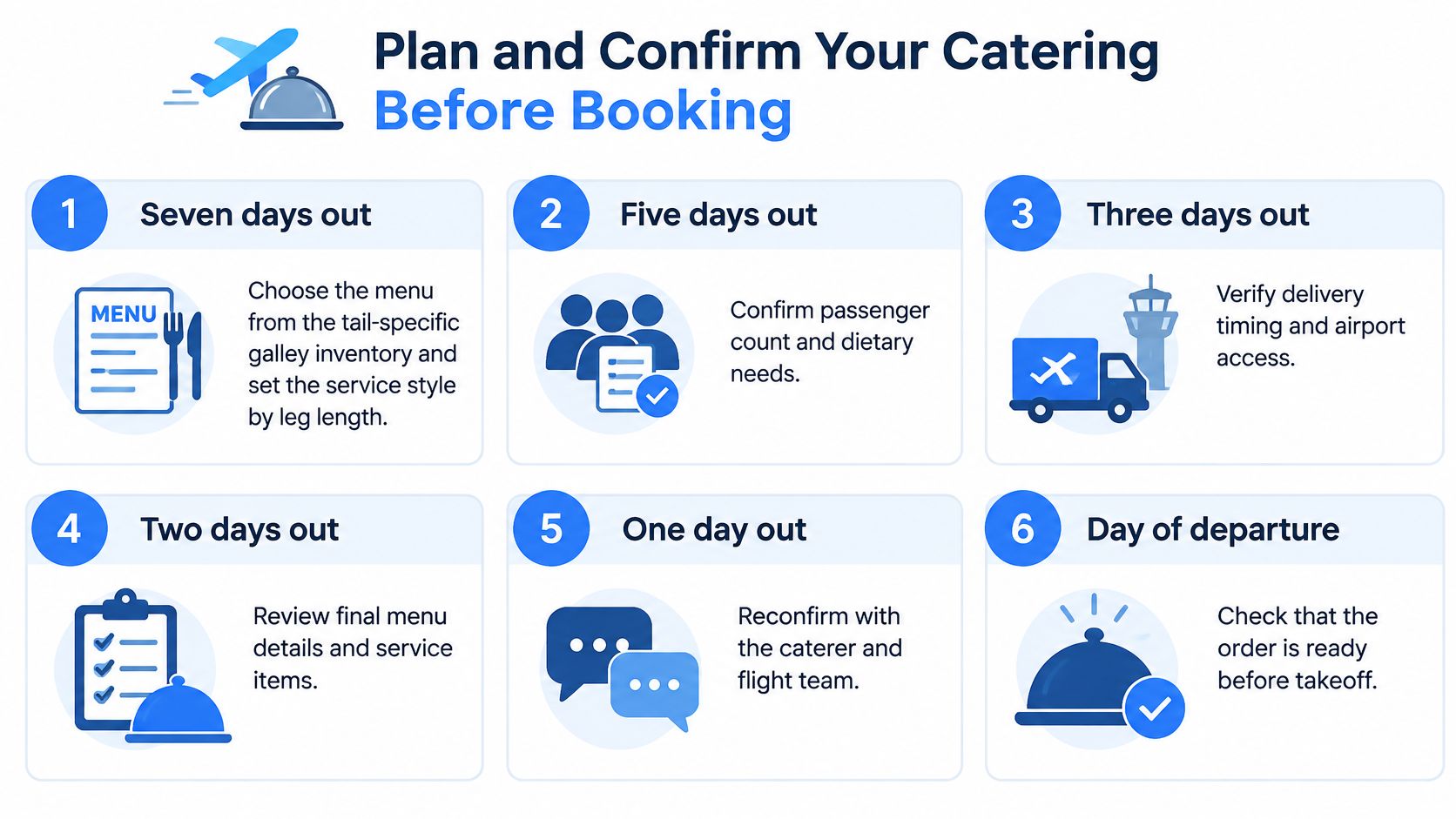
Work backward from departure
Use this as a suggested planning schedule, not a claim that every trip requires a week's notice. Urgent trips need the same decisions compressed into the available time.
- Seven days out, establish the service plan. Choose dishes from the tail-specific galley inventory and set the service style for each leg. If the tail hasn't been assigned, keep the menu provisional.
- Forty-eight to 24 hours out, lock the catering brief. Confirm headcount, medical allergy severity and required certificates. Name the delivery FBO, receiving contact and delivery window.
- The day before, verify the holding arrangement. Confirm refrigerated storage at the FBO and agree a delay plan for every departure point. Identify who can authorize replacement or cancellation.
- On departure day, complete acceptance. Brief the crew, match labels to the passenger requirement list and confirm the operator's written catering plan before loading. Resolve unexplained substitutions on the ground.
- In flight, follow the agreed service sequence. Time meals for cruise when the crew permits service. Track remaining service supplies for the return without treating outbound perishables as the return meal plan.
- After landing, close the record. Log untouched and opened food, document regulated-waste handling and send the results to the travel manager.
The planning checklist below offers an earlier-start version of the same preparation, useful when passenger details are available well ahead.
Treat the return as its own order
Consider a hypothetical six-person executive offsite, departing at 9:00 a.m. on a midsize jet and returning at 4:00 p.m. The outbound might need a light breakfast, while the return order reflects who is traveling and whether they've eaten at the meeting.
Book the return delivery window separately and arrange a fresh order. Don't make leftovers the contingency plan. If a passenger leaves the group or the meeting runs late, update the return caterer and receiving FBO rather than only changing the flight manifest.
For a Dubai itinerary with a ground reception, IFM Gourmet Food Store's resource can help you compare Dubai high tea catering prices. Keep that hospitality budget separate from aircraft catering, which needs its own packaging, transport and operator acceptance.
For Midsize, Super Midsize and Heavy jets, we can arrange VIP catering on request, including custom hot meals from a customer's favorite restaurants. Restaurant preference remains subject to the practical acceptance and handling decisions for the assigned aircraft.
Booking decision: If allergies, a tight timeline or multiple legs materially affect the trip, get the catering plan confirmed in writing before confirming the aircraft.
A useful confirmation names the receiving party, identifies the approved meals and explains what happens when something changes. That's more valuable than a menu approval alone.
We coordinate private jet catering alongside aircraft selection, ground transport, security and special requests, with the meal plan matched to your itinerary. Visit Approved Jets and contact our flight advisors or use the Get a Quote button for a personalized charter proposal, including your passenger requirements, preferred meals and departure details.