Private Aircraft Hire Explained: Costs, Aircraft and Booking
Learn how private aircraft hire works, from choosing a jet and booking a charter to pricing factors and what a charter broker does.
14 min read

Three quotes for the same trip land in your inbox on a Tuesday afternoon. Same city pair, same Thursday departure, same midsize cabin on the spec sheet, and the totals differ by $4,100.
The cheapest carries a positioning leg, a validity window measured in hours, and a line that reads "aircraft subject to crew confirmation." The most expensive names the operator, the tail number, and the cancellation terms in plain language. Between those two documents sits the price you'll pay, and the gap isn't a markup. It's the cost of the assumptions each seller left out.
Private aircraft hire is a risk document with a number attached. Read the number without the assumptions and you're comparing the wrong thing.
Table of Contents
- How Private Aircraft Hire Works Compared With Owning a Jet
- Three ways to get the aircraft
- Choosing an Aircraft by Passengers, Range and Luggage
- One trip, walked through the rows
- The 30-seat line that changes the rules
- How to Book a Private Flight From Request to Wheels-Up
- The steps from brief to wheels-up
- Who can book
- What a Charter Broker Does and How to Vet One
- What the broker actually adds
- Testing the markup assumption
- What Drives the Price of a Private Flight
- The lines inside a quote
- A worked example from New York to Miami
- When an Empty Leg Discount Is Worth the Risk
- Confirm These Details in Writing Before You Pay
How Private Aircraft Hire Works Compared With Owning a Jet
At 5:30 on a Tuesday morning, a finance director needs to be in a Chicago boardroom by 9 a.m. for a vote that closes an acquisition. The last useful airline flight lands at 11. She doesn't need a better seat or a lounge. She needs a different aircraft, on a different schedule, with her name on the manifest.
That's the first thing private aircraft hire sells: a departure time you choose rather than one an airline publishes. You aren't buying a seat on someone else's schedule. You're hiring the whole aircraft for the trip, the way you'd take a taxi instead of waiting for a bus that stops in four cities.

Three ways to get the aircraft
Full ownership puts every fixed cost on you: the capital, crew salaries, maintenance reserves, hangar, insurance, and depreciation that arrives whether or not the aircraft flies. A fractional share or a jet card trades some of that capital for a commitment, usually prepaid hours or a multi-year term, in exchange for guaranteed access. On-demand charter removes the commitment: you pay for the trip, and the operator supplies the aircraft, the crew, the maintenance program and the insurance.
Practical rule: the model that fits is the one that matches your flying pattern, not your net worth. A handful of trips a year belongs in the charter column no matter how the ownership pitch is framed.
In all three models, the flying responsibility sits with the operator. In the U.S., on-demand charter generally runs under FAA Part 135, which places the operating certificate, crew training and maintenance oversight on the operator rather than the passenger. The FAA's 2022 General Aviation and Part 135 Activity Survey is the honest way to read the market: it tracks active aircraft, total hours flown and average hours by aircraft type and primary use from 2011 through 2022, and separates air-taxi aircraft from privately operated ones. Capacity claims should survive contact with those tables, because hours flown show what the fleet did, not what was sold.
Ownership economics are their own subject. If you're weighing a purchase against charter, how much private jets cost to own lays out the fixed lines that never appear on a charter quote. And for the ground half of a charter day, private jet coordination with Hamptons Leisure Limo covers the transfer that decides whether time saved in the air survives the drive.
Three questions decide every trip: which aircraft fits the mission, how the booking runs from request to wheels-up, and what is inside the price.
Choosing an Aircraft by Passengers, Range and Luggage
Headcount and distance decide most of the shortlist before anything else matters. Luggage, cabin height and the destination's runway length then narrow what is left.
Aircraft class | Typical passengers | Typical range (nm) | Best fit |
|---|---|---|---|
Light jet | 4–7 | 1,000–1,800 | Short regional hops with few bags |
Midsize jet | 7–8 | 2,000–2,500 | Domestic and short international trips |
Super midsize jet | 8–10 | 3,000–4,000 | Coast-to-coast and Caribbean trips |
Heavy jet | 10–14 | 4,000–6,000 | Transcontinental and transatlantic flights |
Turboprop | 4–9 | 300–700 | Short trips to smaller regional airports |
Airliner charter | 100–200+ | 2,000–8,000 | Sports teams, large groups and events |
These are typical ranges for the class, and figures vary with the specific model, the fuel load and the day's weather. The same class names appear on a broker's aircraft listings, and this table is the right way to read them.
One trip, walked through the rows
Four executives, four golf bags, New York to Scottsdale. Roughly 1,700 nautical miles, and the aircraft needs more than that once alternate fuel and reserves are loaded. A light jet whose book range tops out near 1,800 nm does not make the trip with a full cabin and a full hold, whatever the brochure photo suggests. A super midsize solves range and bags together, and a heavy adds stand-up cabin height for a five-hour leg, which matters more than most first-time buyers expect.
This is also where a cheap quote gets expensive. A jet stretched to the edge of its range becomes the first schedule risk of the trip: a headwind forces a fuel stop, the fuel stop eats into the crew's legal duty day, and the afternoon ends with a delayed departure or a cancelled return. Paying for the bigger cabin up front is frequently the cheaper decision once that failure cost is priced in.
Luggage kills more shortlists than price does. Clubs, ski bags and production cases fill a hold fast, and if anyone in the party travels with mobility equipment, the acceptance rules sit with the operator rather than the broker, so flying with a mobility scooter is worth checking before the aircraft is locked in.
The 30-seat line that changes the rules
A public charter using airplanes with 30 or fewer passenger seats can qualify as an on-demand operation and must be conducted under Part 135 rules, according to the FAA's notice of intent on public charter definitions. That single threshold explains why a six-seat light jet, a 14-seat heavy jet and a 30-seat public-charter aircraft can all be sold as private travel while sitting under different operating structures. A team travelling with staff needs the passenger count, the seating configuration and the operating authority confirmed, not just a bigger cabin.
On service, midsize, super midsize and heavy jets can carry VIP catering arranged on request, including custom hot meals from a restaurant you name. Across a network of over 1,000 aircraft, that usually means several genuine options for the same mission rather than one take-it-or-leave-it airframe.
Before you approve anything, get three answers in writing from your broker: the exact seat count with bags loaded, the hold capacity in real luggage rather than litres, and the range with reserves for your date.
How to Book a Private Flight From Request to Wheels-Up
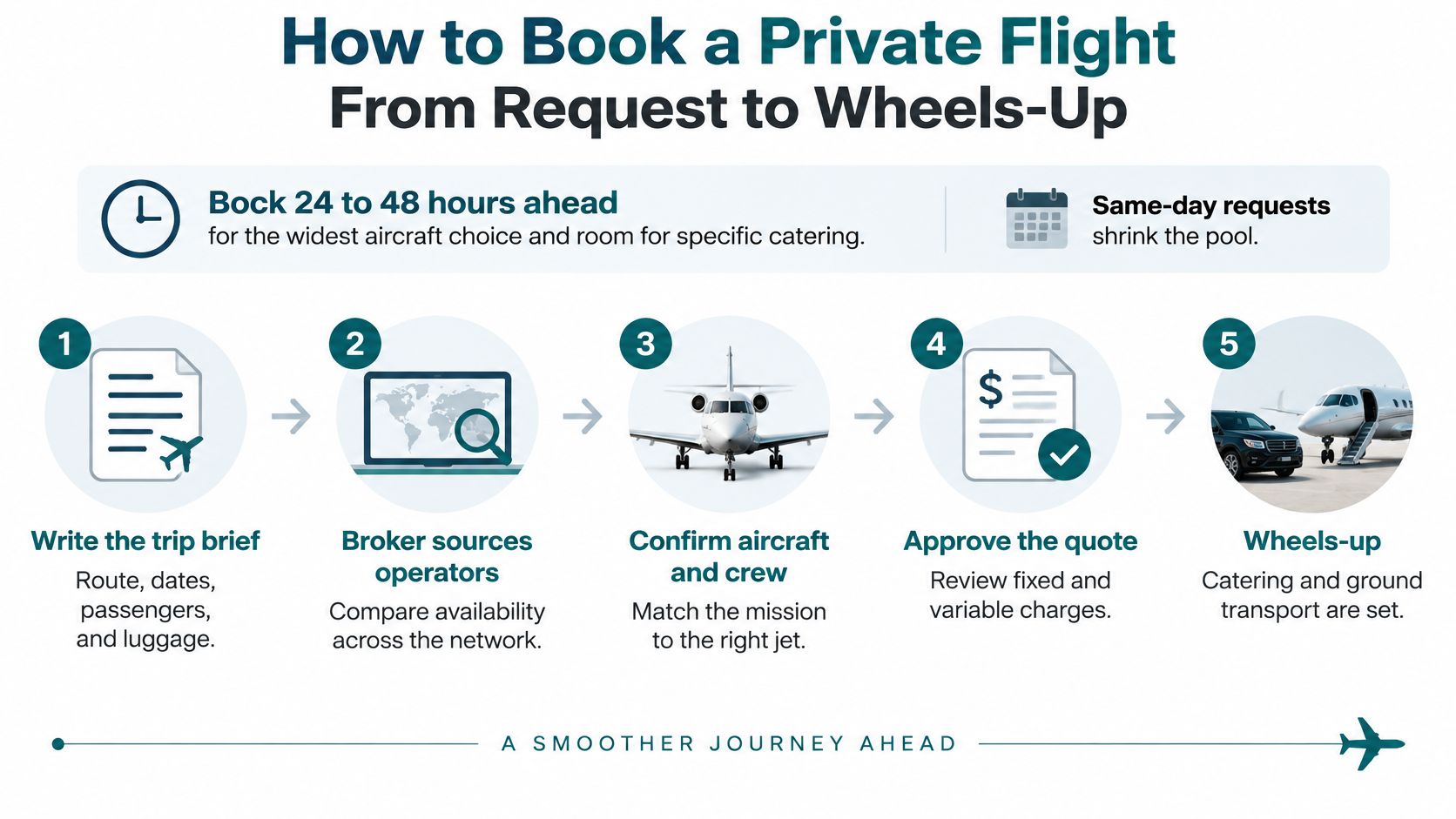
Notice period drives everything else. Booking 24 to 48 hours ahead gives the widest aircraft selection and leaves room for specific catering or logistical requests. A same-day call still moves, but the pool shrinks to whatever happens to be positioned and legally crewed that morning.
A quote at this stage is an estimate, not a price. Read it as a risk document: the cheapest-looking option can cost more once repositioning, fees and crew duty limits are counted, so the work below is about closing those gaps before money moves.
The steps from brief to wheels-up
- Write the trip brief. Passengers, bags, airports, dates, and whether your times are fixed or flexible. That last item alone changes which aircraft are viable, because a flexible return opens up one-way pricing and repositioning options.
- Request a personalised quote. Through a broker's quote form or a flight advisor, in writing. A written proposal lets you compare line against line later, which a phone number cannot do.
- Mark which figures are firm and which are estimates. Quotes can move with aircraft availability, fuel costs, positioning fees, landing fees, overnight charges, de-icing, catering and ground transportation. They are also time-stamped: a quote is valid for the period stated in it, or 48 hours from issuance if no period is stated, after which pricing and availability must be reconfirmed.
- Check the aircraft and operator pairing. Seat count and range with reserves, matched to the brief rather than to the category name.
- Confirm a crew is legally available for the whole duty day. This is the step buyers skip. Under the flight-time limits in FAA Part 135 rules, a two-pilot unscheduled operation can assign no more than 10 hours of total flight time in any moving 24-hour period, single-pilot is capped at 8 hours, and each assignment needs at least 10 consecutive hours of rest in the 24 hours before planned completion. Those limits count other commercial flying the crew has already done that day.
- Sign the booking agreement. Until it is signed, you hold a proposal rather than a reservation, and no operator has committed an aircraft to your mission. Final pricing is confirmed only when the booking agreement is executed or confirmed in writing.
- Pay through the broker's booking platform. Payment and the aircraft hold should sit in the same record, giving you one paper trail if anything is later disputed.
- Arrange ground transport, catering and security. A broker coordinates these; leaving them to the morning of the flight is how a 20-minute saving turns into a missed departure.
- Arrive at the FBO 15 to 30 minutes before departure with bags tagged and passports in hand. That margin is the whole point of the private terminal.
- Track the flight through arrival. Someone should be watching the inbound aircraft and the destination weather, not just the departure board.
The hidden constraint: FAA guidance on duty and rest treats on-call standby as duty when the crew remains under the operator's responsibility, and the required rest period must be established prospectively. An aircraft parked nearby with a crew that has already flown two legs may not be dispatchable at all. If an operator can't produce a crew-duty timeline, treat the availability claim as unconfirmed.
Who can book
Passengers must be at least 18 years old and able to form a legally binding contract, and a parent or legal guardian may book on behalf of a minor. It sounds like paperwork, but it determines whose name sits on the charter agreement when something needs changing at short notice. That name matters for a practical reason too: passenger details are passed to the operator and flight crew to fulfil the booking, and to government authorities where aviation regulations require it, so the contracting party is the point of contact for all of it.
What a Charter Broker Does and How to Vet One
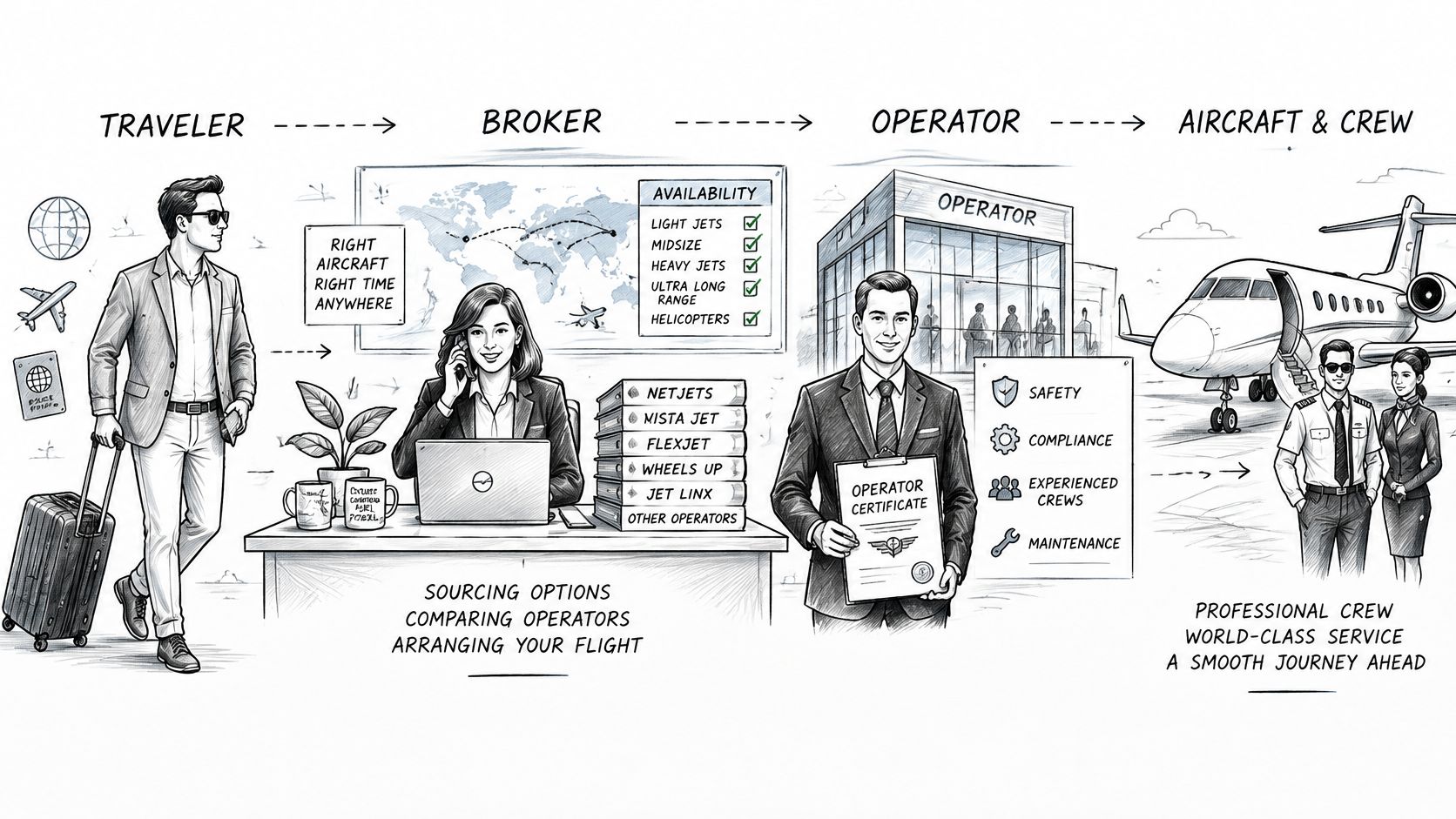
The chain runs traveller → broker → certificate-holding operator → aircraft and crew. Only one of those four links is permitted to fly the airplane. A broker arranges; the operator operates.
What the broker actually adds
Approved Jets is a private aviation brokerage and concierge that operates exclusively as a charter broker: it does not own, operate, lease or maintain any aircraft, and it is an Air Charter Broker under DOT regulations, operating under Part 295. Aircraft come from Part 135 and foreign-equivalent operators, matched to the mission.
The value isn't a phone call. It's sourcing across multiple operators in the time you'd otherwise spend on three of them, matching the airframe to the actual brief, one contact for catering and ground logistics, and one accountable party when the flight changes at 6 p.m. the night before.
Testing the markup assumption
The fair criticism is that a broker's fee has to be visible. Ask how it appears in the quote, as a separate line or inside the aircraft price, and expect a straight answer. If you want the longer version of how sourcing and fee disclosure work, aircraft charter brokerage explained goes through it.
Then move to operational control. The NTSB's review of Part 135 safety performance examined more than 500 fatal and nonfatal accidents from 2010 through 2022 and found that in 12 accidents, flight dispatch and operational-control functions were deficient because the responsible personnel weren't certificated flight dispatchers and FAA rules didn't require them to be. The agency also recommended stronger flight-data-monitoring programs.
Three questions separate a real broker from a booking page. How is this aircraft matched to my mission? Who holds operational control and makes the final go or no-go call? And how is your fee shown in this quote?
That second question is the one the accident record makes concrete.
What Drives the Price of a Private Flight
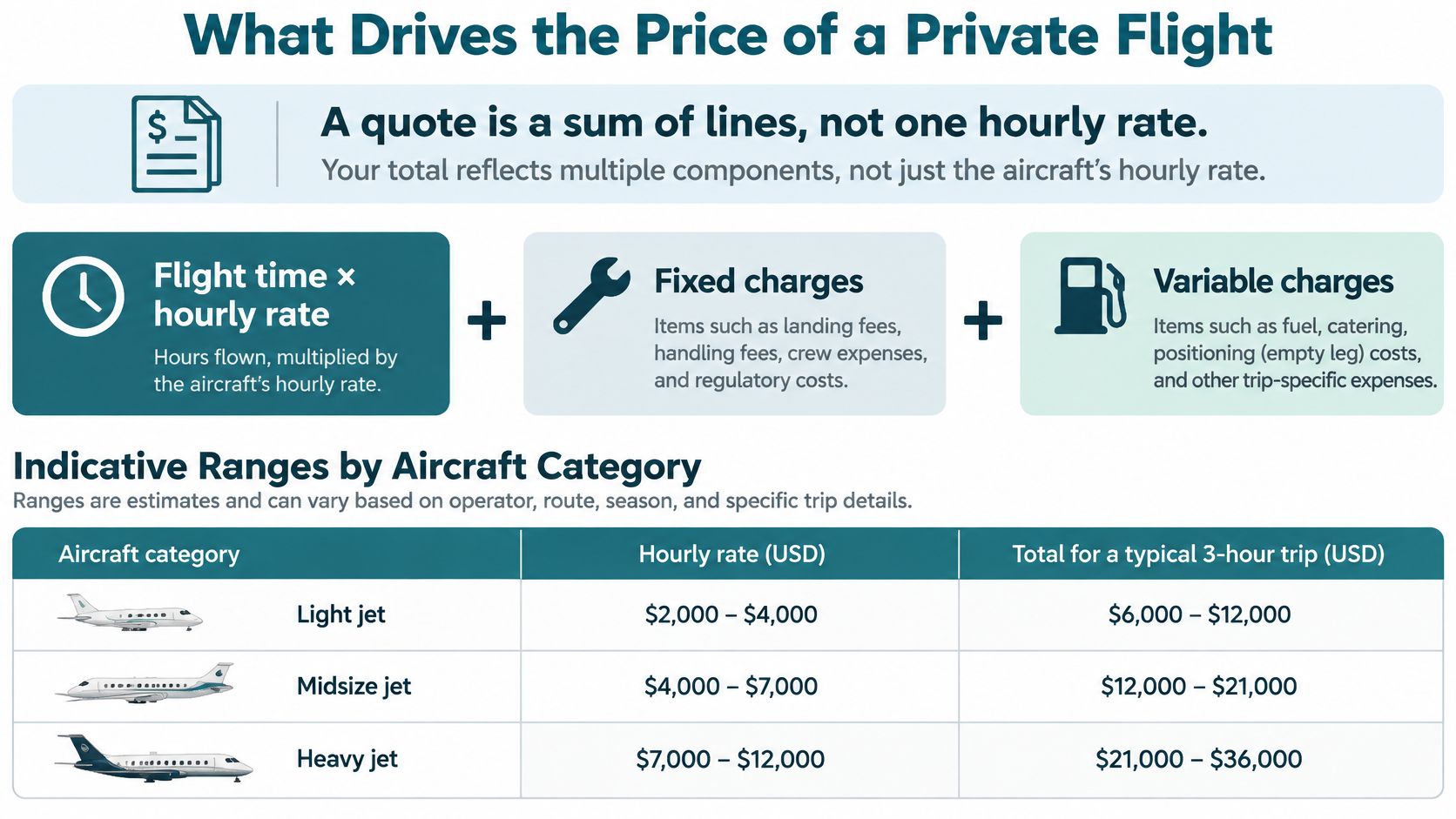
A quote is a sum of lines, not one hourly rate. Flight time multiplied by the hourly rate gets you the base; fixed and variable charges decide the total. Two quotes for the same trip can share an hourly rate and still land thousands apart once positioning, handling and seasonality are counted.
The lines inside a quote
Cost line | Typical range | When it applies |
|---|---|---|
Light jet hourly rate | $2,500–$3,500 per flight hour | Base cost for flight time |
Midsize jet hourly rate | $4,000–$5,500 per flight hour | Base cost for flight time |
Super midsize jet hourly rate | $5,500–$8,000 per flight hour | Base cost for flight time |
Heavy jet hourly rate | $8,000–$12,000 per flight hour | Base cost for flight time |
International handling | $500–$3,000 per stop | Each foreign or international airport stop |
De-icing | $1,500–$8,000 per event | Winter departures and arrivals |
Peak-period premium | 20%–50% uplift | Holidays, event weekends and busy periods |
The handling, de-icing and peak-period figures come from 2025 guidance on private jet costs, which also notes that U.S. broker regulations require disclosure of total transportation cost and known or good-faith estimated third-party fees before contracting when requested. Ask for that breakdown even when you aren't required to get it.
A worked example from New York to Miami
Say the trip is 2.5 flight hours in a midsize at $4,500 an hour, which is $11,250. The aircraft isn't based in New York, so a one-hour positioning leg adds $4,500. Handling runs about $1,000, catering $800, ground transport $400. Total before any seasonal uplift: $17,950.
Now apply a 20% peak-period premium to the base flight time, $2,250, and the same trip lands at $20,200. None of those lines is unusual. The seller who quoted you $14,000 left four of them out.
Keep three categories straight when you read a quote: broker fee, operator charges, and government charges such as landing fees and taxes. Our quotes are estimates only and can change with aircraft availability, fuel costs, positioning fees, landing fees, overnight charges, de-icing, catering and ground transportation. Pricing is confirmed only when a booking agreement is executed or written confirmation is issued, and a quote is valid for the period stated in it, or 48 hours from issuance if no period is stated, after which pricing and availability must be reconfirmed.
Where quotes actually move: fuel, positioning, overnight crew costs, de-icing and, above all, how many aircraft are chasing the same date. The lowest headline hourly rate is usually the least useful number on the page, because it describes the cheapest hour, not the trip.
When an Empty Leg Discount Is Worth the Risk
An empty leg is a repositioning flight the operator has to fly anyway to reach its next customer. That's why it can be sold at a 30% to 70% discount: the alternative is flying it empty. The trade-off is that the route, departure time and aircraft type are set by the original trip, and the flight can be cancelled or moved if that booking changes, as industry guidance on charter and empty legs sets out.
So a half-price quote isn't automatically a saving. Run the arithmetic with failure priced in. A $6,500 empty leg with a one-in-five chance of moving, where a $4,000 commercial backup is needed, has an expected cost of $7,300 ($6,500 plus $800). That still beats an $11,000 fixed charter, but only if a move costs you nothing beyond the backup fare.
Trip type | Empty leg fit | Reason |
|---|---|---|
Leisure trip with flexible dates | Good fit | A moved flight costs little beyond rebooking |
Passenger near several airports | Good fit | Can switch departure airport if the leg moves |
Non-critical event attendance | Conditional fit | Works only if a backup can cover a late arrival |
Executive meeting with a hard deadline | Poor fit | A cancellation can cost the meeting and a hotel night |
International connection | Poor fit | Onward flights may not hold if the leg moves |
Sports fixture or production | Poor fit | Schedules and crew are fixed to the event |
Medical evacuation | Not suitable | Time and equipment needs rule out an unconfirmed leg |
Check three terms before you count on one. Confirmation status, because an empty leg shouldn't be represented as arranged until the operating aircraft has committed to carrying you. Substitution rights, because a different aircraft may appear. Refund or replacement terms, if the primary booking moves. And set the latest safe moment to buy a commercial backup seat before you accept.
Confirm These Details in Writing Before You Pay
- Name the certificate-holding operator. The FAA currently lists 1,837 Part 135 certificate holders and 11,582 authorized aircraft, according to its charter operations guidance, so "we use Part 135 operators" narrows very little. Get the certificate holder's name and confirm it's authorized for your route and aircraft type.
- Record the aircraft type and registration, plus what happens if the operator substitutes a different tail number.
- Get every fee line and mark the estimates. Fixed charges, variable charges, taxes, and which numbers could still move.
- Read the change, cancellation and refund terms, including what happens if the flight itself moves.
- Confirm the dispute route. For charters arranged through Approved Jets, disputes are resolved through binding individual arbitration administered by the American Arbitration Association under its Commercial Arbitration Rules.
- Keep the signed agreement and final itinerary together in one file, so the version you agreed to is the version you can produce later.
The next action is small: send a trip brief with passenger count, route, date flexibility and bags, and ask for a written quote. Then take it apart line by line against the cost lines above. That's the whole skill.
Approved Jets arranges private aircraft hire through a network of Part 135 and foreign-equivalent operators, matching your route, dates, passengers and luggage to aircraft that fit the mission, then coordinating catering, ground transport and security around it. Send a trip brief through Approved Jets and you'll get a written proposal that names the aircraft, the operator and the terms, so you can compare it line by line instead of guessing what the cheapest quote left out.