Luxury Private Jet Interiors: 7 Cabin Studies
Luxury private jet interiors through seven cabin studies: zones, width, suites, showers, and medical layouts, with practical booking takeaways.
12 min read

The usual advice about luxury private jet interiors starts with leather, wood veneers, and bigger seats. That's the wrong starting point. On a long flight, the useful difference is how the cabin separates work, dining, sleep, and care, and whether passengers can use those spaces without interrupting one another.
A bedroom isn't much help if everyone passes through it to reach a lavatory. A conference table isn't a working office unless the whole team can sit around it, hear clearly, and connect their devices. Even specialist approaches such as additive manufacturing for cabin interiors belong behind the operational questions, not ahead of them.
The decision order runs from multi-zone ultra-large cabins to a width-first cabin, a three-zone trijet, a widebody suite platform, a large executive cabin that isn't the biggest available, a shower-and-bedroom package, and a medical conversion. Each presents a different bargain between dedicated rooms and flexible space. The test is straightforward: who does the layout serve, what does it displace, and what must be confirmed before chartering?
Table of Contents
- 1. Bombardier Global 7500 Four-Zone Cabin
- Confirm the Rooms, Not Just the Model
- 2. Gulfstream G700 Widest-in-Class Cabin
- Specify What Must Fit
- 3. Dassault Falcon 8X Three-Zone Layout
- Quietness Must Be Measured
- 4. Airbus ACJ350 XWB Widebody Suite Cabin
- Check the Airport Before the Bedroom
- 5. Embraer Lineage 1000E Executive Cabin
- Match the Aircraft to the Actual Load
- 6. Stand-Up Shower and Full-Flat Bedroom Suite
- Verify the Overnight Package
- 7. Medical Evacuation Cabin Conversion
- Comfort Still Needs Evidence
- How These Cabin Concepts Compare
- Match the Cabin to the Mission
- Request Evidence You Can Use
1. Bombardier Global 7500 Four-Zone Cabin
The Global 7500 makes the strongest case for judging a cabin by activities rather than seats. Its published arrangement includes four configurable cabin zones, with a conference suite for six, an entertainment suite, and an aft suite containing a bed, work area, and en-suite lavatory, according to Bombardier's aircraft factsheet.
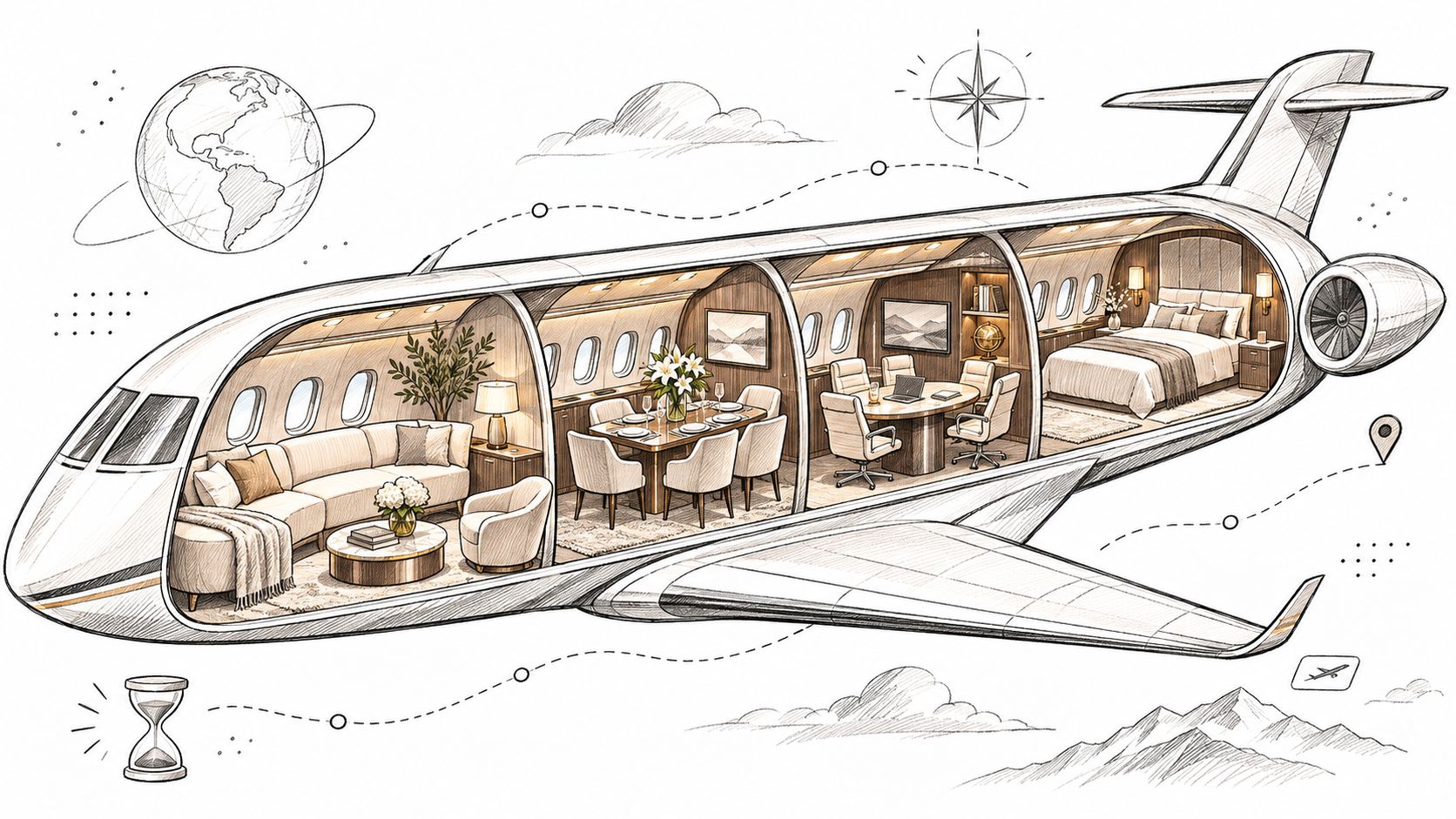
For a leadership team flying overnight, that separation can matter more than upholstery. Executives can finish a meeting while another passenger prepares for sleep, provided the actual configuration offers suitable partitions and circulation. A family might instead prioritize an entertainment area that remains usable after someone retires to the bedroom.
The trade-off is dedicated space versus seating flexibility. A permanent bed and substantial conference furniture occupy space that could otherwise support another seating arrangement. Don't assume a brochure's maximum passenger capacity also describes its most comfortable overnight setup.
Confirm the Rooms, Not Just the Model
- Meeting capacity: Tell us how many people must work together, and request the actual table arrangement, including whether it's fixed or deployable.
- Sleeping capacity: Distinguish a permanent bed from seats or divans prepared for sleeping.
- Privacy: Check doors, lavatory access, and the service route between the galley and occupied zones.
We use your travel requirements to source aircraft and present configuration options. Send the flight duration and intended sleep schedule alongside the passenger list, so the comparison reflects simultaneous activities rather than an impressive seat total.
2. Gulfstream G700 Widest-in-Class Cabin
Width is useful only when the furniture leaves room to use it. The G700's finished cabin measures 8 ft 2 in wide and 6 ft 3 in high, according to Gulfstream's aircraft specifications. Those dimensions provide a concrete starting point, unlike an unqualified claim that a cabin feels spacious.
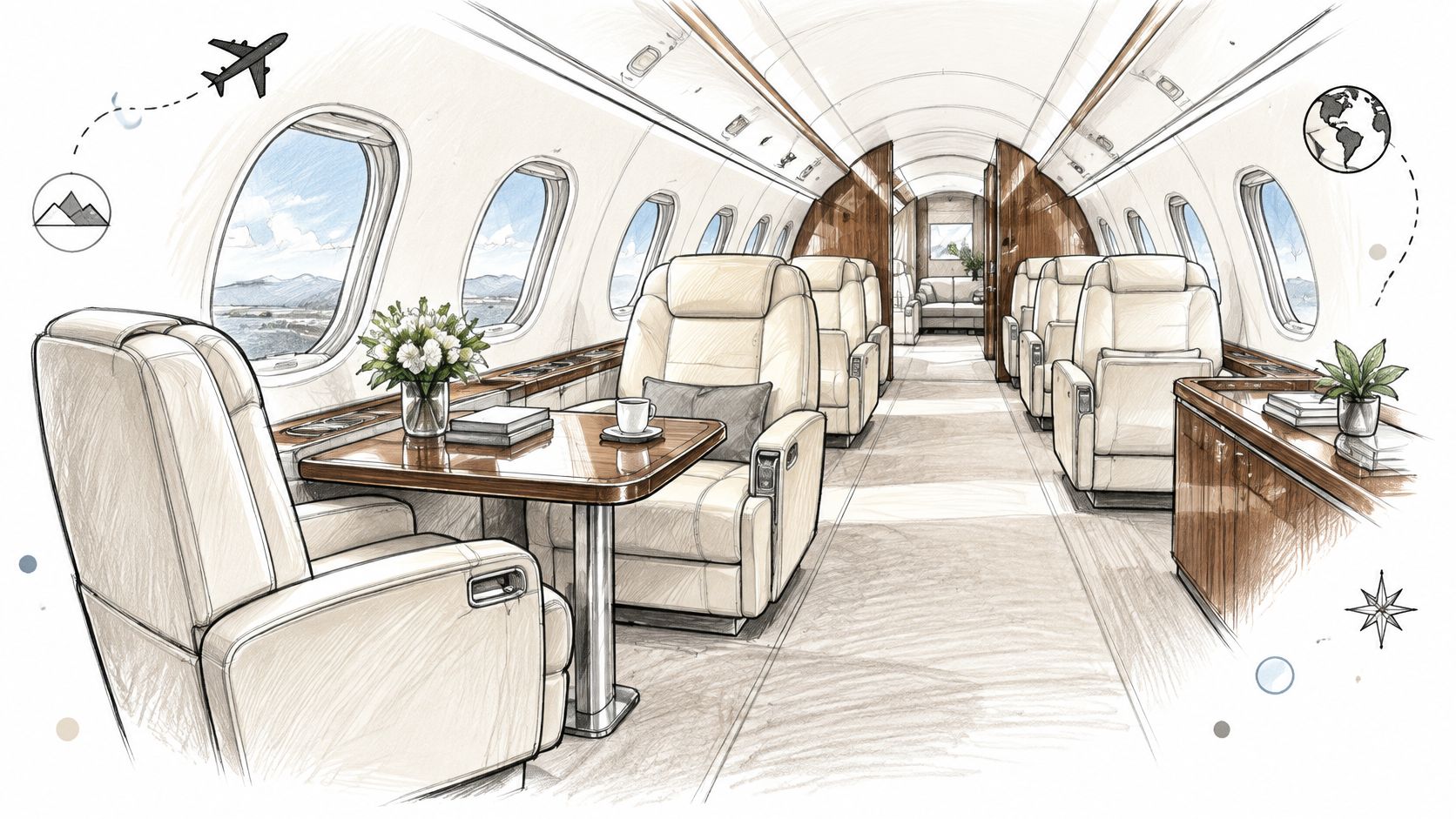
Consider an entertainment group traveling with managers and performers. They may value room to circulate during catering more than another enclosed compartment. An executive team might prefer an open lounge for informal discussions, but still need a proper table for reviewing documents.
Neither outcome follows automatically from cabin width. Deep cabinetry, broad seats, and deployed dining tables can change the available aisle. Request photographs with the furniture in its working position, not just folded away for presentation.
A wide cabin and a wide aisle aren't the same thing. Judge circulation with tables deployed and sleeping surfaces prepared.
Specify What Must Fit
Give us the passenger count, baggage requirements, and whether the priority is a meeting table, dining arrangement, or dedicated bed. We match the request to aircraft options rather than treating the model name as a complete specification.
For an alternative Gulfstream charter reference, the guide to chartering a Gulfstream G650 provides a separate starting point. Don't transfer a G700 layout assumption to another aircraft, or even assume that different examples of the same model have identical interiors.
3. Dassault Falcon 8X Three-Zone Layout
For a Falcon 8X charter organized around separate forward, middle, and aft areas, the decisive question is which activity receives the protected space. A corporate principal may want a forward working area while staff rest farther aft. A family may care more about keeping meals and conversation separate from a sleeping passenger.
Treat that three-zone arrangement as a configuration to verify, not a promise attached to every aircraft. A lounge, conference area, and private aft space can serve different purposes depending on seating, partitions, and service access. Our private jet seating guide is a useful starting point for distinguishing passenger capacity from usable working and resting positions.
Quietness Must Be Measured
Acoustic performance deserves the same attention as the floor plan. In a refurbishment documented by Duncan Aviation, additional insulation reduced measured cabin noise by 3 dB after flight testing. That's a refurbishment example, not a Falcon 8X noise specification.
The practical lesson is to request evidence about the particular aircraft rather than infer quietness from photographs. A partition may provide visual privacy without delivering the acoustic separation needed for confidential discussions or undisturbed sleep.
- Working zone: Confirm seats around the table and access to power.
- Rest zone: Check whether meal service passes sleeping passengers.
- Service timing: Agree when catering should pause during a meeting.
For a team preparing a confidential transaction, schedule the working session before the cabin is converted for rest. Efficient zoning depends partly on furniture, but also on how passengers and crew use it.
4. Airbus ACJ350 XWB Widebody Suite Cabin
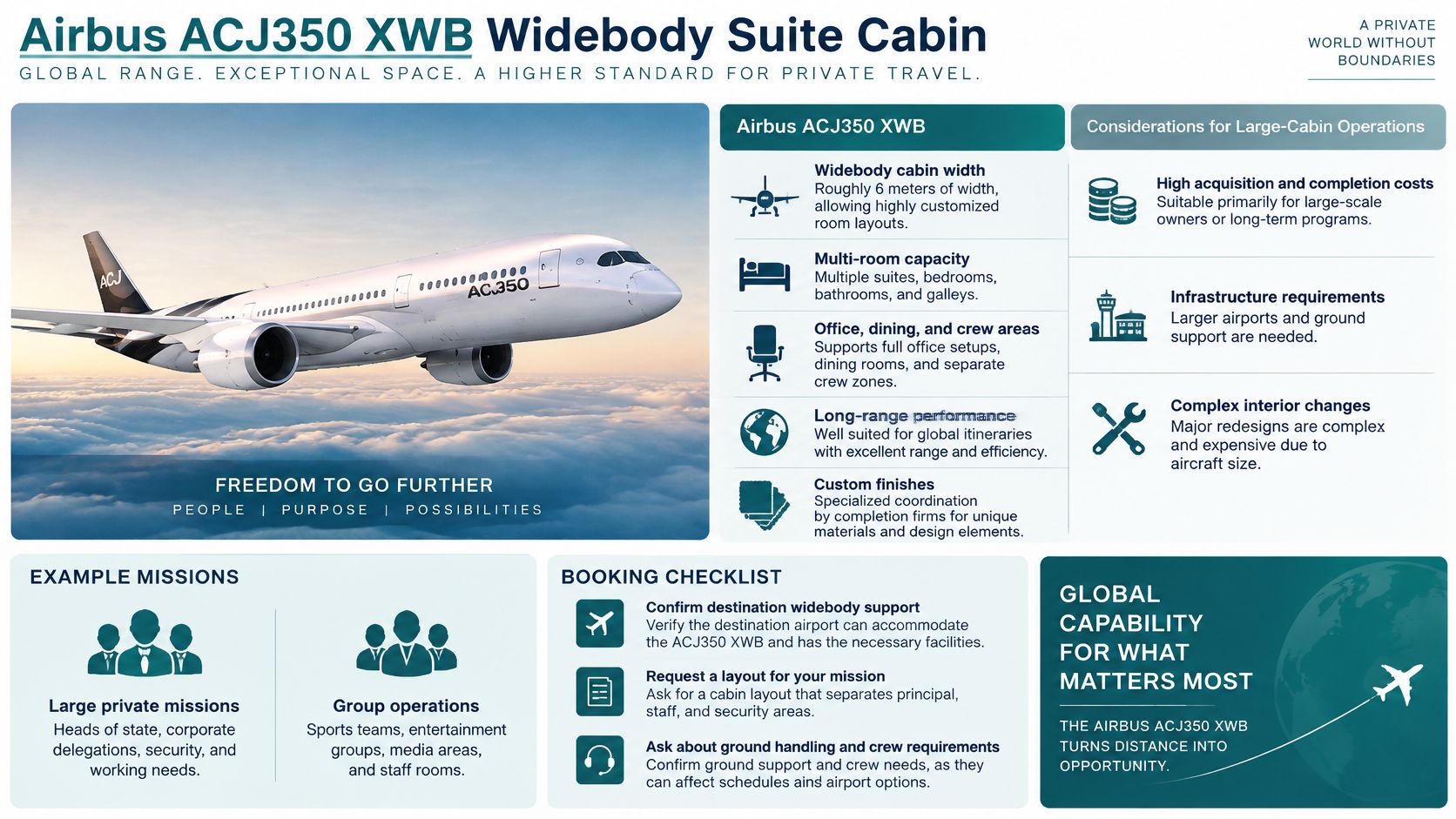
A widebody cabin can offer more rooms and still work poorly for a particular trip. For an ACJ350 XWB mission, evaluate whether the completion separates principal passengers, staff, security, and service traffic without making daily movement awkward. Cabin width and room count matter only when they support the group's work and rest patterns.
A delegation may need a private working suite and a separate staff briefing area. A sports or entertainment group may place greater value on shared seating, equipment storage, and space for management discussions. Those priorities can compete: adding private rooms may reduce common seating or restrict access between areas. Ask which activities need privacy, and which passengers need to move between zones.
Model names do not define the interior. Jet Aviation dates its landmark bespoke VVIP interior unveiling to June 1977, illustrating the distinction between an aircraft platform and its individually designed accommodation. Review the actual floor plan and amenity package offered for the aircraft under consideration.
Check the Airport Before the Bedroom
Provide the destination airport and acceptable alternatives before narrowing interior requirements. Airport suitability, handling, crew arrangements, and cabin configuration all affect whether the itinerary works as planned. For a widebody charter inquiry, resolve these together rather than selecting a layout in isolation.
Planning rule: More rooms are valuable only when they separate activities that genuinely need separation.
Request a floor plan that shows doors, lavatories, galley access, and baggage arrangements, not just room names. Then trace a staff member's route to deliver a document. If that path crosses a private suite or interrupts a meeting, the residential appearance may conceal a practical weakness. Ask how the layout supports work, rest, and readiness on arrival.
5. Embraer Lineage 1000E Executive Cabin
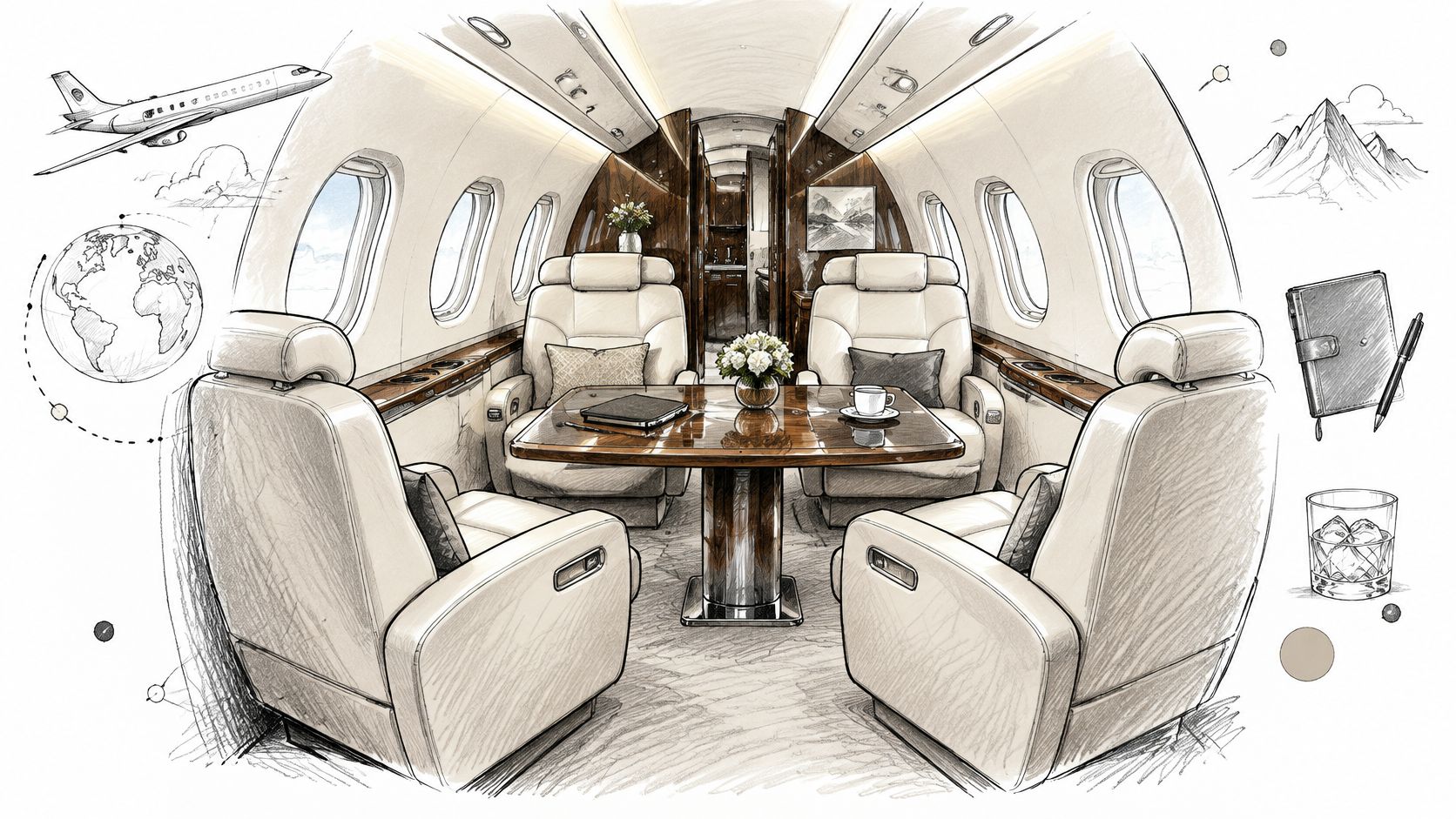
The Lineage 1000E belongs in a comparison for travelers who want substantial executive accommodation without automatically selecting the largest platform. The useful question is whether its offered configuration supplies the required meeting, dining, and resting space without paying for rooms the group won't use.
For an executive team on an international trip, a practical arrangement might prioritize a conference table, accessible luggage, and a separate relaxation area. Lighting and finishes matter, but they shouldn't disguise an awkward table position or insufficient storage.
Broader aircraft-interior market coverage identifies weight reduction, modular design, and more sustainable materials as industry priorities. For a charter client, the useful implication isn't to demand a particular material. It's to ask whether the cabin preserves the capacity and flexibility the mission needs.
Match the Aircraft to the Actual Load
- People and luggage: Supply bag dimensions and identify rigid cases, presentation equipment, or unusually heavy items.
- Working furniture: Confirm that the proposed meeting table accommodates the intended participants.
- Route suitability: Compare quoted aircraft against the actual itinerary, including any proposed fuel stop.
Don't infer medical or sensitive-cargo suitability from an executive cabin's size. A stretcher, clinical equipment, or specialist cargo requires a separately verified arrangement.
A smaller suitable aircraft may be the better choice for a short meeting trip. Conversely, extra cabin space can be justified when passengers must work and rest simultaneously. The right comparison is usable accommodation for the mission, not which aircraft looks larger in photographs.
6. Stand-Up Shower and Full-Flat Bedroom Suite
For an overnight traveler facing an early negotiation, a bedroom and shower package addresses a specific objective: a protected opportunity to sleep, followed by space to wash and dress. It doesn't guarantee arrival readiness. Departure timing, cabin conditions, and uninterrupted rest still matter.
Ask for a full-flat sleeping surface and an operational shower explicitly. A reclining seat, a prepared divan, and a permanent bedroom are different propositions. So are a shower shown in marketing material and one confirmed for use on the proposed flight.
Lighting is another specification worth separating from appearance. Bombardier describes the Global 7500's Soleil system as circadian-based, using dynamic daylight simulation. That identifies a mechanism and intended comfort benefit, not a guarantee that a passenger will avoid fatigue.
Verify the Overnight Package
Confirm bed preparation, usable sleeping dimensions, linen arrangements, shower availability, water-use restrictions, and when the crew can prepare breakfast. For family travel, establish who uses the bedroom and where everyone else rests.
The best overnight layout protects sleep from service interruptions. A bedroom door alone doesn't establish that.
The package costs space and flexibility. A dedicated suite may be worthwhile for frequent overnight travel but unnecessary for a daytime group itinerary.
Presentation also needs separating from evidence. Advice on how to style high-end interior shoots concerns how rooms are presented; charter decisions need current configuration details. Request photographs showing the bed prepared and the washroom arrangement, then confirm those amenities against the quoted aircraft.
7. Medical Evacuation Cabin Conversion
A medical cabin reverses the usual luxury hierarchy. Clinical access, equipment compatibility, and patient requirements come before decorative finishes. The relevant layout must accommodate the patient, stretcher installation, medical team, oxygen arrangements, equipment power, and safe access during care.
For international repatriation, the accompanying clinicians should define the patient's transport needs before aircraft selection. For a specialist medical team or organ movement, the requirements may instead center on equipment handling, timing, and coordination with receiving facilities. These aren't interchangeable missions.
Our guide to medical evacuation and repatriation explains the service context. We process the travel requirements and source aircraft through our operator network; clinical suitability must be confirmed with the treating and transport teams.
Comfort Still Needs Evidence
The FAA's Airliner Cabin Environment report examines environmental factors including ventilation, contaminants, pressure, and noise. It isn't evidence that a particular private aircraft is medically suitable, but it supports looking beyond visible luxury when evaluating the patient environment.
- Clinical specification: Provide the equipment list, patient needs, accompanying personnel, and any positioning restrictions.
- Aircraft documentation: Confirm approval of the installed medical configuration and compatibility with required equipment.
- Transfer continuity: Align ground ambulances, hospital acceptance, border documentation, and flight arrangements.
A stretcher installation can displace passenger seats and restrict circulation. Medical equipment also competes with personal luggage for space, so accompanying family members need an accurate seating and baggage plan.
Start sourcing early enough to resolve those details. The objective is appropriate care throughout the transfer, not merely an available aircraft with a spacious cabin.
How These Cabin Concepts Compare
Cabin size matters less than how its space is divided. Separate zones can let passengers work, dine, and rest at the same time, while a widebody layout supports more rooms and suites. Those gains come with trade-offs: added space, more complex amenities, and airport or operating constraints. The table compares each concept by its likely use and the limitation a traveler should weigh.
Item | Cabin concept | Best mission | Scale cited | Main constraint |
|---|---|---|---|---|
Bombardier Global 7500 Four-Zone Cabin | Four distinct living zones, including an aft bedroom | Intercontinental trips combining meetings, dining, and rest | Long-range intercontinental cabin | High ownership and operating costs |
Gulfstream G700 Widest-in-Class Cabin | Extra-wide, tall cabin with flexible seating | Long-haul group travel and open-plan work | Marketed as the largest cabin in its class | Premium acquisition and operating costs |
Dassault Falcon 8X Three-Zone Layout | Three zones for work, socializing, and rest | Long-range mixed-use business travel | Long-range, three-zone cabin | Zone separation can limit shared conversation |
Airbus ACJ350 XWB Widebody Suite Cabin | Widebody cabin designed for multiple suites and rooms | Large delegations and multi-room global travel | Widebody-class cabin | High costs and need for widebody-capable airports |
Embraer Lineage 1000E Executive Cabin | Refined, configurable executive cabin | Regional and transcontinental business or leisure trips | Large relative to many jets in its category | Smaller than widebody options; range may require a stop |
Stand-Up Shower and Full-Flat Bedroom Suite | Private bedroom suite with shower and full-flat bed | Overnight long-haul flights focused on rest and arrival readiness | Requires substantial cabin space | Added space, plumbing, weight, and limited availability |
Medical Evacuation Cabin Conversion | Patient-focused layout with stretcher and medical systems | Long-distance patient transport and medical response | Stretcher bay with fewer passenger seats than a standard cabin | Certification, maintenance, and reduced passenger seating |
These categories describe different cabin priorities, not interchangeable levels of luxury. A four-zone jet separates activities; a widebody-class cabin supports distinct rooms; a bedroom suite centers the trip on sleep. Medical conversion instead gives priority to patient access and equipment, reducing space available for other passengers. For a meaningful comparison, ask how the quoted aircraft's layout supports the work, rest, or care required, and what seating or circulation that arrangement gives up.
Match the Cabin to the Mission
Start by counting people and bags, including staff, children, rigid equipment cases, and anything that can't be compressed into ordinary luggage. Then name the activity that must happen in flight. A confidential meeting, uninterrupted sleep, group dining, and patient care each produce a different aircraft brief.
Next, identify the feature that makes that activity possible. Choose zones when passengers need to do different things simultaneously. Prioritize width and circulation when movement, catering, and group interaction matter more than enclosed rooms. Specify a bedroom and shower when an overnight schedule makes rest and preparation central to the trip, and require a clinically approved configuration when medical care is involved.
Request Evidence You Can Use
Marketing names don't guarantee a floor plan. The useful request is a specific layout, usable seat count, sleeping arrangement, and confirmed amenity list for the aircraft being quoted. Include table capacity, baggage access, connectivity requirements, and any privacy concern that could change the selection.
Treat photographs as supporting material rather than the full specification. Ask how the cabin works with tables open, beds prepared, and catering underway. A layout can look generous while still forcing passengers to interrupt one another.
We source aircraft and present charter options without requiring the traveler to own an aircraft. We also coordinate catering, ground transport, security, and special requests, with advisors available around the clock. That coordination matters because a successful cabin choice can still be undermined by poorly timed transfers or service arrangements.
The strongest brief describes an outcome rather than a brand preference. “The team needs to meet while another passenger sleeps” gives us more to work with than “send a luxury jet.” Send the route, passenger count, sleep or meeting requirement, and any medical or luggage constraint with your quote request.
Approved Jets offers private charter brokerage and concierge coordination, matching travel requirements with aircraft options and managing trip logistics. Visit Approved Jets to request a proposal with your route, passenger count, and the cabin features your trip needs.