Jet Charter Services: Aircraft, Costs and How to Book
Jet charter services explained: aircraft categories, pricing drivers, booking steps and how to verify a certificated operator before you fly.
13 min read

You're three days from a board meeting in another city, and the commercial options are a 6 a.m. departure with a connection and a four-hour cushion you don't need. Someone on your team says, "Just charter a jet." You start looking, and within an hour you've got five quotes, four aircraft categories you can't tell apart, and a nagging question nobody answers directly: who flies this thing?
That question is the one that matters most, and it's usually the last one a first-time buyer asks. Jet charter services rent you the whole aircraft and crew for your group on your schedule, the way a private taxi takes your party door to door instead of selling you a seat on a bus. The cabin and the hourly rate are the easy part to compare. The legal operator, the certificate behind the flight, and who holds operational control are where a good booking is separated from an expensive mistake.
What follows is the walk-through a seasoned planner would give a first-time buyer, starting with which aircraft fits your trip and ending with the checks to run before you pay.
Table of Contents
- Charter Aircraft Categories and Their Real Limits
- Service Types and Which Trip Each Suits
- Verify the Operator and Choose a Partner
- The six checks to run before you pay
- How a Charter Booking Works Step by Step
- What a realistic timeline looks like
- What Drives the Price of a Charter Flight
- Work the math on a sample trip
- Book Your First Charter With Confidence
Charter Aircraft Categories and Their Real Limits
A charter rents the entire aircraft and crew for your group on your timetable. You're not buying a seat; you're buying the plane, the pilots, the fuel and the schedule. That single distinction explains most of what follows, including why the price is quoted per flight hour rather than per person.
Aircraft categories exist because range and payload trade against each other. Here's how the market is normally segmented.
Aircraft category | Typical seats | Typical range | Best fit |
|---|---|---|---|
Very light jet | 4-6 | About 1,000-1,500 nm | Short regional hops |
Light jet | 5-7 | About 1,200-1,800 nm | Two to four passengers on short routes |
Midsize jet | 6-8 | About 2,000-2,500 nm | Cross-country trips |
Super midsize jet | 8-9 | About 2,500-3,300 nm | Coast-to-coast with small teams |
Heavy jet | 10-16 | About 3,500-5,000 nm | Long-range flights and larger groups |
Airliner (group charter) | 50-200+ | Varies by aircraft | Sports teams, large events |
Read that table as three separate constraints, not one. Cabin seats decide whether everyone fits comfortably. Range decides whether a nonstop is physically possible. Runway performance decides which airports are open to you at all, which matters more than most first-time buyers expect, because short mountain strips and small regional fields rule out plenty of otherwise suitable aircraft.
Two examples make it concrete. Four passengers flying Los Angeles to Aspen fit comfortably in a light or midsize jet, and the trip is well inside the range of either. New York to London nonstop is a different problem entirely: that's heavy jet territory, because you need the fuel load and the cabin to cross an ocean without a stop.
The FAA frames aircraft selection the same way. Its Part 135 certification guidance requires operators to show that each aircraft and its equipment conform to the requirements of the intended operation, and the rules call for current flight manuals for aircraft used in air transportation. The same guidance lists the inspection paths an operator may use, including annual, 100-hour, progressive and approved aircraft inspection programs. The practical takeaway is that a category can't be chosen by comparing cabin size alone, because a mission may hinge on range, runway performance, weather capability, equipment, crew configuration or operating authorization.
The value rule: the smallest aircraft that clears your range, runway and payload requirements is usually the best value. Going one category up costs money and burns fuel you didn't need.
That's also why a group itinerary may need an aircraft specifically authorized and configured for the passenger load, and why a cargo mission can depend on equipment a perfectly good passenger jet doesn't carry. For a wider view of how traffic patterns and route demand shape the market you're booking into, this collection of air travel trends in numbers is a useful reference. Approved Jets' luxury charter services range from quick regional hops to transcontinental journeys, and you can review the available aircraft categories to see how the fleet maps to each trip type.
Hourly costs move with fuel prices, so treat any rate you hear as a starting point rather than a fixed number.
Service Types and Which Trip Each Suits
The right service type depends on trip shape, timing flexibility and passenger count, and getting it wrong is one of the most common ways first-time buyers overspend.
Service type | Best for | How you pay | Watch for |
|---|---|---|---|
One-way charter | A single trip with no return | Flight hours plus fees | Repositioning can add cost |
Round-trip charter | Same-day or return visits | Hours flown both ways plus fees | Ground waiting time is often billed |
Empty-leg flight | Flexible dates and routes | Discounted one-way fare on a repositioning flight | Limited dates and no control over timing |
Jet card or membership | Frequent flyers who want prepaid hours | Prepaid hours at a set rate | Unused hours may expire |
Group charter | Teams, weddings and large parties | Whole aircraft or airliner priced for the block | Largest fixed commitment |
Medical or cargo mission | Urgent transfers and sensitive freight | Mission-specific quote | Needs specialized equipment and documentation |
Charter is a large operational category, not a luxury niche. The FAA's study of Part 135 operators reported that on-demand aircraft, including passenger and cargo charter, air medical and certain air-tour operations, flew approximately 3.5 million hours in 2016. On-demand air-taxi activity accounted for about 2.371 million of those hours, roughly 68% of the total, and on-demand Part 135 activity grew from 3.1 million hours in 2010 to 3.5 million in 2016, about 12.9% over six years.
The round-trip trap deserves its own explanation. Say you need Chicago to Dallas and back the same day. The aircraft flies you down, then waits on the ground for your meeting to end, then flies you home. Waiting time is usually billed, because the crew is on duty and the aircraft is unavailable to anyone else, so the round trip can cost more than two separate one-way legs. Now take a three-person team flying one way to a conference: a one-way charter is the clean answer. If that same team returns the next day on a fixed schedule, a round trip becomes the sensible booking.
Ask for quotes on two service types, then compare the total. The hourly rate alone won't tell you which is cheaper.
If you're weighing where a charter can take you, this guide to destinations reachable from Norwich Airport shows how regional airports open up routes that hub schedules don't serve.
The decision rule is simple: match the service type to your timing flexibility, your passenger count, and whether the aircraft has to wait for you.
Verify the Operator and Choose a Partner
Before comparing cabins or prices, establish who has legal control of the flight. A charter broker arranges a trip with an operator; the operator holds the relevant certificate and conducts the flight. A direct operator sells flights on its own certificated aircraft, while an online marketplace may list options from different providers. In every case, verify the certificate holder for the specific trip.
Partner type | What it does | Who flies the trip | Watch for |
|---|---|---|---|
Charter broker | Arranges flights across an operator network | Certificated operator named on the quote | Confirm the operator before paying |
Direct operator | Sells and flies its own certificated aircraft | The operator itself | Check authorization and availability for your route |
Online marketplace | Lists options from many sources | Varies by listing | Verify the certificate holder for each listing |
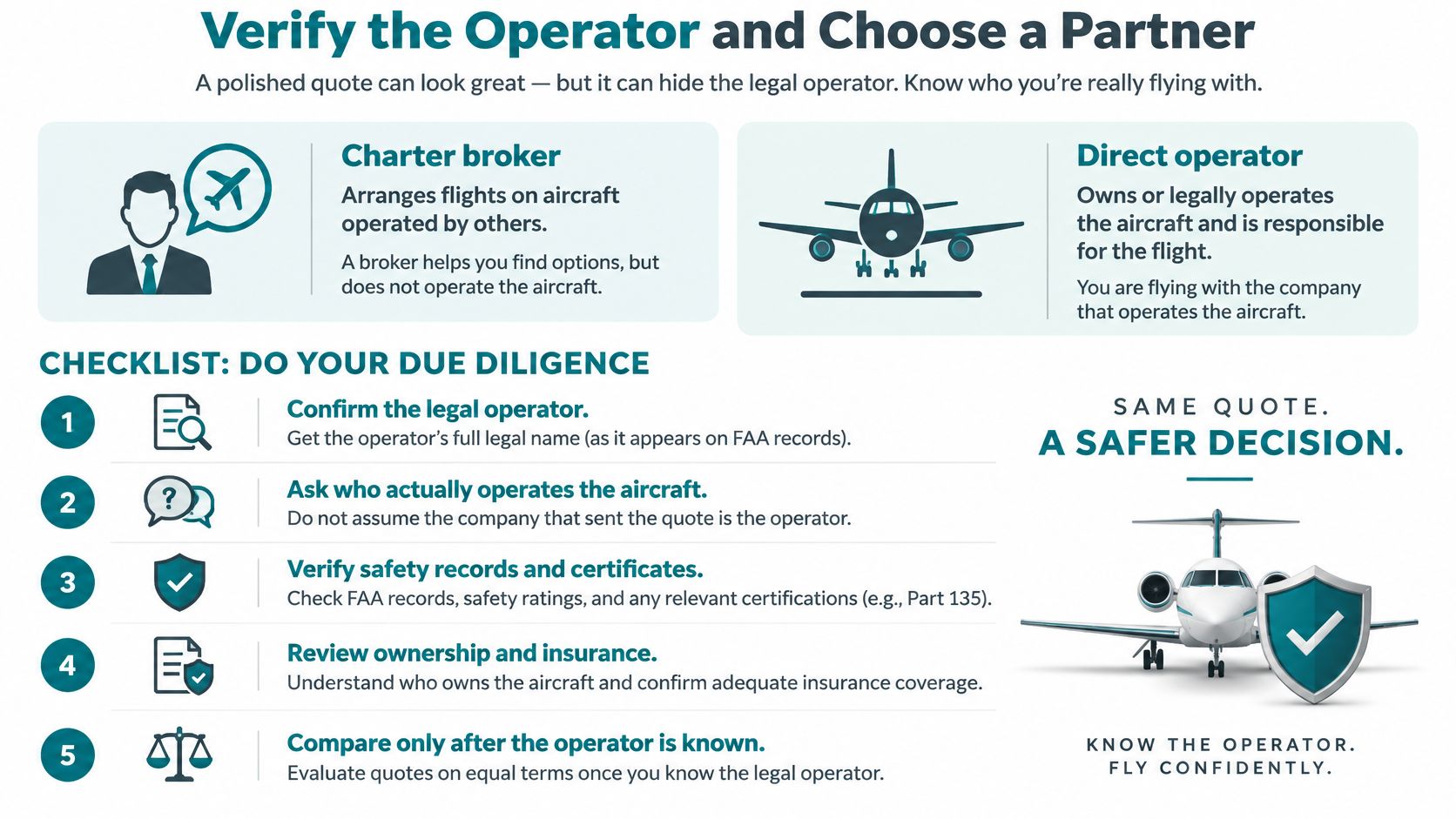
The FAA's guidance on thinking about chartering an aircraft advises passengers to request the operator's Air Carrier or Operating Certificate before booking. It also identifies warning signs such as unusually low pricing, missing Federal Excise Tax, refusal to show authorization, or coached answers to inspectors.
The six checks to run before you pay
- Ask for the Air Carrier or Operating Certificate. A safety badge or membership logo is not a substitute. The operator should be able to identify its certificate.
- Match the operator on the quote to the certificate. If the names differ, ask which company will conduct the flight and why the quote names another company. If the operator changes, get the new details before paying.
- Confirm the proposed aircraft is authorized for charter. Ask the operator to confirm that the aircraft is authorized for the planned trip.
- Ask who holds operational control. The certificate-holding operator is responsible for the flight's operation, including dispatch and crew assignment. Get a clear answer about which operator controls the trip.
- Review the tax line. Federal Excise Tax should be addressed in the quote for a domestic passenger charter. If it is absent, ask why before treating the quote as a lower-cost option.
- Confirm that the operator will give passengers a safety briefing. Ask who will provide it and when.
A quote that is unusually low compared with similar offers should prompt questions, not an immediate booking. Ask what the quoted price includes and whether any fees or services are missing.
A response to question: “Our partners are all certified” does not identify who holds the certificate for your flight. Ask for the operator's name and certificate details.
For cargo or medical evacuation, confirm that the operator can meet the trip's specific requirements. The FAA's Part 135 hazmat guidance describes requirements related to aircraft, maintenance, and hazardous-materials training. Special cargo or medical missions may require additional equipment, crew, documentation, or handling arrangements.
Then assess the broker's role. Approved Jets is a charter broker and does not own, operate, lease, or maintain aircraft. It sources operators and aircraft, presents charter options and pricing, and coordinates booking logistics with the selected operator. Approved Jets is an Air Charter Broker under DOT Regulations, operating under Part 295. For questions or claims about the flight, aircraft safety, crew conduct, baggage handling, or onboard experience, contact the applicable operator. Learn more about how an aircraft charter brokerage works.
Use the same checks again if the operator or aircraft changes. A certificate verified for one operator does not verify a replacement.
How a Charter Booking Works Step by Step
A charter request moves through seven stages, and each one exists for a reason. Skipping a stage is how buyers end up with a surprise on the invoice.
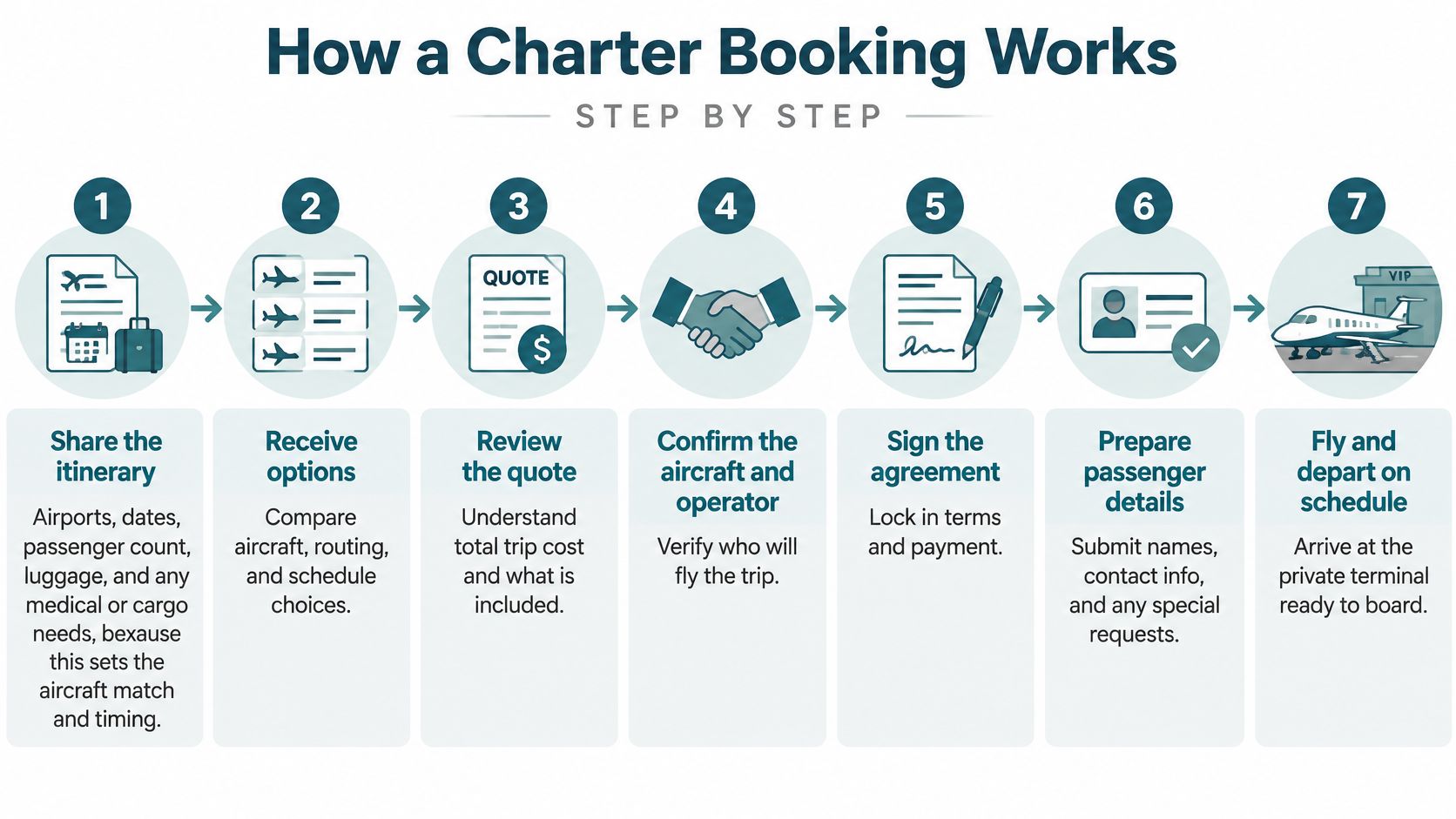
- Share the itinerary in full. Airports, dates, passenger count, luggage volume, and any medical or cargo needs. The aircraft match depends on the complete mission profile, so a vague request produces a vague quote. Mention pets, mobility equipment and oversize bags now, not at the FBO.
- Receive options with the operator named. You should get aircraft choices with pricing and itinerary detail, sourced through an operator network. Request quotes from at least two partners, and ask each one to identify the certificate holder up front.
- Confirm the operator. Before anything else moves forward, establish which certificate holder flies the trip, because that entity controls the flight. The six checks in the verification section are what you run here.
- Review the charter agreement. Cancellation terms vary by operator, aircraft type and how close to departure you cancel, so get them in writing before you sign. Read the payment schedule and the quote's validity window in the same pass.
- Pay the deposit or balance as the agreement states. Match the amount to the agreement, not to a verbal number in an email thread.
- Coordinate the pre-flight details. Ground transport, catering, security and customs paperwork all get arranged here. International trips need more lead time because customs and immigration documentation has to clear before departure.
- Fly, then close out the invoice. Confirm any itinerary changes before wheels-up, then check the final invoice against the quote line by line. Discrepancies are easiest to resolve while the trip is fresh.
What a realistic timeline looks like
Say you request a Friday trip on Tuesday. Tuesday goes to gathering the itinerary details and sending them to two partners. Wednesday brings options back, and you verify the operator and compare the quotes. Thursday is for signing the agreement and paying. Friday morning covers the coordination items, and the invoice check happens after you land.
Compress that and the trade-offs get real. A request made the day before departure limits how many aircraft are available and shortens the window for verification, which is exactly when buyers accept whatever they're offered.
The time rule: an early request buys you two things, more aircraft to choose from and enough room to verify the operator properly.
Approved Jets coordinates ground transport, catering, security and special requests, and manages the complete trip through arrival. For complex itineraries where the flight is one piece of a longer journey, the 24/7 concierge service handles the pieces around it.
What Drives the Price of a Charter Flight
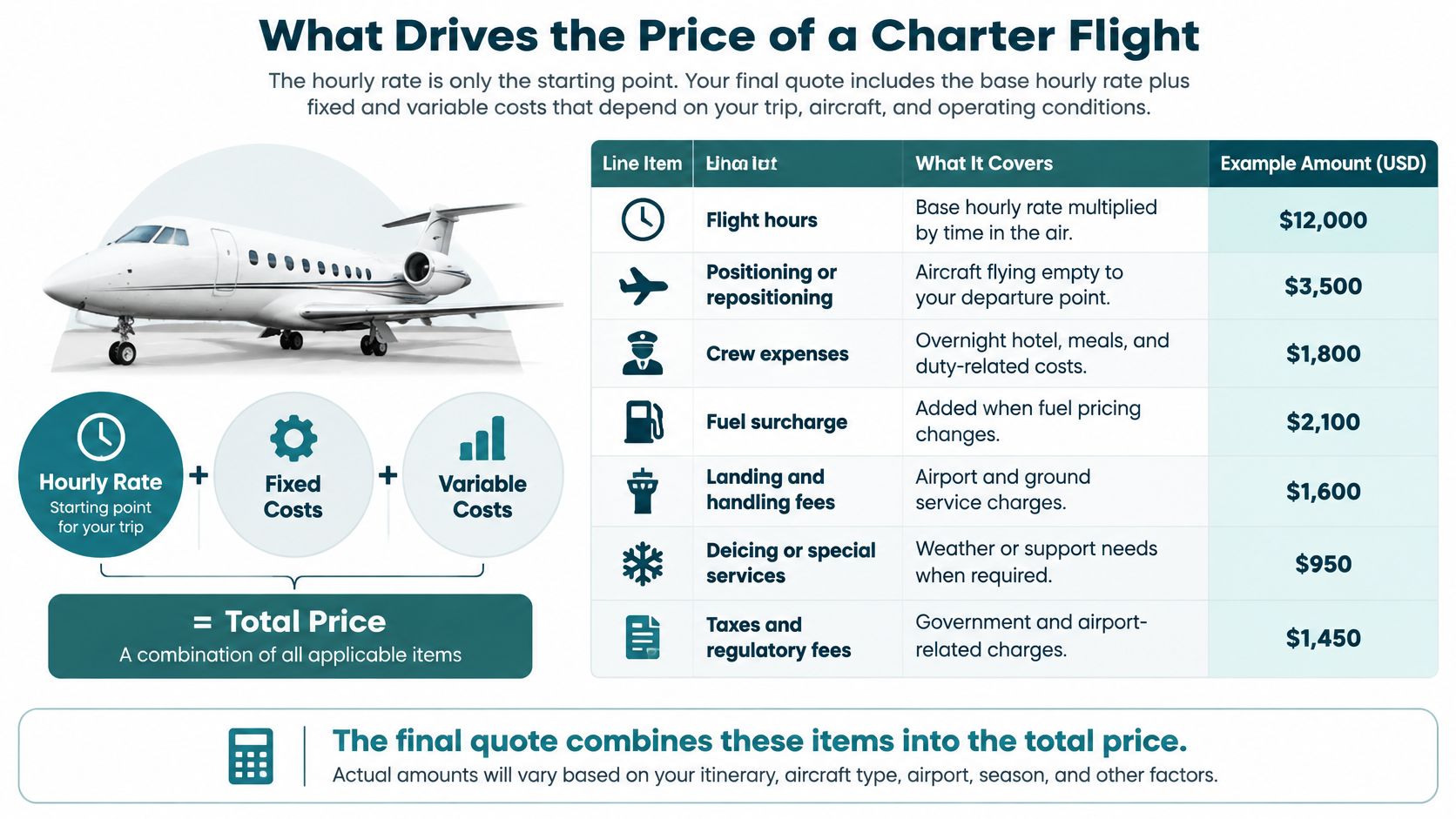
A charter quote is based on an hourly rate combined with fixed and variable charges, so the hourly rate is just the starting point. This is what contributes to the total.
Cost line | How it is billed | Typical effect |
|---|---|---|
Flight hours | Block time from departure to arrival | Largest share of most quotes |
Positioning or repositioning | Flight to collect the aircraft, often billed | Adds cost on one-way trips |
Federal Excise Tax | Percentage of the passenger charge | Applies to most domestic passenger charters |
Federal segment fee | Fixed amount per passenger per flight segment | Small per passenger, but adds up on multi-stop trips |
Landing and handling | Per airport and per visit | Varies widely at busy airports |
International fees | Customs, immigration and overflight charges | Added on cross-border trips |
Overnight and crew costs | Crew hotel and daily allowance on multi-day trips | Applies when the aircraft stays away |
Add-ons | Catering, ground transport and security | Optional, but often bundled into quotes |
Work the math on a sample trip
Take a midsize jet at $4,500 per hour, with 2.5 hours of flight time and 1 hour of positioning. That's 3.5 billable hours, or $15,750 before taxes and fees. Now add the 7.5% Federal Excise Tax on the passenger portion, roughly $1,180, and remember that segment fees and airport charges push the total further. Reproduce the same arithmetic with your own hourly rate and flight time and you'll know roughly where a quote should land before it arrives.
Positioning is the line first-time buyers overlook. If the aircraft has to fly empty to your departure airport, you may pay for that empty flying, which is why a one-way trip sometimes costs more per hour than a round trip on the same aircraft.
Ask this before you compare: "Is this quote itemized, and does it include positioning, taxes and airport fees?" Two totals built on different assumptions aren't comparable.
Quote validity matters too. Approved Jets quotes are valid for the period stated in them, or for 48 hours from issuance if no period is stated, and after expiration pricing and availability have to be reconfirmed. Get that window in writing.
Corporate buyers should also ask whether the quote includes sustainable aviation fuel or offsets, and request route-specific emissions data with its calculation boundary and passenger-load assumption. A single average figure won't survive an internal reporting review. On taxes, the client is responsible for duties, surcharges and regulatory fees on a charter, including Federal Excise Tax, segment fees, international customs and immigration fees, and local airport taxes, so budget for them rather than discovering them on the final invoice.
Book Your First Charter With Confidence
A three-person executive team needs to get from Boston to Chicago tomorrow morning. The commercial itinerary means a connection and a late arrival that costs half a working day. That's the moment the calculation shifts.
The decision rule: charter makes sense when the time saved, the schedule control and the privacy outweigh the cost gap, and a jet card starts to pay off for buyers flying several times a year.
Run the earlier sections against this trip. A light or midsize jet covers Boston to Chicago with room for three people and their luggage, and the route sits well inside either category's range. The service type depends on the return: one-way if the team stays and flies home commercial, round trip if the aircraft should wait or come back for them. The quote needs to be itemized so two offers can be compared line by line rather than on a single headline number.

Send the booking facts from the process section to a flight advisor at Approved Jets and ask for at least two quotes with the operator named on each. Flight advisors are available 24/7 for immediate charters at +1 (866) 678-1411, and you can also reach the team at charter@approved-jets.com.
Before you sign, run the operator checks and confirm two things in writing: the cancellation terms and the quote's validity window. Those two lines decide what happens when plans change, and plans change.
Approved Jets arranges private jet charter across the United States, Europe, Asia, South America and the United Arab Emirates, sourcing aircraft through a vetted operator network and naming the certificate holder on every quote. Whether you need a light jet for a regional hop or a heavy jet for a transcontinental trip, the team builds an itemized proposal around your route, passenger count and luggage, with the operator identified before you commit. Visit Approved Jets to send your trip details and get a written quote back.