Executive Travel: How Private Aviation Saves Time
Executive travel explained: how private aviation and coordinated trip services save time, protect discretion and keep schedules flexible in 2026.
15 min read
The average business trip now costs $1,128, up from $834 in the previous survey, a rise of about 35%, and 86% of travelers across 33 countries still describe their trips as worthwhile, according to the Global Business Travel Association's 2025 forecast. That pairing captures the executive-travel problem in a single line. Organizations are paying more per journey while the people taking them insist the journeys earn their keep.
Ticket price answers a much narrower question than the one that matters. A senior leader's journey consumes working hours, exposes the traveler to queues and delay, and generates an emissions record that lands in a Scope 3 filing. Judge the trip on total mission time, discretion controls and auditable emissions, and the comparison between a commercial seat and a chartered aircraft stops being a debate about comfort.
Table of Contents
- Why Executives Measure Travel in Lost Hours
- The Narrow Band of Trips That Carries the Risk
- Private Aviation Options Compared Side by Side
- Three Tests That Narrow the List
- How Time Savings Add Up on Each Journey
- The Components Most Estimates Leave Out
- Discretion and Schedule Control Beyond Speed
- What Discretion Actually Consists Of
- Where the Control Ends
- Matching Aircraft and Operators to Each Mission
- What Fits Which Trip
- The Checklist Before You Accept a Quote
- Measuring Emissions and Total Trip Cost
- The Fields Every Mission Needs
- Choosing Your Setup and Booking Path
- From Answers to a Setup
- The Booking Path in Four Steps
Why Executives Measure Travel in Lost Hours
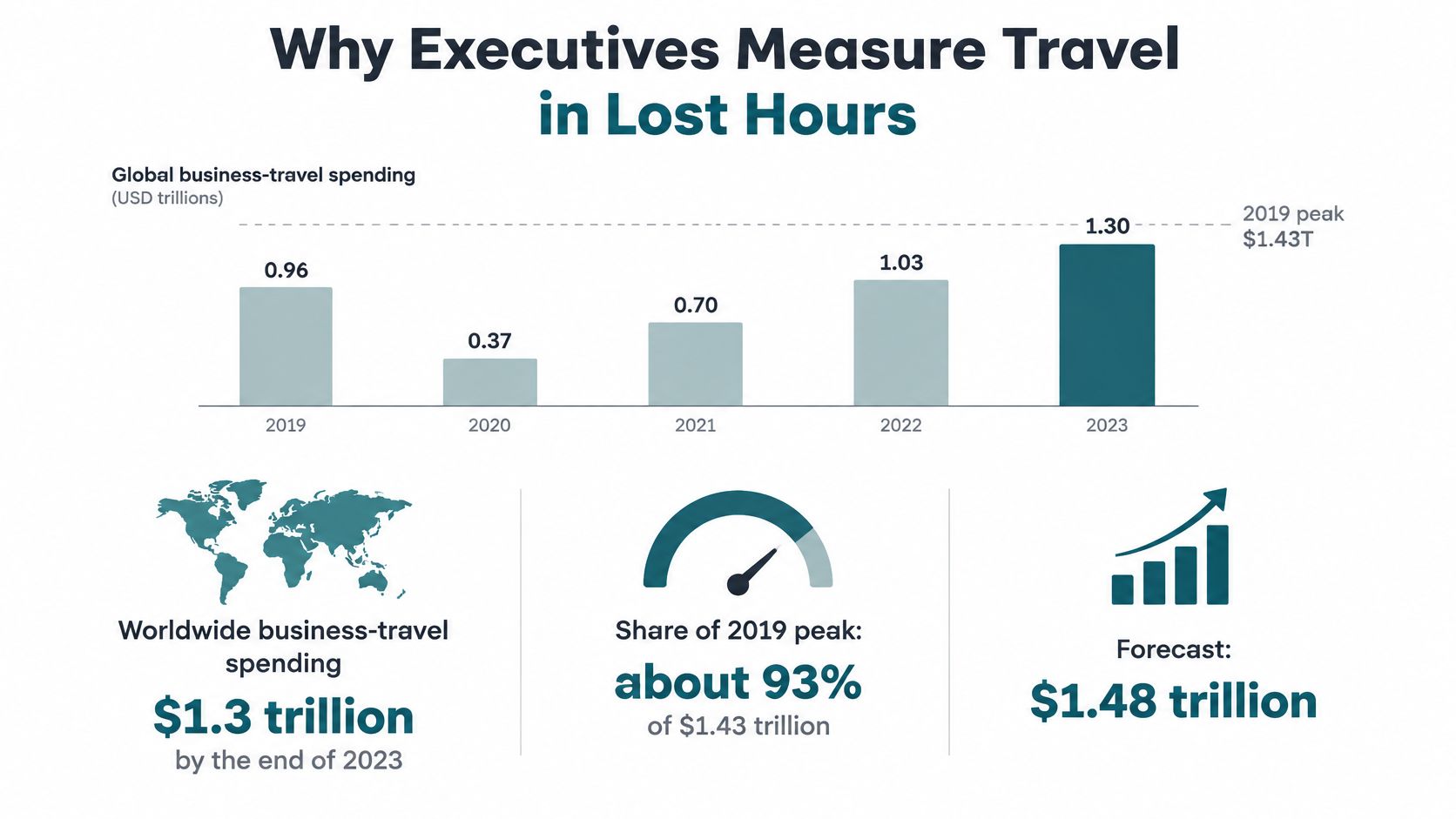
Business travel never shrank after 2020. The GBTA spending forecast puts worldwide business-travel spending at about $1.3 trillion by the end of 2023, roughly 93% of the $1.43 trillion recorded in 2019, after the sector lost an estimated $770 billion in 2020 and clawed back about $675 billion of it. That recovery represented 30% growth on 2022. The 2024 forecast of $1.48 trillion sat about $50 billion, or 3.5%, above the previous record and 11.1% above 2023, with $1.57 trillion projected for 2025 and more than $2 trillion by 2029. Treat the last two figures as projections rather than receipts.
The shape of that recovery is the backdrop for every travel-policy decision being made this year, which is why the spending curve is worth seeing before the arguments start.
The Narrow Band of Trips That Carries the Risk
Executive travel is a subset of that total: the journeys senior leaders take for client meetings, site visits, board sessions and cross-border operations. Volume is modest against the whole market. Consequence per trip isn't. A missed connection on a $400 fare can cost a board vote, a signing or a plant opening, and the fare is the smallest number in that ledger.
Think of a private aircraft as an office that happens to be at altitude. The seat isn't a reward for seniority. It's a desk where the traveler can take a call, review a document and reach the meeting with the work already done. That reframing changes what gets compared: not luxury against economy, but productive hours, control over timing and exposure to disruption.
Three levers decide whether a journey earns its cost. Time is the hours the itinerary consumes door to door. Discretion is how many crowded touchpoints the traveler passes through and how confidentially the arrangements are handled. Schedule flexibility is what happens when the meeting runs ninety minutes long. Physical recovery sits alongside them: when two long legs and four meetings stack into two days, the bill arrives the following week, and ease travel neck tension with SunnyBay covers positioning and recovery habits worth building into a dense itinerary.
This guide works through three questions in order:
- What are the options? Five structures, from a business-class seat to a share of an aircraft, each buying a different kind of control.
- How much time does each save? The door-to-door measurement, plus the arithmetic that turns saved hours into a comparable number.
- How do you choose and report the trip? A booking path that ends with actual times against the estimate, and emissions data that survives an audit.
Private Aviation Options Compared Side by Side
Five structures sit between a business-class seat and a share of an aircraft. They differ in what you commit to before the first flight, not only in what the flight costs. Scan for the row that matches your travel pattern, then test it against the three filters underneath.
Option | How You Pay | Booking Lead Time | Best For | Main Trade-Off |
|---|---|---|---|---|
Commercial business or first class | Per seat | Days to weeks, same day possible | Routine trips with flexible timing | Connections, queues and fixed schedules |
Semi-private (fly-sharing) | Per seat on a shared flight | Scheduled departures | Solo travelers seeking lower cost | Fixed routes and departure times |
Jet card | Prepaid flight hours | Planned in advance | Frequent flyers who want predictable access | Minimum commitment; hourly rates vary by aircraft |
Private charter (whole aircraft) | Per flight quote | Hours to days, subject to availability | Multi-stop or time-critical trips | Higher total cost; quotes change with fuel and fees |
Fractional ownership | Share of aircraft plus usage fees | Planned in advance | High, steady utilization | Long-term commitment and shared scheduling |
Three Tests That Narrow the List
Trip frequency is the first filter. A handful of journeys a year rarely justifies prepaid hours, because unused balances and minimum commitments sit on the balance sheet whether or not anyone flies. Steady monthly travel changes the arithmetic, which is why road-heavy teams drift toward jet cards and shares rather than ad hoc charter.
Passenger count decides whether you're buying seats or an aircraft. A solo traveler can take a shared seat and keep the cost near a premium airline fare. Four colleagues with luggage and one shared schedule need the whole cabin, and at that point the honest comparison is a charter quote against four business-class fares plus the cost of moving everybody through a terminal together.
Lead time separates planned from urgent. Prepaid access rewards booking ahead, while availability governs everything when a meeting moves to tomorrow morning. Short-notice missions are feasible, but only when an appropriate aircraft is positioned and authorized for the route.
No row wins on every criterion. Semi-private saves money and surrenders departure times. Charter buys control and charges the whole aircraft to one mission. A card smooths access and ties you to a provider's fleet. Ownership gives the most predictable availability and the longest commitment.
Treat every quote as an estimate. Fuel, positioning, landing, overnight and de-icing charges move between the first call and the invoice, so the structure you pick matters more than the first number printed on it.
How Time Savings Add Up on Each Journey
Executives flying business aviation report saving roughly two to three hours per journey compared with commercial flights, according to a 2025 survey of 67 senior professionals across China, Hong Kong and Singapore, with 5% reporting savings above three hours, as Aviation Updates Philippines reported. The saving isn't mostly in the air. It's door to door: direct routing, less airport processing, fewer connection risks, and arrival at an airport closer to the operating site.
Network access turns out to matter as much as speed. The same study found 72% of respondents had at least one-quarter of their routes unserved by commercial aviation, which means the alternative wasn't a faster flight but an extra overnight and a long drive.
The Components Most Estimates Leave Out
Block time is the number airlines publish. Mission time is the number the traveler experiences.
- Arrival buffer: the gap between leaving the office and being at the gate, which most schedules absorb.
- Checkpoint and boarding: security queues, gate walks, boarding groups and the aircraft's own departure sequence.
- Connection buffers: the layover built to protect against a delay you may never get.
- Ground transfers: cars at both ends, plus the walk between terminal and curb.
- Disruption recovery: the hours lost when a missed connection becomes a rebooking.
Take a same-day board meeting between two major cities. The commercial itinerary carries every item on that list before the meeting starts and again on the way home. A private plan can depart from a business-aviation terminal and coordinate the car around the meeting's actual end time.
Practical rule: measure the itinerary from the executive's desk to the meeting room, not from gate to gate. The gap between those two numbers is what you're actually buying.
Put a hypothetical number on it. Suppose an itinerary saves three hours and the fully loaded hourly value of that executive's time is $800. That's $2,400 of recovered capacity per journey. If the charter premium over a flexible commercial fare runs to five figures, time value alone doesn't close the gap. The case then rests on what the recovered hours produce: the meeting that happens instead of an overnight, the second client visit added to the same trip, the departure that waits for the vote to finish. Use an executive travel itinerary template to lay each leg against meeting times so the comparison is visible rather than assumed.
The survey sample was small and regional. Use the two-to-three-hour figure as a planning benchmark, then replace it with your own recorded times after four or five trips.
Discretion and Schedule Control Beyond Speed
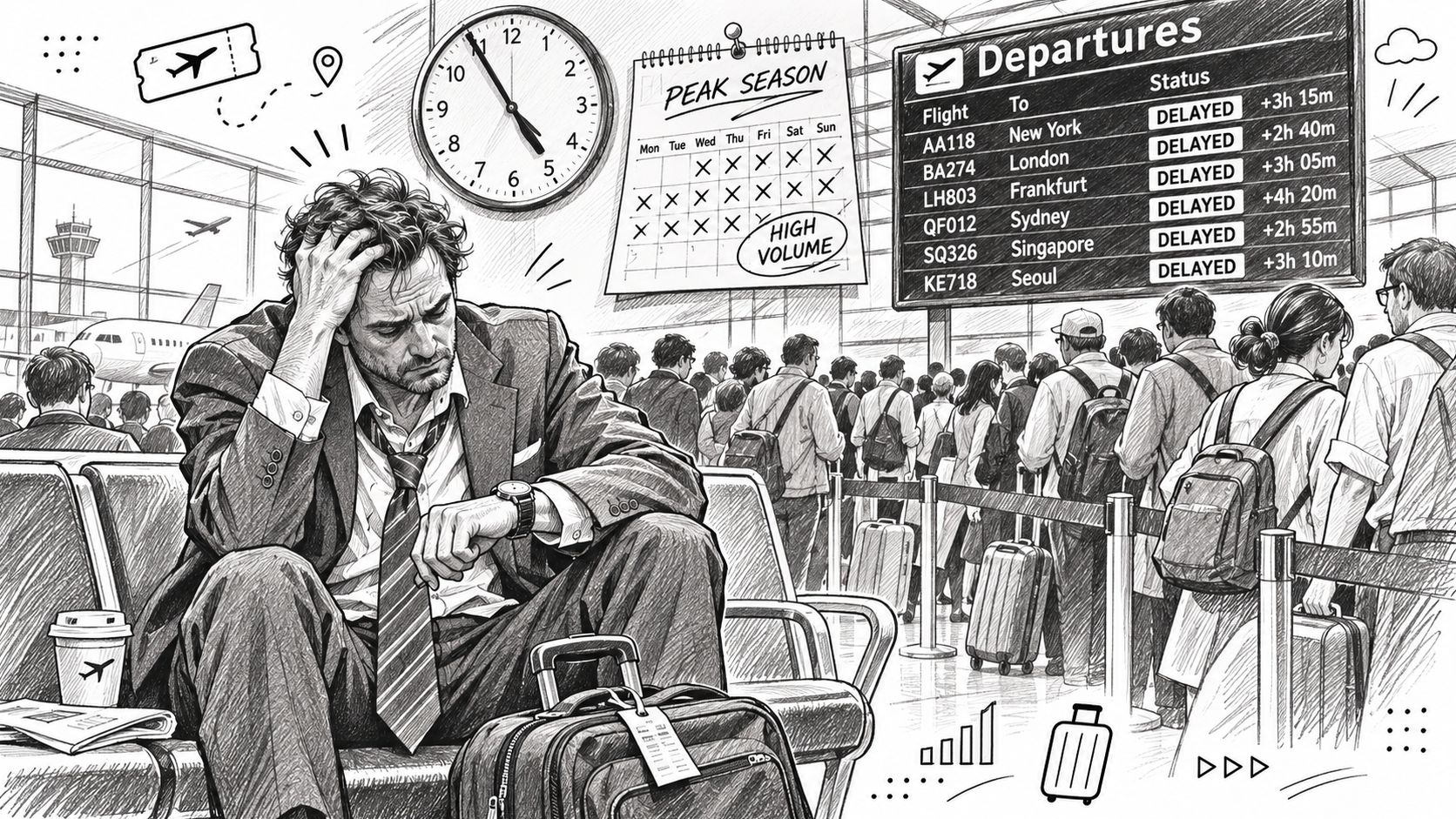
Commercial terminals put a floor under how much of a trip anyone controls. The Transportation Security Administration reported that all ten of the busiest days in its history fell in 2024, including July 7, when officers screened more than 3 million passengers nationwide, and it projected 18.3 million people through checkpoints over the 2024 Thanksgiving period, about 6% more than the comparable stretch a year earlier (TSA). The agency's stated wait-time standards, under 10 minutes in PreCheck lanes and under 30 minutes in standard lanes, are targets for an airport rather than guarantees for a specific traveler on a specific morning.
For a fixed 9 a.m. meeting, that queue is a variable in the itinerary, not a footnote. The image below is the version of the trip most executives recognize.
What Discretion Actually Consists Of
Discretion isn't upholstery. It's a set of controls: fewer crowded touchpoints, a private terminal instead of a public concourse, limited exposure while waiting, and confidential handling of manifests, itineraries and passenger names. A traveler who arrives and walks a short distance to a waiting car has a different exposure profile from one who arrives and queues for a taxi rank with a name board in the arrivals hall.
Ground arrangements carry much of that weight. We coordinate ground transport, catering, security and special requests for each journey and manage the complete trip, which keeps the logistics out of a public terminal. Round-the-clock coverage is what turns an overrunning meeting into a shifted departure instead of a rebooked connection, and a 24/7 concierge service is the difference between those two outcomes on a Friday evening.
Sensitive work needs the same treatment before anyone leaves. An acquisition site visit or a talent negotiation requires confidential planning for sensitive projects built into the first brief, not added at check-in. Accessibility belongs in that brief too as a standard element. Only 18% of corporate travel buyers say their programs accommodate accessibility needs extensively, and 44% say they're unaware of employee requests for accessible services, according to the GBTA October 2025 poll. A pre-trip conversation handles more than a checkbox ever will, particularly for needs the traveler would rather not announce.
Where the Control Ends
Discretion depends on the operator, the airport's handling arrangements and the destination. It should be written into the trip brief as a requirement, then verified: who meets the aircraft, who holds the manifest, which areas the traveler passes through, and who speaks to the press if anyone does. Assumed discretion is the version that fails.
Matching Aircraft and Operators to Each Mission
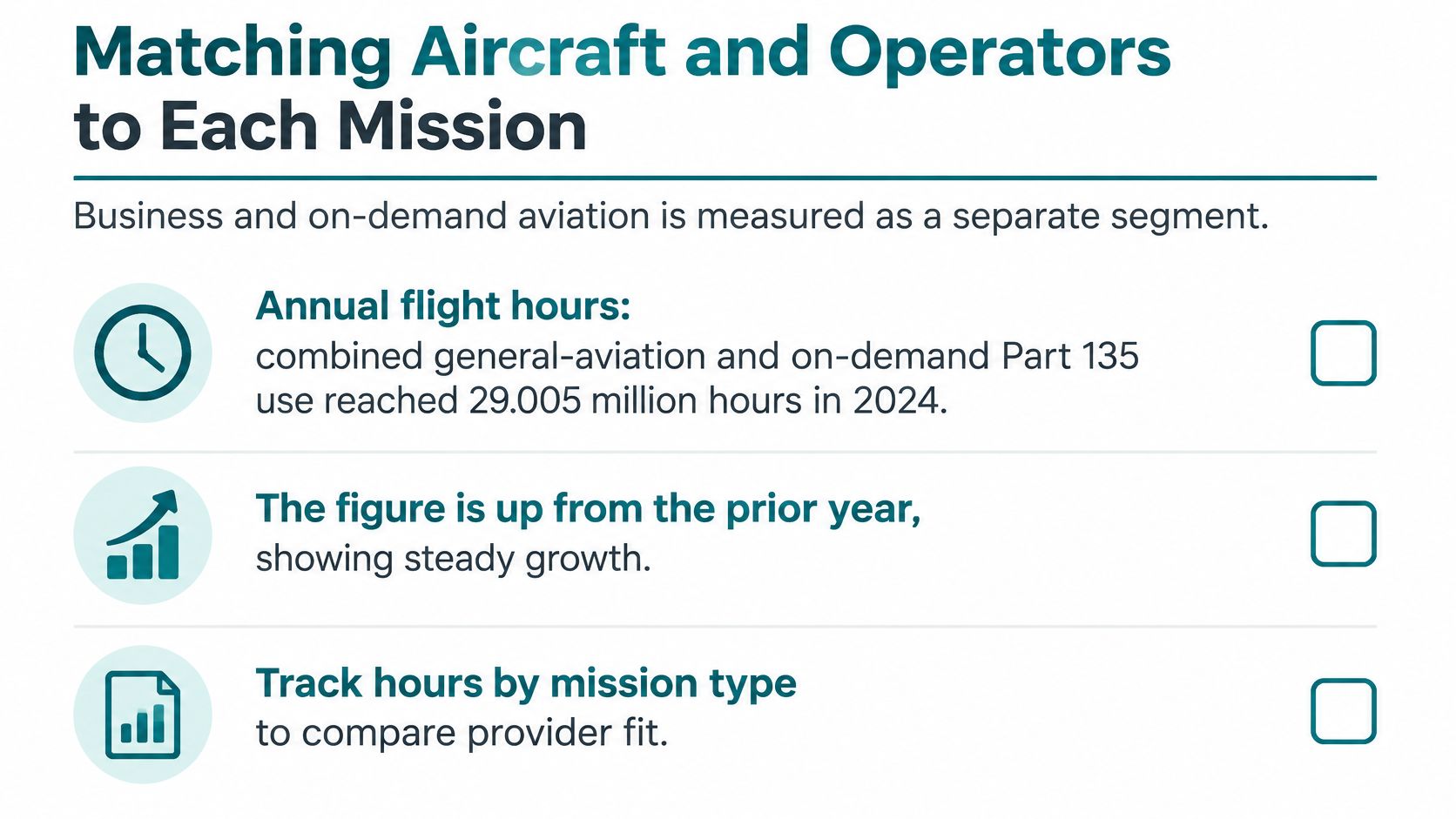
Business and on-demand aviation is a separately measured operating segment, not an occasional hobby. The FAA's 2024 activity survey estimated 29.005 million hours of combined general-aviation and on-demand FAR Part 135 use, against 28.563 million hours in 2023 and 22.875 million in 2013, an increase of roughly 1.5% year over year and about 26.8% across the decade (FAA 2024 activity survey). Inside that total, business flying without a paid flight crew accounted for 14.253 million hours and business flying with a paid crew for 9.354 million hours.
Those categories matter because a quote names an aircraft while a mission is defined by crew, category and regulatory status. The same city pair can call for a crewed Part 135 charter for a management team and fall into a different reporting category for a company flying its own aircraft. The distinction drives compliance checks, operator qualification, crew planning and realistic availability.
What Fits Which Trip
Trip Profile | Usually Fits | Verify Before Booking |
|---|---|---|
Solo day trip, one city pair | Light or midsize jet, or semi-private seat | Schedule and seat availability |
Four travelers with oversized presentation kit on an international leg | Midsize or super midsize jet | Range, baggage volume and customs clearance |
Executive team visiting several cities | Crewed charter, often multi-leg | Crew duty limits and positioning flights |
Corporation operating its own aircraft | Owned or managed aircraft | FAA reporting category and compliance status |
Medical or high-value cargo move | Specially equipped aircraft | Equipment, handling and chain-of-custody controls |
A request moves through a fixed sequence. We receive and process the quote request and travel requirements, source aircraft and operators through the network, and present charter options with pricing and itinerary details. Before the aircraft is confirmed, a flight advisor verifies luggage requirements, because baggage volume eliminates more aircraft than range does on short and medium legs.
The Checklist Before You Accept a Quote
- Range with reserves: confirm the leg, the alternate and the weather allowance, not the brochure figure for a still-air day.
- Baggage reality: count hard cases, golf bags, presentation crates and their dimensions, then match them to hold volume rather than a passenger number.
- Customs and border requirements: identify where clearance happens and who files the paperwork for each stop.
- Crew duty and positioning: on a three-city day, ask where the crew started and how the aircraft gets to the first airport.
- Operator credentials: request the safety credentials and certificate details for the specific operator, not the network average.
Scale is the reason the last item can't be waved through with a fleet count. The FAA's sample for this survey covered 85,010 aircraft and is designed to measure activity and fleet composition rather than to rank safety or certify any operator, as the FAA methodology explains. A network can list a thousand aircraft and still have nothing positioned, authorized and correctly sized for your mission tomorrow morning.
Measuring Emissions and Total Trip Cost
Per-seat emissions math breaks the moment the aircraft is exclusive. Travalyst's emissions framework calculates private-aviation emissions from aircraft-specific fuel burn and flight distance, assigns the emissions of the entire aircraft to the journey rather than dividing them by passenger seat, and includes a known empty repositioning leg in the footprint.
The consequence is easy to get wrong. Comparing a charter with a commercial itinerary using only passenger-kilometre factors will materially understate the charter's attributed emissions, which then makes the reporting look better than the operation is. If the number is going into a disclosure, it needs to survive the question of how it was built.
The Fields Every Mission Needs
- Aircraft type: the airframe determines the burn rate far more than distance alone.
- Routing distance: the flown route, including any diversion for weather or airspace.
- Fuel-burn assumption: the figure used, stated explicitly so two trips can be compared.
- Passenger count: recorded even though it doesn't divide the total, because it drives consolidation decisions.
- Empty-leg status: whether a repositioning leg is known and whether it's included.
Collect those five fields per mission and report with one consistent fuel-based or distance-based method. Mixed methods produce a chart nobody can audit.
Cost completeness follows the same discipline. Ask for line items on fuel, positioning, landing, overnight, de-icing, catering and ground transport rather than a single total, then compare like with like against the commercial alternative, including the overnight the airline itinerary requires and the productive hours it consumes.
Measurement pressure is rising even as tracking thins. The Deloitte 2025 corporate travel study found 48% of travel managers optimizing travel to mitigate environmental impact, while the share who said their organizations needed to cut travel volume by at least 20% rose to 45% from 24% a year earlier. Yet the share tracking sustainable aviation fuel fell from 48% to 25%, and the share tracking emissions per flight declined from 38% to 30%. Ambition is outrunning the data.
Two misconceptions are worth retiring. Offsets don't erase operational impact, so they belong in a separate line from the trip footprint. And an emissions figure doesn't prove one mode is always preferable; it defines the inputs for an honest comparison. If the output feeds a wider inventory, it helps to find a net-zero strategy consultant who can align trip-level data with the corporate method instead of building a parallel one.
What lowers the number is operational: consolidate passengers onto one aircraft, right-size the airframe to the mission, reduce empty repositioning, and coordinate ground legs so a single vehicle covers the day.
Choosing Your Setup and Booking Path
Five questions, answered with care, will point to a setup before you speak to anyone. Write the answers down; they become the brief.
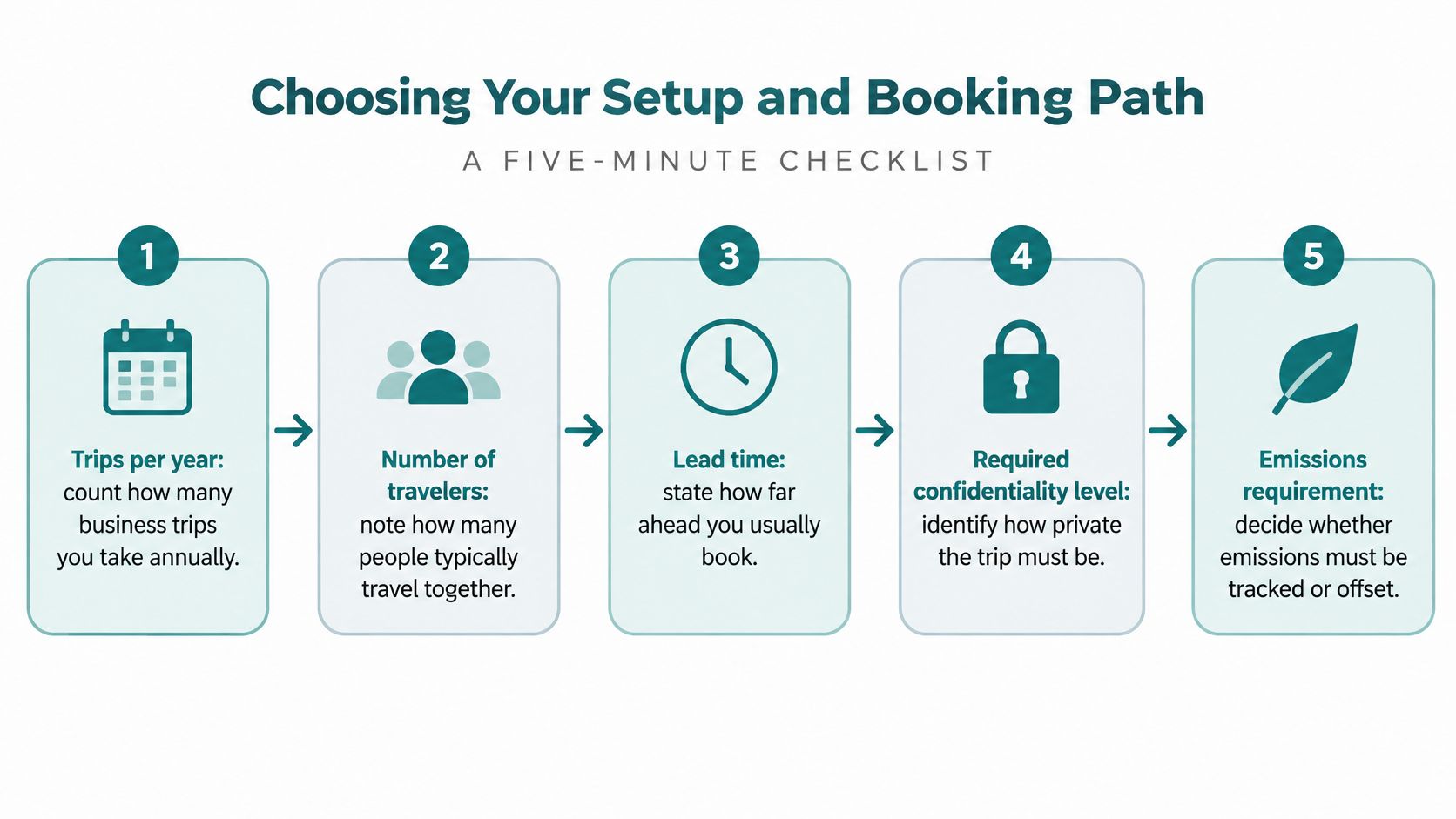
- Trips per year: count journeys, not legs. Three or four points to charter; monthly or more opens the card and share conversation.
- Travelers per trip: note the typical party size and the largest one, since a single traveler and a team of five are different purchases.
- Lead time: state how far ahead you usually book, and how often trips appear with a day's notice.
- Confidentiality level: decide whether the trip needs a private terminal, restricted manifests and controlled ground contact.
- Emissions requirement: confirm whether emissions must be reported per trip, and to which method.
From Answers to a Setup
Few trips, one or two travelers, flexible timing: commercial or semi-private, with charter reserved for the days when timing collapses. Steady monthly travel with a team: a card or share for predictable access, and charter for the multi-stop weeks when one aircraft beats five seats. High confidentiality with short notice: charter, because the controls travel with the aircraft. Whatever the answer, test it against one rule. If the option can't be explained in terms of mission time, control and emissions, it isn't a strategy yet.
The Booking Path in Four Steps
- Inquiry and Discovery: share route, dates, passenger count, luggage volume, and any customs, accessibility or equipment needs.
- Aircraft Sourcing and Quoting: compare categories and operators, then request line-item pricing covering fuel, positioning, landing, overnight, catering and ground transport.
- End-to-End Logistics: confirm ground transport, catering, security coordination and customs paperwork, and write the discretion requirements into the trip brief.
- Wheels-Up and Beyond: track the departure, confirm arrival handling, and record the actual door-to-door times against the estimate you built.
If you're weighing structures for the first time, a plain explanation of aircraft charter brokerage clarifies who does what between the request and the flight, which is usually where first-time buyers lose a day.
Then act once, properly. Send a complete brief, with route, dates, party size, luggage, confidentiality and emissions requirements, and ask for options with itemized costs. Score every option against the same four criteria: hours saved door to door, total cost including the overnight and the ground legs, discretion controls confirmed in writing, and the emissions fields you can report. Run the mission-time arithmetic before the meeting is booked, not after the invoice arrives.
Approved Jets arranges corporate charter for executives and teams whose schedules can't absorb a rebooked connection, matching aircraft to the route, passenger count and luggage requirements and coordinating ground transport, catering, security and customs paperwork as one trip. If you're weighing a specific itinerary against a commercial plan, our flight advisors will build the comparison on mission time rather than ticket price. Start at Approved Jets and send the brief.