End to End Logistics in Private Aviation: A Practical Guide
End to End Logistics in Private Aviation covers quotes, aircraft, customs, ground transfers and arrival. See the stages, steps and data behind a smooth trip.
14 min read

Ships carried roughly 12.3 billion tons of global maritime trade in 2023, a 2.4% rebound after a contraction the year before, and maritime transport still moves more than 80% of world trade by volume, according to UNCTAD's Review of Maritime Transport 2024. That single number explains why the working language of freight is handoffs, cut-off times and proof of release. The vehicle is almost never the constraint.
Private aviation inherits that language whether it likes it or not. A jet can leave Miami in the morning and be in Bogotá by lunch, and the trip can still fail at four in the afternoon because nobody booked the car, signed the export document, or told the receiving hospital which terminal to send a wheelchair to.
End to end logistics is the coordinated control of a trip from first inquiry to final arrival, judged by whether the whole journey completes on time rather than whether the aircraft departs on time. The chain has seven stages, and most of the failures happen in the five that don't involve flying at all.
Table of Contents
- The Seven Stages of End-to-End Logistics for Private Trips
- Why One Flight Never Makes the Whole Trip
- From Quote to Wheels-Up and Pre-Book Checks
- Three questions to ask any provider before you commit
- Customs, Documents and Who Validates Them
- Ground Transfers, Catering and Arrival Support
- Tracking Milestones and Who Owns Each One
- Resilience Planning When a Leg Fails
The Seven Stages of End-to-End Logistics for Private Trips
A private trip runs through seven stages, and each one has a different owner and a different piece of evidence that proves it's finished. Our own booking process groups the work into four steps (Inquiry & Discovery, Aircraft Sourcing & Quoting, End-to-End Logistics, and Wheels-Up & Beyond), and every one of them lands somewhere in the table below.
Read it down the left column and notice how often the aircraft appears. It shows up in two rows. The other five are people, paperwork and vehicles on the ground.
Stage | What happens | Owner | Output |
|---|---|---|---|
Inquiry and discovery | Goals, passengers, luggage and timing captured | Broker and client | Mission brief |
Aircraft sourcing and quote | Operators matched, options and pricing presented | Broker | Quote within 2-hour target |
Booking and funding | Charter agreement signed, cancellation terms reviewed, funds cleared | Client and broker | Confirmed booking |
Ground and document planning | Transfers, catering, security, customs and pet paperwork arranged | Trip coordinator | Document checklist and transfer schedule |
Departure | Pre-flight checks and aircraft status confirmed | Operator and crew | Dispatch approval |
Flight | Live oversight from departure | Trip coordinator | Status updates |
Arrival support | Ground transfer and hand-off at destination | Coordinator and ground team | Arrival confirmed |
The useful thing about this map is that it lets you localise your own risk instead of carrying a vague worry about the whole trip. A medical mission usually carries its risk in the document row, where a single missing permit can ground an aircraft that's otherwise ready. A family flying to Europe with two dogs carries it in ground and document planning too, but for entry rules rather than clinical paperwork. A board meeting that cannot move carries it in aircraft sourcing, because the wrong category of jet with a short runway limitation can turn a two-hour flight into a five-hour drive.
Practical rule: name the stage where a delay would cost you the most, then read that stage's detail below before you compare prices. Price comparison across two quotes usually reveals less than a side-by-side of who owns each row.
A provider that can tell you who owns each of these rows without going away to check is usually one that has run the trip before. When the answers arrive late or vague, the gap shows up on the day, not in the quote.
Why One Flight Never Makes the Whole Trip
A relay team can field four fast runners and lose by ten metres, because races of that kind are decided at the changeover, not the sprint. Drop the baton and the speed of the legs stops mattering.

That's the honest way to read a private flight quote. The aircraft is one leg. The baton is everything that changes hands around it.
The World Bank's 2023 Logistics Performance Index scored 139 countries on six connected capabilities, from customs and border-clearance efficiency through tracking and tracing to delivery timeliness. Its most consequential benchmark found that, on average across potential trade routes, 44 days elapsed between a container entering the exporting country's port and leaving the destination country's port. That port-to-port interval represented approximately 60% of the total time required to trade goods internationally, and ocean transit was only one component inside it. Clearance, handoffs, documentation, inland transport and port processes made up the balance.
So even in freight, where nobody is boarding a plane, most of the clock runs when the cargo is standing still. The World Bank also reported that digital coordination across the end-to-end chain, particularly in emerging economies, could cut port delays by as much as 70% compared with less digitally enabled processes, which tells you the delays are coordination failures rather than speed limits.
Watch how many separate companies touch one container before it reaches a customer. The count is the argument.
Now translate it to a passenger. A family lands exactly on schedule at a private terminal, but the transfer was never booked, so they stand in the FBO lobby for forty minutes while someone calls around for a van. The aircraft performed perfectly. The trip still felt late, and the meeting started late.
The test to apply to any quote: does it include what happens after landing, with a named owner and a time attached? If the answer is "we can arrange that", you're buying a flight, not a journey.
From Quote to Wheels-Up and Pre-Book Checks
A charter can have the right aircraft and still fail before departure if the luggage does not fit, the funds have not cleared, or nobody owns a late schedule change. Pre-book checks work like a relay: each handoff needs a clear owner, and the next person needs the information in time to act.
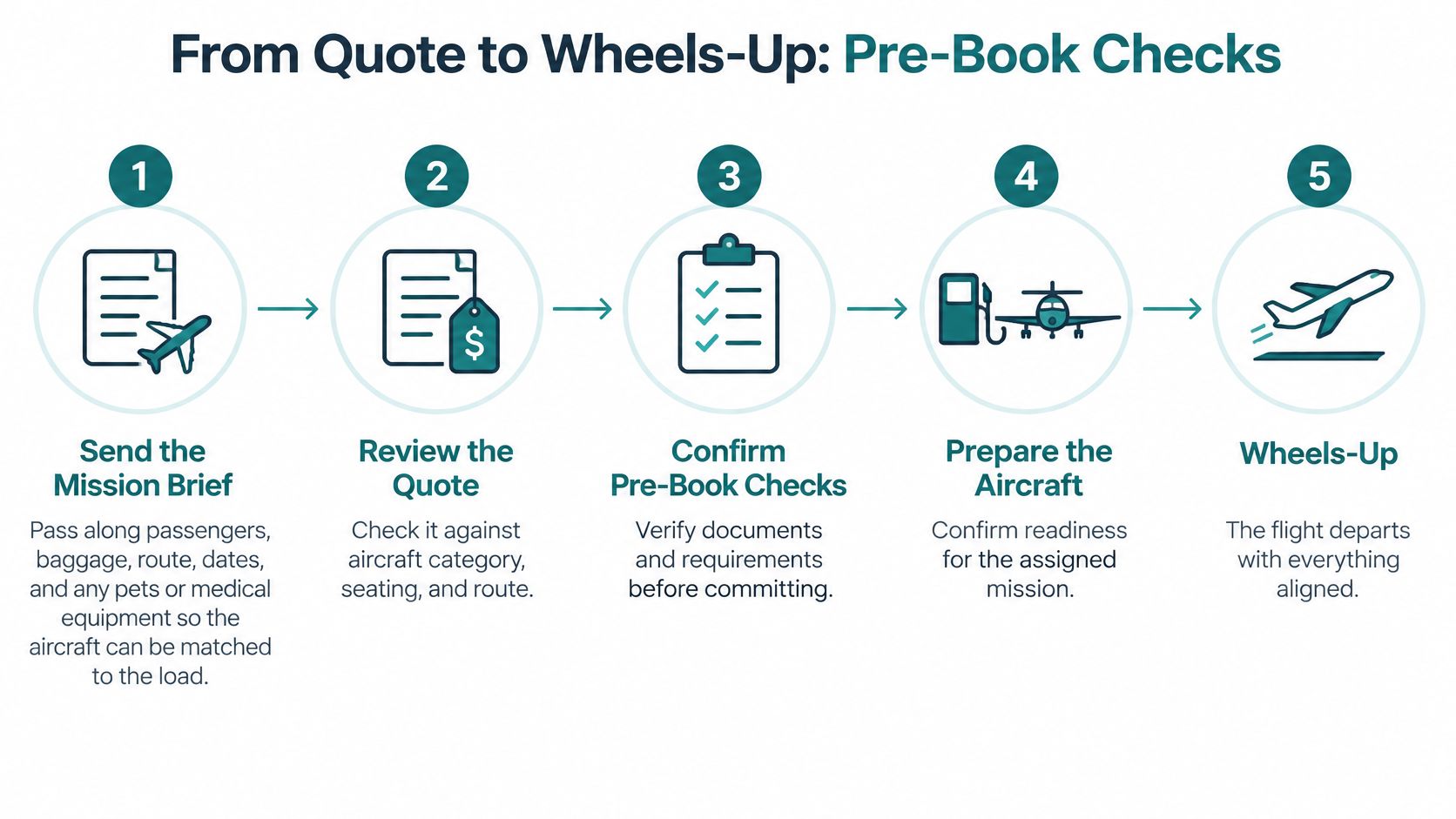
- Send the mission brief. Include passengers, luggage, route, dates, pets and any medical equipment. Aircraft are matched to the trip's requirements, not just its passenger count. A flight advisor verifies luggage requirements before the aircraft is finalized, since nine passengers with large cases may need a different cabin or aircraft than nine passengers traveling light.
- Review the quote against the mission. Check the aircraft category, seat count and itinerary against what you requested. Approved Jets targets a two-hour turnaround for quotes. Confirm that the options and pricing reflect the trip you described.
- Read the cancellation terms before signing. The exact terms are provided before the charter agreement is signed. Check how they apply to a change of plan while you still have time to make an informed decision.
- Confirm payment timing. Full cleared funds are required before wheels-up. A verbal agreement does not meet that requirement.
- Clarify who handles each handoff. Approved Jets sources aircraft and Operators through its network, presents charter options, pricing and itinerary details, and facilitates communication between the client and the selected Operator. It also assists with payment processing and booking logistics. Ask who will relay changes and who will contact you if an operational decision affects the plan. This guide to aircraft charter brokerage explains the broker's role in arranging a charter.
- Ask how the selected Operator checks aircraft status. FAA operational guidance describes real-time airworthiness oversight as a distinct coordination task. The Operator tracks an aircraft's status, informs dispatch, uses approved equipment lists to assess in-service aircraft and determines whether a discrepancy can be repaired or deferred under accepted procedures, as described in FAA Advisory Circular 120-101. If a system issue arises before a multi-leg trip, the Operator must assess whether the aircraft can legally depart, coordinate any maintenance and update flight-following contacts. A problem that cannot be deferred may require a replacement aircraft and changes to ground arrangements.
Maintenance oversight also matters. FAA guidance for Part 121 and Part 135 carriers covers maintenance-program responsibilities such as airworthiness, required inspection items, recordkeeping and continuing surveillance. Ask how the Operator tracks maintenance status, particularly when an aircraft is away from its usual base.
- Name the flight-following contact and check the departure window. Confirm who will provide updates and how you will be reached if the schedule changes. A contact name and phone number make the handoff clear.
Three questions to ask any provider before you commit
- Which milestones do you track? Ask for the few that would change your decisions, not a stream of updates without context.
- Who owns each one? Get a named role and a way to reach that person.
- What happens if one is late? Look for a decision trigger and a next step, such as revising the pickup time if departure moves.
Booking with 24 to 48 hours of notice gives the widest selection of aircraft and more room for specific catering or logistical requests. With less notice, the available options may be narrower.
Before anyone leaves for the terminal, check that the aircraft and crew are confirmed, the trip arrangements are in place and funds have cleared. If one item is still open, find out who owns it and when they will resolve it.
Customs, Documents and Who Validates Them
Real-time tracking doesn't mean a trip is legally cleared. A shipment or a passenger can be visible in flight and still be operationally blocked by a missing permit, an inconsistent commodity description, a sanctions screen that hasn't run, or a customs-data mismatch.
That distinction matters more in private aviation than most clients expect, because the terminal changes and the immigration requirement doesn't. If you're new to it, this guide to flying internationally by private jet covers what changes at the border.
Trip type | Key documents | Who validates | Last safe submission time |
|---|---|---|---|
Corporate passenger trip | Passports, visas, passenger manifest | Trip coordinator and crew | 72 hours before departure |
International pet travel | Health certificate, rabies vaccination record, import permit | Coordinator and destination authority | 48 hours before departure |
Medical mission | Fit-to-fly confirmation, medical equipment manifest, customs declaration | Medical team lead and coordinator | 24 hours before departure |
High-value cargo | Air waybill, commercial invoice, packing list, export licence | Customs broker and coordinator | 48 hours before departure |
Group or sports team | Manifest, visas, equipment carnet | Coordinator and operator | 72 hours before departure |
The air-cargo industry is trying to close this gap. It's moving toward IATA's ONE Record standard, intended to replace fragmented messages with a single shipment record, and a 2025 example involving Cathay Cargo and GLS Hong Kong enabled real-time sharing of customs-clearance statuses and reduced manual updates, as IATA's ONE Record update reports. Until that's universal, fragmented systems keep producing manual handoffs, and manual handoffs are where documents go missing.
Pets are the clearest everyday case. An animal flying internationally needs health and entry certificates checked against destination rules before departure, not at the counter, and for international flights with pets the customs paperwork here is handled by Approved Jets. Travelers assembling the rest of their file will find a useful pre-departure document checklist from BTOURS covering general travel paperwork that is often forgotten.
Then there's money. The client is responsible for taxes, duties, surcharges and regulatory fees on a charter, including Federal Excise Tax, segment fees, international customs and immigration fees and local airport taxes. Travelers routinely budget for the flight and get surprised by the fees attached to crossing a border.
For cargo, run four checks before the truck leaves. The commodity description matches the paperwork word for word. Every permit is current for the dates of travel. Sanctions screening is complete and documented. Proof of release is on file, not promised. Our cargo and logistics service moves high-value goods, sensitive equipment and urgent freight, and the document set travels with the shipment rather than behind it.
The question that closes the loop: who signs off each document, and by when? Anything vaguer than a name and a time is a gap waiting for a Monday morning.
Ground Transfers, Catering and Arrival Support
The last hour of a trip decides how the whole thing is remembered. Here's a worked example of a well-built arrival.
A six-person team lands at 18:40. The transfer is booked for 19:00, not for the scheduled landing time, so it absorbs a twenty-minute slip without anyone standing on a curb. Hotel check-in is pre-confirmed under the lead traveler's name. A backup driver is named in the file, with a number, in case the first is stuck in traffic. Nobody in the group has to make a decision after a nine-hour day.
The private terminal is what makes that timing realistic. Arriving 15 to 30 minutes before departure at a private FBO removes the security lines and crowds that make commercial connections unpredictable, and it works the same way on the return. Teams planning ground movements at both ends of a longer trip often find a transport checklist for remote team offsites useful for the parts that happen away from the airport.
Catering follows flight length rather than budget. A short regional hop needs a light snack and decent coffee. A transcontinental leg needs full meals, and dietary requests confirmed in advance rather than mentioned at the gate. For Midsize, Super Midsize and Heavy jets, VIP catering including custom hot meals from a favorite restaurant can be arranged on request, which is the kind of detail that turns a working flight into a usable one.
What ties it together is ownership. Approved Jets coordinates ground transport, catering, security and special requests for each journey and manages the complete trip, so the arrival plan isn't a separate vendor's problem.
Confirm these 48 hours before landing:
- Pickup address and entrance. Hospitals, hotels and stadiums all have a wrong door that looks like the right one.
- Driver contact and vehicle size. Luggage volume, not passenger count, decides the vehicle.
- Backup arrangement. A named alternative, not "we'll send another one".
- Dietary and accessibility requests. Passed to catering and ground transport in writing.
Tracking Milestones and Who Owns Each One
A trip can have clear status updates and still lack clear ownership. The weak points tend to appear when responsibility passes between the client, broker, Operator, customs, and ground team. Each handoff needs a named owner, a recorded time, and a specific response if the milestone slips.
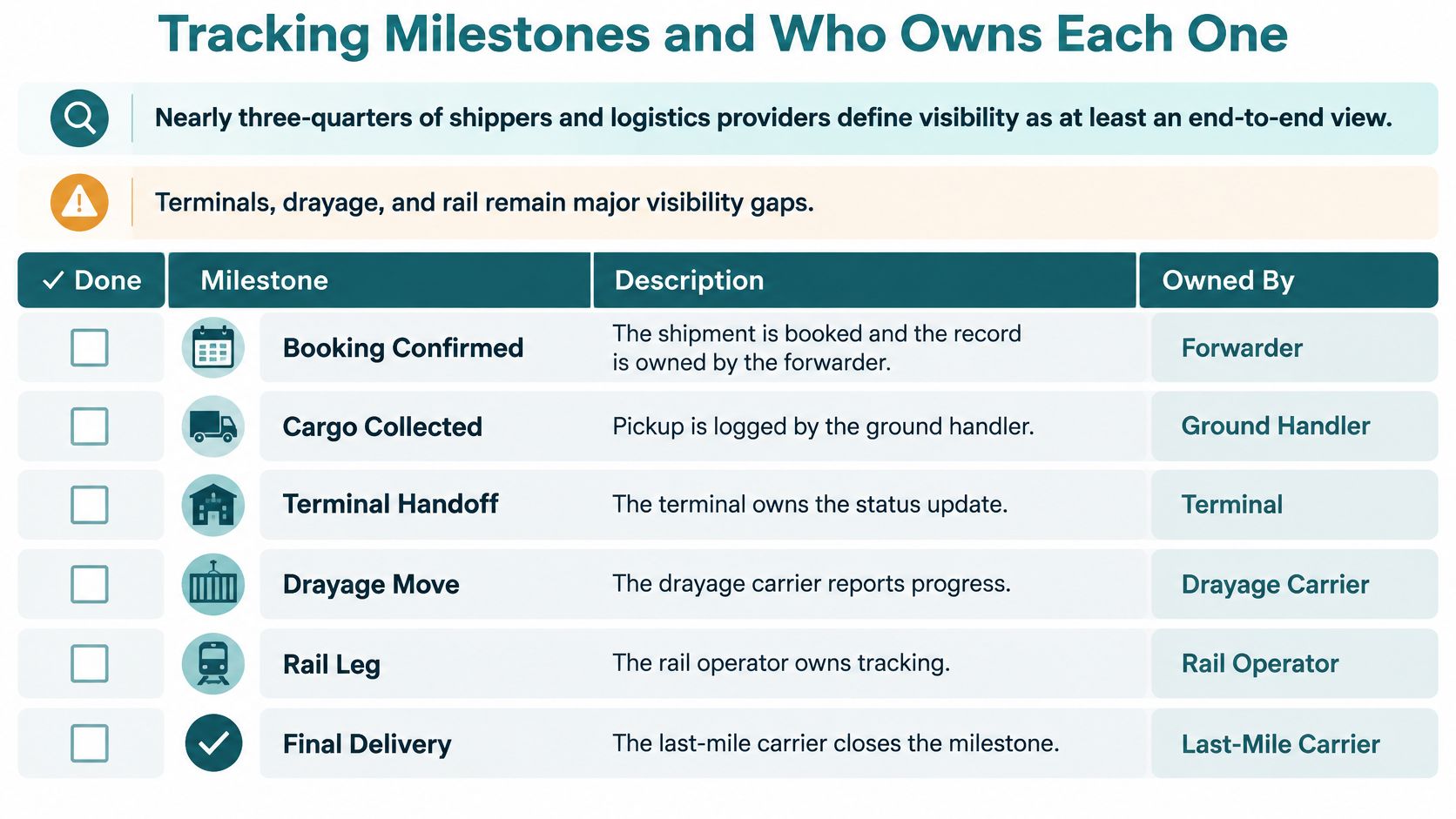
Track the milestones that trigger a decision, not every possible update. For a private trip, that means knowing who confirms the booking, who validates customs documents, and who changes the arrival plan when the aircraft is late.
Milestone | Owner | Timestamp standard | Escalation threshold | Recovery action |
|---|---|---|---|---|
Booking confirmation | Client and broker | Signed charter agreement and cleared funds | Signature or cleared funds missing before departure | Confirm status with the selected Operator and resolve the outstanding booking requirement |
Origin handoff | Trip coordinator and ground team | Handover at the agreed pickup point | Pickup delayed past the scheduled window | Contact the ground team and confirm the revised pickup |
Departure | Operator and crew | Wheels-up time | Departure slips beyond the approved window | Notify passengers and revise the arrival transfer |
Customs release | Customs broker and coordinator | Clearance confirmed before the required cut-off | Required document remains unvalidated at cut-off | Contact the responsible customs party and update the itinerary |
Arrival | Coordinator and ground team | Actual landing time | Landing differs from the current estimate | Update the pickup timing with the ground team |
Final delivery | Ground team and receiving party | Handover to passenger or recipient | Handover is not confirmed after arrival | Contact the named backup and confirm responsibility for the handoff |
Consider a missing customs document. If customs release has an owner and a cut-off, the coordinator can identify the gap before departure and update the itinerary. Without that checkpoint, the problem may surface only after the passenger reaches the airport.
Approved Jets provides active oversight from departure through arrival. It also facilitates communication and coordination between the client and the selected Operator, so the person responsible for a milestone can raise a delay and coordinate the next step.
When choosing a location app for lone workers, keep the tool distinct from the trip plan itself. A location update does not establish who owns a handoff or what action follows a missed milestone.
Before booking, ask the provider to name the owner, timestamp, escalation threshold, and recovery action for each key milestone. A useful plan makes responsibility visible before anything goes wrong.
Resilience Planning When a Leg Fails
A private charter reduces some travel friction, but it does not remove operational risk. A study analysing 121 million flights found that 21% experienced disruptions; among those incidents, 90% involved delays, with previous aircraft delays accounting for 38%, airline operations 31%, and air-traffic control 26%, according to the Journal of Transport and Supply Chain Management study.
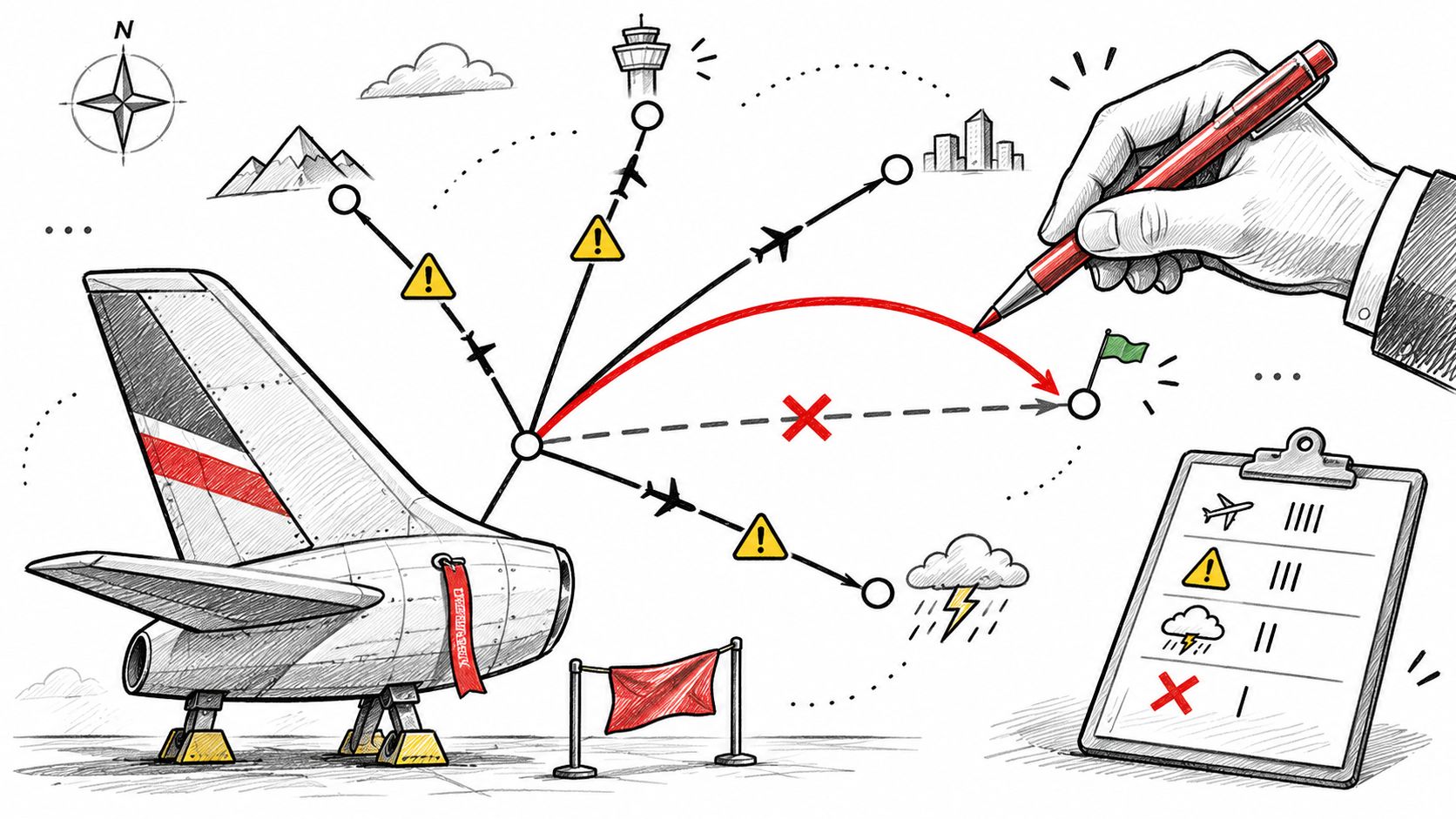
A single aircraft, airport, or border crossing can become a single point of failure. A direct route may save time, yet leave fewer options if weather, maintenance, or a document hold disrupts the plan.
Failure point | Fallback option | Decision trigger |
|---|---|---|
Aircraft defect | Replacement aircraft in the same category | The defect cannot be deferred under the approved MEL |
Airport or weather closure | Alternate airport and ground transfer | Forecast closure overlaps the arrival window |
Delay on the previous aircraft | Repositioned aircraft or revised departure window | Projected arrival misses the required deadline |
Customs hold | Alternate entry point, if available | Required document is not validated by the cut-off time |
These are planning questions, not promises that every fallback will be available. Aircraft availability, airport access, crew duty limits, and border requirements can constrain a change. A replacement aircraft, for example, still needs a qualified crew with legal duty time, and the relevant maintenance and inspection records must be current. A backup that cannot meet those conditions is not usable.
A medical team working toward a surgery window needs more than an earlier departure. The plan should identify who can approve a route change, what information they need, and how a ground transfer will be coordinated if the aircraft diverts. A digital supply-chain twin study describes how end-to-end visibility can help identify disruptions earlier and limit their effects across a network, as outlined in this study of digital supply-chain twins.
Before booking, ask the provider to explain the handoffs: who receives a disruption update, who contacts the client, and who coordinates the Operator and ground team. Then ask what decisions the provider can make and which require the client's approval. A clear answer shows how information and responsibility move when the itinerary changes.
24/7 concierge support can help coordinate requests around a trip, but the specific fallback options still depend on the mission and availability. Approved Jets facilitates communication and coordination between the client and the selected Operator, assists with booking logistics, and provides active oversight from departure through arrival.
Send your itinerary, passenger list, luggage requirements, and dates for a corporate trip, medical mission, or high-value freight movement. Approved Jets will return the quote, pricing, and itinerary details for review. Visit Approved Jets to start the inquiry.