Chartered Flight Services: Types, Costs and How to Book
Chartered flight services explained: charter types, aircraft sizes, booking steps, operator safety checks and real cost drivers for 2026.
16 min read
You got the message at 4 p.m. Three executives have to be in another city before a signing tomorrow morning, the last nonstop is gone, and a connection would land them after the meeting starts. That's when chartered flight services stop being a luxury line item and become a scheduling tool. The number on the quote is not the whole price. Certificate authority, maintenance status, and a written disruption plan belong in the same column as the hourly rate. What follows is the desk-side version: which trip type fits, which cabin the headcount and bags need, and what to verify before anyone pays.
Table of Contents
- Five Types of Chartered Flight Services Compared
- Aircraft Categories and Seat Counts to Expect
- Seats, range, and bags together
- Real Charter Missions for Corporate, Group and Medical Trips
- A signing in six hours
- Thirty people on a Friday night
- Hospital to hospital
- Batteries and medical freight
- Charter Versus Commercial Travel by Criteria
- Emissions and safety without the slogans
- What Drives the Price of a Charter Flight
- A placeholder total, not a market rate
- How to Verify the Operator Before You Pay
- Questions to ask before money moves
- How to Book a Charter from Request to Wheels-Up
- Confirm the Contract and Disruption Terms Before You Sign
Five Types of Chartered Flight Services Compared
These five are the trips you can buy. Chartered flight services are built around a customer, a group, an itinerary, or a mission. They are not a published timetable you join.
Charter type | Best for | Typical aircraft | Booking note |
|---|---|---|---|
On-demand charter | One trip on your own schedule | Light to heavy jets | Short-notice availability, subject to aircraft and crew |
One-way charter | A single leg with no return flight | Any category matched to the route | Priced for the leg you fly only |
Empty-leg flight | Flexible travelers on fixed dates and routes | Whatever aircraft is repositioning | Discounted, limited, and needs date flexibility |
Group charter | Sports teams, retreats and large parties | Heavy jets up to airliners | Quoted on total seats and cabin needs |
Medical evacuation | Hospital-to-hospital transfers and repatriation | Medically equipped aircraft | Clearances and ground logistics included |
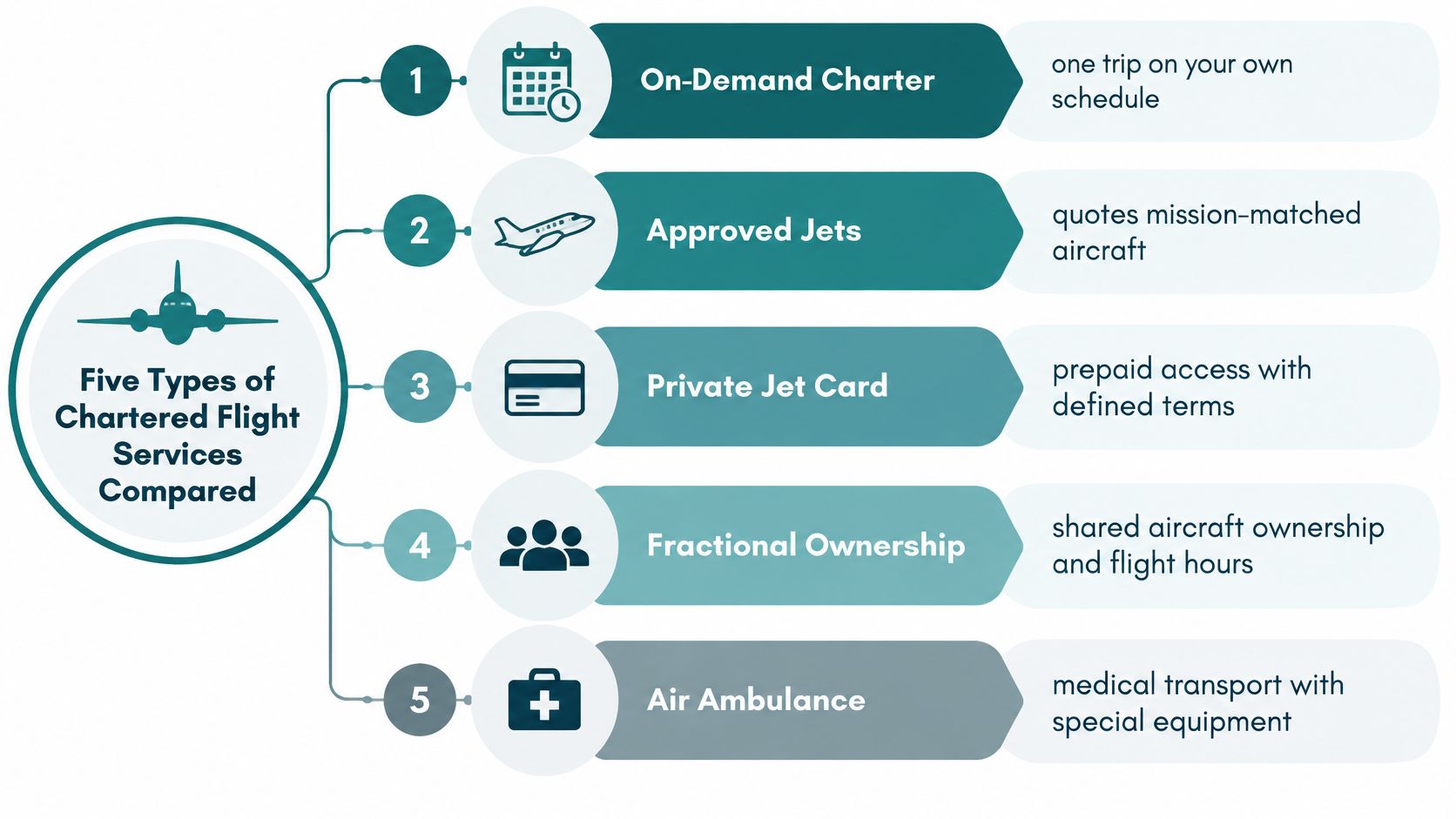
The chart also shows two longer commitments, a private jet card and fractional ownership. Those are prepaid hours or a share of an aircraft, not a single mission. They only make sense when annual hours are predictable enough to absorb the commitment. Approved Jets quotes against the mission instead: luxury charter, corporate travel, group travel, cargo and logistics, aircraft management, and medical evacuation and repatriation.
On-demand charter is one trip on your clock. The buyer is usually a regional VP who has to leave after a board call, not on the 6:10. Flight advisors are available 24/7 for immediate charters, but departure still depends on an aircraft and crew being free. Ask for the operator's certificate holder and maintenance status before you treat the quote as a schedule.
One-way charter covers a single leg. A team flying out for a closing and coming home on the airline the next week should not fund a return they will not use. You pay for the leg you fly, and the operator still has to position the aircraft. That positioning cost can hide in the quote, so compare the total, not the hourly rate alone.
Empty-leg flights are repositioning sectors the operator has to fly anyway. They are discounted, but the date and city pair are fixed. They suit a trip that can move, not a signing. Confirm the operator and aircraft before paying; a cheap empty leg on a poorly maintained aircraft is not a bargain.
Group charter means you buy the cabin. Sports teams, retreats, events, and destination weddings run from heavy jets up to airliners, and the quote is built on total seats. If the party is staying in one metro area and never needs to fly, compare Atlanta charter bus options before you spend on an aircraft.
Medical evacuation uses a medically equipped aircraft. Clearances, ground transfers, and hospital-to-hospital logistics are part of the service, not add-ons you arrange yourself. The quote should identify the operator and the aircraft's medical configuration, because the mission fails if either is wrong.
Practical rule: Ask how many people travel, how fixed the date is, and whether the trip is routine or urgent. Passenger count picks the row. A fixed date kills an empty leg. Urgency points to on-demand or medical evacuation. For every row, put certificate authority, maintenance status, and the disruption plan next to the price.
Aircraft Categories and Seat Counts to Expect
Category decides seats, range, and cost before the route does. Our luxury charter work runs from short regional hops to transcontinental trips, and the wrong cabin shows up as a bag left behind or a fuel stop you didn't plan.
Aircraft category | Typical seats | Best use |
|---|---|---|
Light jet | 4 to 7 | Short regional hops |
Midsize jet | 6 to 8 | Cross-country routes with more baggage room |
Super midsize jet | 8 to 10 | Transcontinental trips |
Heavy jet | 12 to 19 | Long-haul flights and larger parties |
Boeing 737 class airliner | 143 to 175 | Large group programs |
Airbus A320 or A321 class airliner | 150 to 210 | Largest group movements |
A 2023 Department of Transportation charter record.pdf) lists multi-flight programs on Boeing 737 aircraft with about 143 to 175 seats and on Airbus A320 and A321 aircraft with about 150 to 210 seats. Charter is not only executive flying. The same public prospectus system records operators, routes, dates, and planned flight numbers, so large-group movements are a documented product, not an informal workaround. Seat layouts differ by operator, which is why a private jet seating guide is worth reading before you lock a cabin.
Seats, range, and bags together
A larger aircraft is not automatically the better buy. Payload and distance decide it.
Say six executives need about 2,000 nautical miles with roller bags and a presentation case each. A light jet's 4 to 7 seats look fine on paper and then fail on fuel or baggage. A super midsize (about 8 to 10) or a heavy (about 12 to 19) is the honest match.
Flip it. Twelve salespeople, 500 miles, overnight bags only. A midsize jet in the 6 to 8 seat band is too small, but you still don't need a 737. A heavy jet, or two midsize aircraft if the group can split, keeps the quote tied to the mission. For sports teams, retreats, and destination weddings, group travel sourcing moves to airliners and heavy jets sized to the party, not to the most impressive photo.
State passenger count, bag count, and total distance in the first request. A broker can match the aircraft only after those three numbers are real.
Real Charter Missions for Corporate, Group and Medical Trips
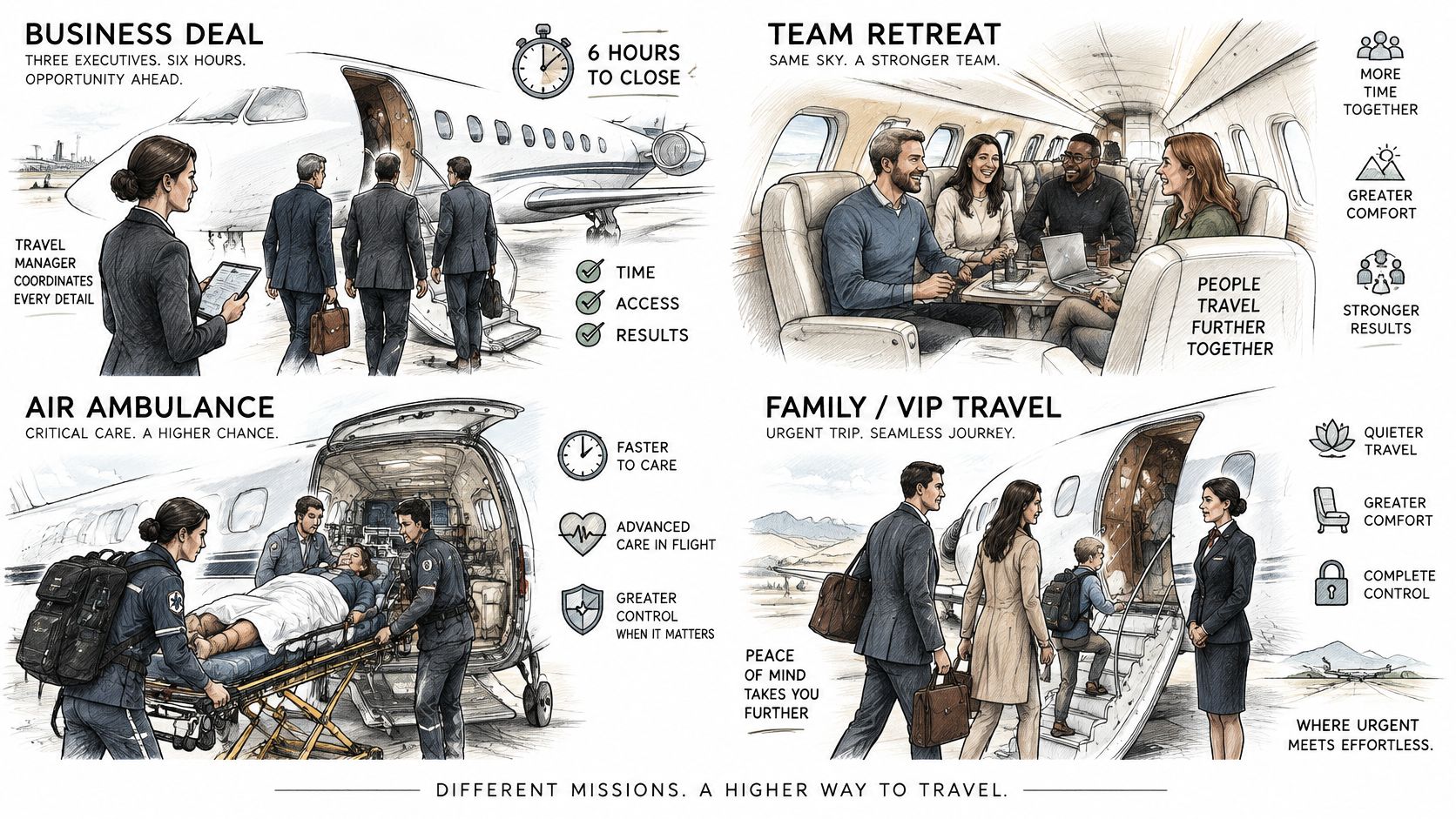
The same tail can fit Monday's mission and fail Friday's. Four charter missions show where the operator's certificate, maintenance status, and disruption plan change the price.
A signing in six hours
Three executives, a closing, no usable airline. Corporate travel programs give key personnel on-demand global access with strict confidentiality, and Approved Jets flight advisors are reachable 24/7 for immediate charters. The aircraft choice turns on baggage and range. The key decision is the certificate holder behind the quote. Approved Jets is a charter broker, not the operator, so get the operator's name in writing and check its operating authority, maintenance status, and disruption plan before you treat the booking as confidential. Approved Jets coordinates ground transport, catering, security, and special requests, but the air carrier remains the entity that must recover the trip if a mechanical issue grounds the tail.
If the deal team needs data at customs, arrange a secure eSIM setup for corporate travel before departure. A private cabin does not fix a dead phone.
Thirty people on a Friday night
A sports roster, kit bags, and a tip-off that will not move. Group travel sources appropriately sized airliners and heavy jets for large parties, sports teams, corporate retreats, and destination weddings. Price is driven by total seats plus ground transfers at both ends. The useful document is a seat map and a bag plan, not a brochure photo. The group charter flights guide explains how large parties get sized, and it is worth reading before you accept a cabin that looks roomy but cannot take the hold load. Ask which certificate holder operates the flight and how the operator handles a delay that threatens the game.
Hospital to hospital
A patient move is not a passenger charter with a stretcher added. Approved Jets' medical evacuation service handles clearances, ground transfers, and hospital-to-hospital logistics end to end. The operator's handling approval is the constraint: confirm that oxygen, medications, and specimens fit the equipment list and the aircraft assigned. Ask for the equipment list matched to the tail, not a generic "medical capable" line. Confirm the certificate holder's medical configuration and the disruption plan before the patient is moved.
Batteries and medical freight
Payload is not permission. The FAA's Part 135 hazardous-materials guidance says most Part 135 carriers must keep an approved program for acceptance, handling, transportation, and training. The rules sit in 49 CFR Parts 100 to 185 and the ICAO Technical Instructions. A high-value shipment of batteries or medical equipment moves only if classification, packaging, and the operator's program cover that material. Approved Jets offers cargo and logistics, but written confirmation that the approved program includes what you are shipping is the document that matters. Check the certificate holder, not just the broker's quote.
This short briefing shows how a charter desk sequences a time-critical trip from the first call through departure.
One aircraft, four different "yes" conditions. If the document you asked for does not exist, that tail is the wrong one even when the cabin looks perfect.
Charter Versus Commercial Travel by Criteria
Charter is a small slice of international flying and a much larger slice of the departures. U.S. Department of Transportation figures for 2024 put charter services by U.S. and foreign airlines at about 0.9% of international seats serving the United States and 4.5% of international departures. Charter passengers were about 0.5% of international passenger travel in that period. Smaller aircraft, more movements, trips built for a specific group rather than for volume. That is the product.
Criterion | Chartered flight | Commercial flight |
|---|---|---|
Schedule control | You set the departure time | Fixed published timetable |
Airport access | Often smaller general-aviation airports | Mainly major hubs |
Passengers per flight | A few, up to a cabin of dozens | Dozens to hundreds |
Emissions per passenger | Roughly 10 to 14 times commercial | Baseline for comparison |
Cost per seat | Highest for a few travelers, lower when a group fills the aircraft | Lowest for routine solo travel |
Privacy and terminal experience | Private terminal with controlled touchpoints | Shared terminals and security lines |
Best fit | Time-critical, multi-stop or small-group trips | Routine, solo, cost-sensitive trips |
Emissions and safety without the slogans
Per-passenger climate impact is the uncomfortable line in that table. Coverage of a Communications Earth & Environment estimate, summarized by GlobalAir, puts private aviation at at least 15.6 million metric tons of direct CO2 in 2023, a 46% increase from 2019. Per passenger, private-jet emissions can run roughly 10 to 14 times commercial, mostly because fewer people share the aircraft. The same year, private aviation was about 0.04% of global fossil CO2. A newer, larger jet is not automatically cleaner. Occupancy, routing, and whether the aircraft would have flown empty anyway decide it.
Safety claims need the same restraint. An FAA safety summary drawing on NTSB figures for 2008–2023, published through FAASTeam materials, reports an approximate overall accident rate of 1.3 per 100,000 flight hours and a fatal-accident rate of about 0.4 per 100,000 flight hours for charter and on-demand Part 135 flying. Those are U.S. averages. They are not a promise about one operator, one runway, or one night.
Smaller-airport access and a departure you set are the advantages. They win when the trip is time-critical, multi-stop, or a small group that would otherwise lose half a day in hubs. Commercial wins for a routine solo trip where the published fare is the point. I would not charter a single traveler on a thick nonstop just to avoid a security line.
What Drives the Price of a Charter Flight
A charter quote is a stack of charges. Comparing hourly rates across two proposals hides the stack.
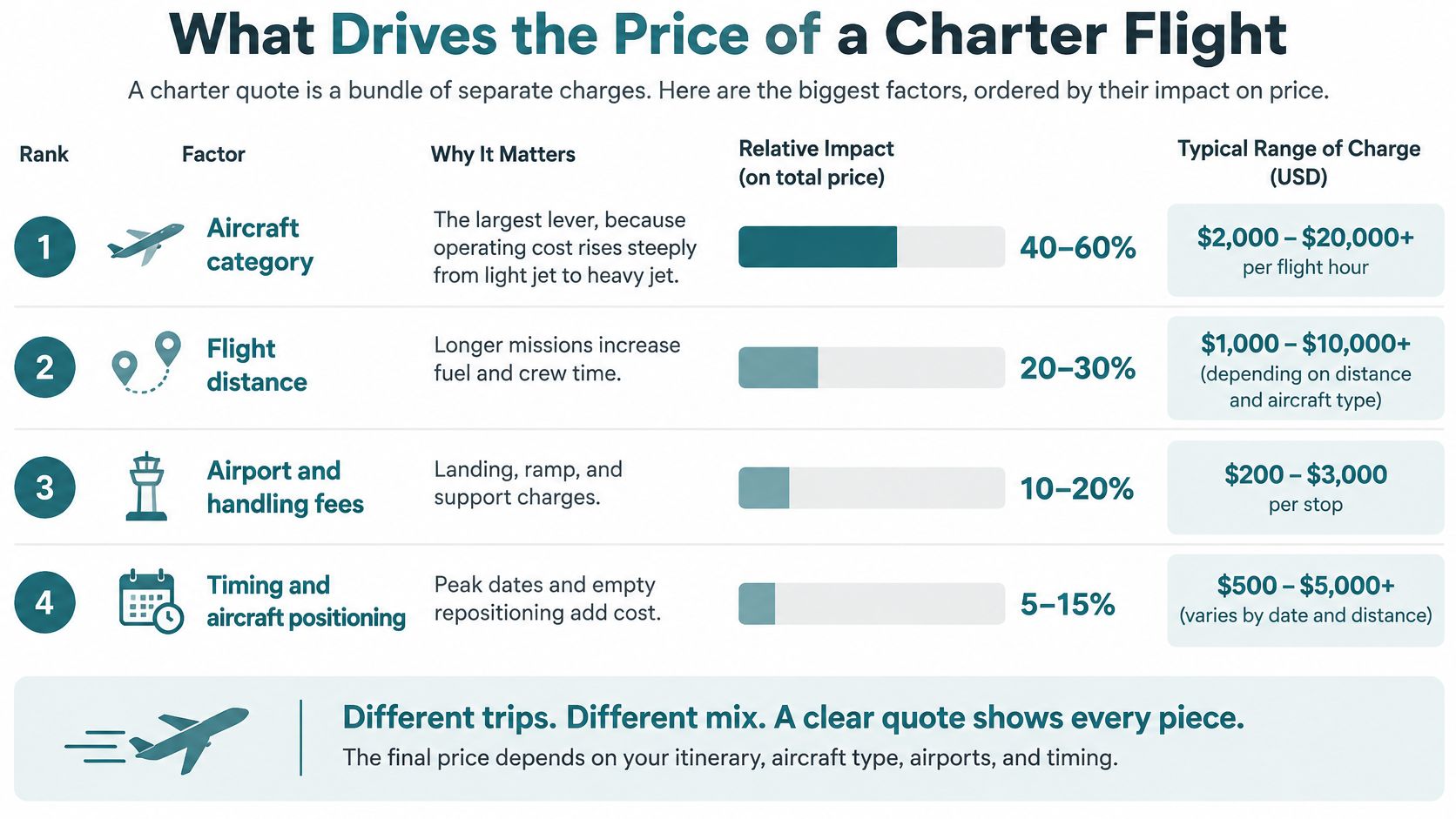
Aircraft category is the largest lever. Operating cost climbs steeply from a light jet to a heavy jet and again to an airliner. Distance sits inside that choice, because a longer mission burns more fuel and more crew time.
Positioning is the surprise. The aircraft often has to fly to your airport first. A 40-minute hop with a two-hour positioning leg costs more than the passenger flight time suggests. Empty legs cut the other way, filling a sector that would fly empty, but only on that date and that city pair.
Timing tightens the market. Last-minute requests, weekends, and holiday peaks shrink the fleet you can buy. Airport and handling fees (landing, ramp, support) sit on top regardless of how short the leg looks.
You, not the broker, pay the government and airport layer. That includes Federal Excise Tax, segment fees, international customs and immigration fees, and local airport taxes, plus other duties and surcharges. Ground transfers, catering, security coordination, and special requests are separate again. If the itinerary includes an animal, budgeting for door-to-door pet relocation belongs in the same total. Cabin policy and a specialist mover are different invoices.
Cancellation is a price term, not a courtesy. It changes with the operator, the aircraft type, and how close you are to departure, and the exact wording arrives before you sign.
A placeholder total, not a market rate
Say a midsize round trip is quoted at a headline $6,500 an hour for 3.0 passenger hours, or $19,500. One positioning leg at the same rate for 1.5 hours adds $9,750. A placeholder tax-and-fee layer of $3,200 and ground transfers of $900 put the file near $33,350. The headline was barely 60% of that. These figures are placeholders so you can test the shape of an itemized quote. They are not our rates.
Ask for the line items, check the validity window, and compare totals. Our quotes hold for the period printed on them, or for 48 hours from issuance if no period is stated. After that, price and availability have to be reconfirmed. Two expired hourly rates are not a comparison.
How to Verify the Operator Before You Pay
A polished site is not an airline certificate. In the United States, on-demand charter is generally flown under FAA 14 CFR Part 135, not under the rules for private, noncommercial flying. The FAA's Part 135 certification overview is blunt about who is responsible. The certificate holder, not the aircraft owner and not the broker, keeps operational control, qualified people, manuals, training, and the authorizations in its Operations Specifications.
On-demand, in that framework, means aircraft with 30 or fewer passenger seats, a maximum payload of 7,500 pounds, or any rotorcraft. A broker can arrange the trip. Only a properly certificated operator can fly it. The FAA warns that unauthorized charter bypasses that framework and the required commercial-pilot qualifications, which raises the risk for everyone on board.
We operate only as a charter broker. We don't own, operate, lease, or maintain aircraft, and we work as an air charter broker under DOT rules, Part 295. The verification questions have to reach the certificate holder. How that split works is covered in our note on aircraft charter brokerage.
Questions to ask before money moves
The regulated market is large enough that "a Part 135 operator" is not a name. The FAA charter page reports 1,837 Part 135 certificate holders and 11,582 authorized aircraft. Part 135 pilots face recurring proficiency checks, and FAA inspectors examine pilots, crew, and aircraft more often than in private flying. Standard operators also keep manuals, training programs, designated managers, and approved operating specifications for the service they sell.
Certification still doesn't copy every airline safety-management rule. The NTSB's review of Part 135 accidents covered more than 500 fatal and nonfatal accidents from 2010 through 2022. It found gaps in flight dispatch, operational control, loading documentation, and safety-data collection. In 12 accidents, dispatch or operational control was deficient because the people responsible were not certified flight dispatchers and the rules didn't require them to be.
- Certificate and specs. Ask for the Part 135 certificate and confirm the operations specifications cover this aircraft and this mission.
- Airworthiness and maintenance. Confirm registration, airworthiness, the maintenance program, and that life-limited components are current. Ask who will send a records summary.
- Who controls the flight. Name the person with operational control. Ask whether the operator voluntarily uses a safety management system and flight data monitoring.
- Weights. Passenger and baggage weights belong on a manifest with a weight-and-balance calculation, not in a guess at the FBO door.
- Cargo or medical. Confirm the hazardous-materials program covers the actual shipment or clinical equipment.
A clean answer sounds ordinary. You get a named certificate, documents that match the tail, and written confirmation before you pay. If the reply is "trust the listing," stop.
How to Book a Charter from Request to Wheels-Up
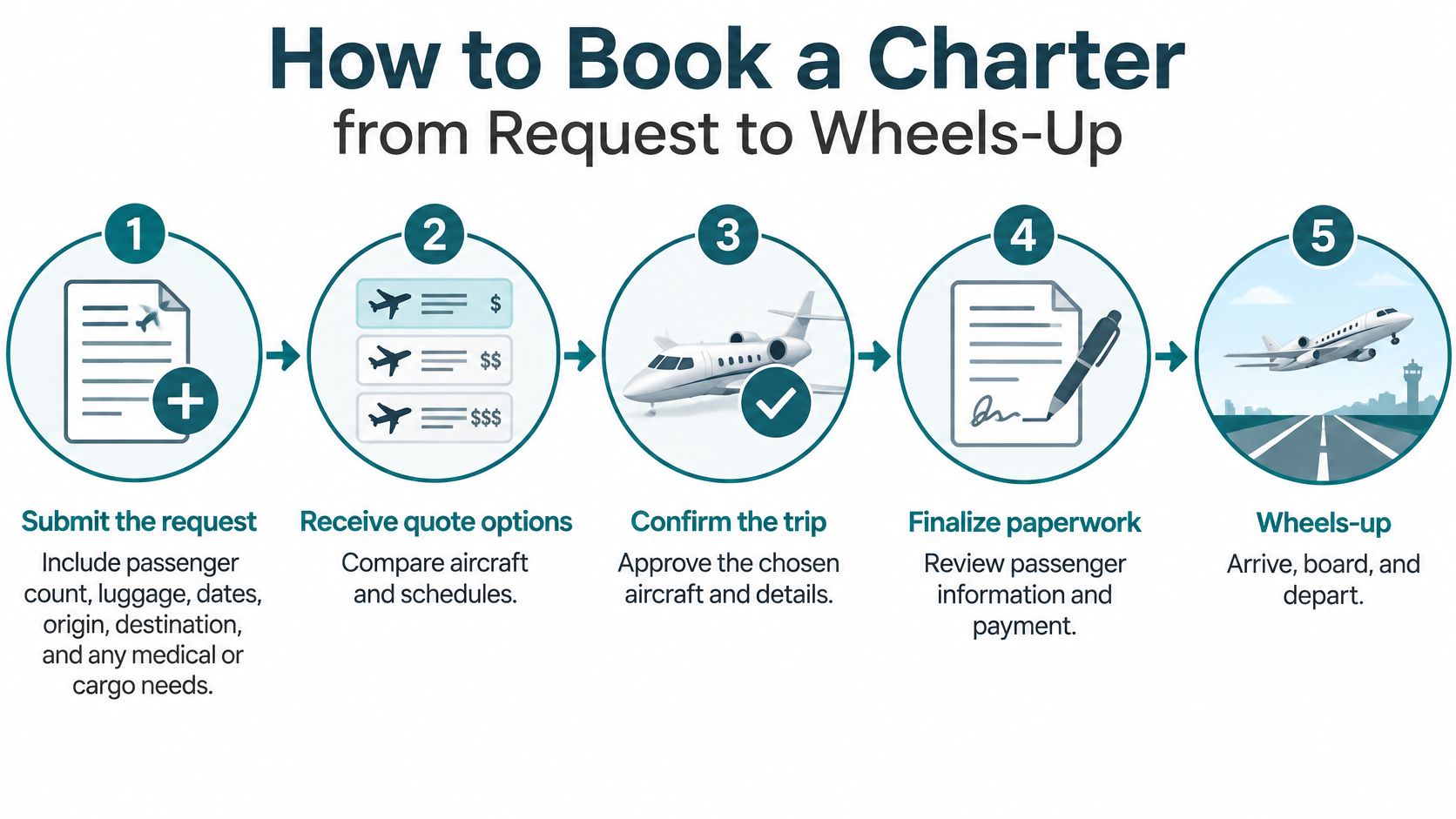
Treat booking as a sequence with a reason and a common miss at each step. The graphic compresses it. The desk version is longer because payment sits after verification, not before.
- Submit the request. Include passenger count, luggage, dates, origin, destination, and any medical or cargo need. Use our flight advisors or the Get a Quote button. The miss is a passenger count with no bag weights, which forces a rematch later.
- Read the proposal. We take the request, source aircraft and operators through our network and an aviation marketplace, and send options with pricing and the itinerary. The miss is treating the first tail as the only tail.
- Compare on the full file. Aircraft type, seats, the operator's certificate, and the total with taxes and fees. The miss is ranking hourly rates.
- Read cancellation before you sign. Terms vary by operator, aircraft, and how close you are to departure, and you get the exact terms first. The miss is assuming a full refund because the trip feels flexible.
- Sign and pay only while the quote is alive, and only after the operator check is done. This is the expensive miss. Paying before the certificate, maintenance, and control questions are answered buys a brochure. If the quote window has closed, reconfirm price and availability. We send booking confirmations and updates once the request is booked.
- Lock the ground plan. Transfers, catering, and security should be confirmed in the same thread as the tail number. The miss is assuming the FBO will invent a car.
- Arrive about 15 to 30 minutes before departure. Private-terminal check-in is controlled, not a two-hour airline queue. The miss is showing up so early that you recreate the terminal wait you paid to avoid, or so late that documents aren't ready.
- Stay on the file through arrival. International legs still need customs paperwork and passenger details that match the manifest. The miss is going silent after wheels-up and discovering a name mismatch on landing.
Step 5 is where trips go wrong. A valid quote plus an unverified operator is not a deal. It is a deposit on someone else's airplane.
Confirm the Contract and Disruption Terms Before You Sign
Demand doesn't make a substitute aircraft free. In the 2026 business aviation outlook covered by AeroTime, 91% of operators surveyed expected to fly the same amount or more in 2026 than in 2025. Among operators taking action, 60% were acquiring more fuel-efficient aircraft and 56% were using sustainable aviation fuel. A busier fleet that is also changing metal means the tail on your quote can move. The contract has to say what happens next.
FAA certification guidance treats maintenance as an acceptance test, not a footnote. Part 135 aircraft with 10 or more passenger seats must be on a continuous airworthiness maintenance program. Smaller aircraft generally use annual, 100-hour, or approved inspection programs. Operators have to follow manufacturer time-between-overhaul limits, keep records without gaps on time- or cycle-limited parts, and keep the current flight manual available. Incomplete records or an overdue life limit can ground an aircraft that looked ready. Inoperative equipment needs an approved minimum equipment list and the matching operations-specification authority. Otherwise that airplane doesn't go.
Get these answers in writing.
- Who may substitute an aircraft, and how much notice do you get?
- If the aircraft is unavailable or a permit slips, who pays for the replacement?
- If weather moves the timing, what portion is refundable?
- Which quote lines are refundable, and which are not?
- How do customs and landing permits change an international departure?
- What happens when bags exceed the aircraft's practical capacity?
- For medical or high-value cargo, how is chain of custody kept at each handoff?
Certificate, registration, inspection basis, and component-life checks belong in the file before the signature, not in a follow-up email after payment.
I would request at least two quotes, check each certificate holder, and refuse to sign until those seven answers are on paper. Our advisors are available 24/7 for immediate charters at +1 (866) 678-1411, and we keep active oversight from departure through arrival.
Approved Jets arranges on-demand charter for executives, groups, cargo, and medical moves, and we match the aircraft only after the operator's authority and the disruption terms are clear. If you are pricing a trip now, bring passenger count, bags, and the route, and ask for two itemized options before you pay. Visit Approved Jets to start that quote with a flight advisor.