

Charter Flights from Miami: The Complete Guide for 2026
Plan charter flights from Miami with insider tips on airports, costs, FBOs, and booking windows. Save time and avoid common mistakes with this guide.

Approved Jets

On this page
- Table of Contents
- Why Charter Flights From Miami Are Worth Considering
- What the charter premium actually buys
- Miami Airports for Charter Flights Which One You Should Use
- Opa-Locka Executive Airport
- Miami Executive Airport
- Miami International Airport
- How to Book and Mobilize Charter Flights From Miami
- Start with the mission data
- What happens during mobilization
- Charter Flight Costs From Miami What Actually Drives Price
- The four cost drivers that change the quote
- When an empty leg helps
- Making the Right Choice Airport Aircraft and Timing Decisions
- Match the airport to the ground journey
- Match aircraft to people and baggage
- Treat urgent mobilization as a constrained mission
- Approved Jets Miami Operations Real Examples and Capabilities
You're in Miami, have a fixed arrival time, and the commercial schedule is already working against you. A connection, a crowded terminal, or a late aircraft can turn a straightforward business meeting or Caribbean escape into a day built around airport uncertainty. Charter flights from Miami solve a different problem than ordinary air travel: they let you plan the mission around your passengers, destination, aircraft, and ground logistics.
The hard part is choosing well. Airport selection, seasonal demand, aircraft positioning, customs handling, and the short mobilization window can affect the result more than the advertised hourly rate. This guide focuses on the operational decisions that determine whether a Miami charter feels efficient or becomes an expensive workaround.
Table of Contents
- Why Charter Flights From Miami Are Worth Considering
- Miami Airports for Charter Flights Which One You Should Use
- How to Book and Mobilize Charter Flights From Miami
- Charter Flight Costs From Miami What Actually Drives Price
- Making the Right Choice Airport Aircraft and Timing Decisions
- Approved Jets Miami Operations Real Examples and Capabilities
Why Charter Flights From Miami Are Worth Considering
A commercial itinerary from Miami to New York can look manageable until the schedule stops matching the day. A morning meeting in Manhattan may require leaving home before sunrise, allowing time for the terminal, security, boarding, and possible disruption along the way. Even a nonstop schedule gives you limited control over departure time, airport experience, and what happens when plans change.
A private charter changes the planning sequence. Instead of starting with an airline timetable, the coordinator starts with the meeting, the passengers, the baggage, the departure area, and the required arrival time. The aircraft then gets matched to that mission. You use a private FBO, avoid the standard commercial terminal process, and can often route directly to an airport more convenient for the destination.

Miami supports this model unusually well. Miami International Airport serves as a gateway to Latin America and one of the most important commercial and private aviation hubs in the Western Hemisphere. It handles more than 44 million passengers annually, ranks as the 30th busiest passenger airport in the world, 12th busiest in the United States, and number one in Florida, while handling more international cargo than any other U.S. airport, according to Miami's private aviation overview. That scale creates demand across business, leisure, Caribbean travel, and Latin American routes.
What the charter premium actually buys
The value isn't just a larger seat or a quieter cabin. It comes from controlling more parts of the journey:
- Time control: You request a departure aligned with the mission rather than accepting the airline's timetable.
- Airport access: Private FBOs offer a more controlled arrival and departure process than a major commercial terminal.
- Direct routing: A charter can connect the selected Miami airport with a destination airport that may be inconvenient or unavailable on a commercial schedule.
- Mission fit: Aircraft selection accounts for passengers, luggage, range, cabin requirements, and international procedures.
- Privacy: Executives, families, athletes, and public figures can keep the travel process more discreet.
Empty-leg availability can improve the economics for travelers with flexible timing and airport preferences. The operational trade-off is that an empty leg follows an aircraft's existing repositioning plan, so the departure time, routing, and cancellation exposure may be less flexible than a dedicated charter. A practical explanation of those trade-offs appears in this guide to private jet charter empty legs.
Charter is a strong fit when time certainty, privacy, and routing flexibility matter more than the lowest possible fare. It's a weaker fit when the itinerary is easy to serve commercially, dates are flexible, and the private aircraft's positioning cost outweighs the convenience. The right decision starts with the mission, not the aircraft brochure.
Miami Airports for Charter Flights Which One You Should Use
Miami's three main airport choices serve different purposes. Treating them as interchangeable is one of the easiest ways to add unnecessary ground time or create an avoidable customs problem.
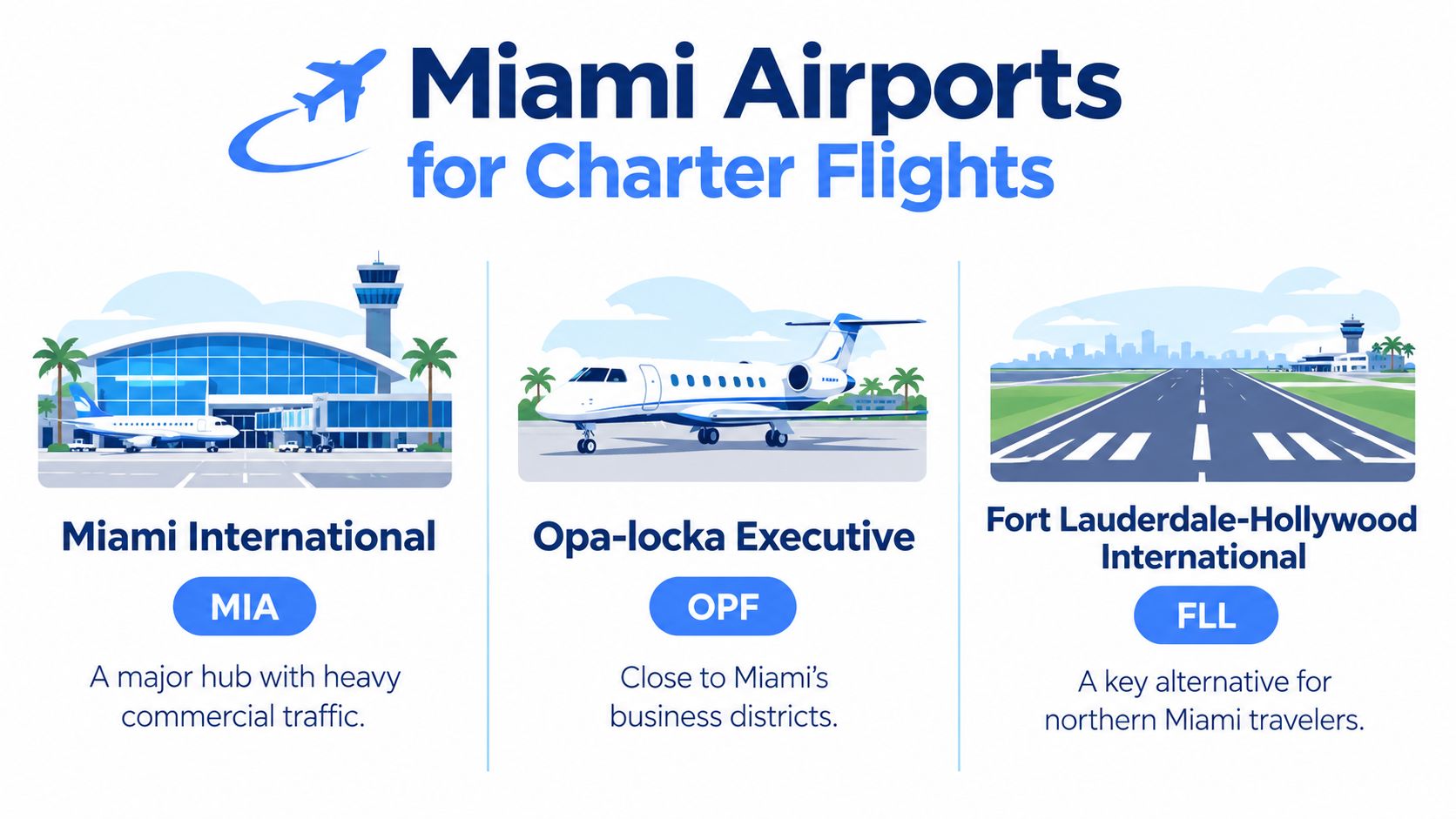
Opa-Locka Executive Airport
Opa-Locka Executive Airport, OPF, is usually the default private aviation choice for travelers headed to Miami's central and northern districts. Independent reporting found that 88% of one Miami broker's private-jet arrivals since 2020 landed at OPF, and the airport ranked as the seventh-busiest private-jet airport in the U.S. in 2025, according to aviation activity reporting on OPF.
OPF is a 1,880-acre joint civil-military airport with three paved runways, multiple FBOs, and infrastructure built around business aviation, as described in this OPF airport profile. That combination generally gives charter buyers a broad aircraft pool and a more direct ramp experience. It works well for light through heavy business jets, subject to aircraft availability and operating requirements.
Miami Executive Airport
Miami Executive Airport, TMB, is the practical choice for South Miami, Coral Gables, and the Keys corridor. The airport operates 24/7, has on-site customs and immigration, and provides 24/7 fire suppression services that support scheduled air-charter operations, according to Miami Executive Airport guidance.
TMB also supports multiple FBO and handler providers, maintenance resources, and ground transportation. That matters when an international departure requires customs coordination, fueling, catering, and a tight turnaround. A passenger coming from Coral Gables may save more by using TMB than by choosing the airport with the largest aircraft inventory.
Miami International Airport
Miami International Airport, MIA, makes sense when international reach or commercial connectivity is central to the trip. It handles charter traffic alongside scheduled service. In August 2026, MIA listed 17 charter carriers among 92 total carriers, demonstrating that charter activity exists within a major commercial hub, as shown on MIA's official airport information.
The trade-off is a more complex operating environment. Heavy commercial traffic can make ground coordination and ramp timing less predictable than at a dedicated business aviation field. MIA can still be the correct choice for certain international missions, but it shouldn't be selected automatically just because it's the most recognizable airport.
| Airport | Best For | Customs | FBO Options | Typical Lead Time |
|---|---|---|---|---|
| OPF | Central and northern Miami, broad private aviation availability | Confirm for the specific aircraft and itinerary | Multiple FBOs | Depends on aircraft positioning and approvals |
| TMB | South Miami, Coral Gables, and Keys corridor | On-site customs and immigration | Multiple handlers and service providers | Depends on aircraft positioning and approvals |
| MIA | International reach and commercial-hub connectivity | Confirm with the operator and itinerary | Charter and commercial aviation facilities | Depends on traffic, aircraft positioning, and approvals |
Ground transport should be planned with the same care as the flight. If passengers are arriving from different neighborhoods or need separate vehicles, reviewing Miami travel car options early can prevent a smooth aircraft booking from ending in a disorganized curbside transfer.
How to Book and Mobilize Charter Flights From Miami
A fast Miami charter begins with a complete inquiry. “I need a jet tomorrow” leaves the broker guessing about the aircraft, airport, customs process, and positioning requirements. Give the coordinator enough information to identify a real solution rather than a marketing estimate.
Start with the mission data
Provide these details in the first message:
- Departure and arrival: Give the preferred Miami airport or neighborhood, destination airport, date, and desired departure time.
- Passenger and baggage profile: State the passenger count, oversized items, golf equipment, pets, or unusually heavy luggage.
- International requirements: Identify passport status, citizenship considerations, and whether the route involves the Caribbean or Latin America.
- Schedule constraints: Explain the hard arrival time, return flexibility, meeting duration, and any onward transport.
- Cabin priorities: Mention Wi-Fi, a lavatory, stand-up cabin preference, catering, privacy, or medical equipment.
What happens during mobilization
A broker may discuss a 2–4 hour mobilization window, but that isn't a universal promise. Aircraft location, crew readiness, maintenance status, airport slots, weather, customs coordination, and passenger documentation determine whether the window is realistic.
The process typically moves through several parallel checks:
- Aircraft sourcing: The coordinator searches suitable aircraft and confirms whether the aircraft can reach the requested airport.
- Operator verification: The broker checks the operating certificate, crew, aircraft status, insurance, and mission restrictions.
- Airport coordination: The team confirms parking, FBO handling, customs, fueling, catering, and ground transport.
- Passenger clearance: International trips require accurate documentation and timing coordination before departure.
- Final confirmation: The operator issues the itinerary, FBO details, passenger instructions, and any changes to the aircraft or schedule.
Practical rule: A fast quote is useful only when it includes the actual departure airport, aircraft category, operator, fees, and conditions that could change the schedule.
Ask who operates the aircraft, whether the quoted aircraft is confirmed or merely indicative, what happens if the aircraft must reposition, and which fees remain variable. A broker who can't explain the mobilization dependencies is offering a price before offering an operational plan. For a broader overview of the booking process, see private jet charter planning.
Arrive at the FBO according to the operator's instructions, not an assumed commercial-airport routine. The correct arrival time depends on the airport, aircraft, international processing, and whether the crew has already completed the pre-departure checks.
Charter Flight Costs From Miami What Actually Drives Price
A Miami charter can look inexpensive until the aircraft's starting position, airport choice, and timing are added to the quote. The hourly rate matters, but the final price also reflects aircraft availability, repositioning, crew commitment, airport services, and the conditions attached to the schedule.
Seasonality is one of the least visible cost drivers. Winter demand can push Miami charter rates 10% to 25% higher from December through March, while summer is comparatively softer, according to Miami charter market reporting. The increase does not apply equally to every aircraft or itinerary. It does, however, give operators less reason to discount a flight or absorb repositioning costs.
The four cost drivers that change the quote
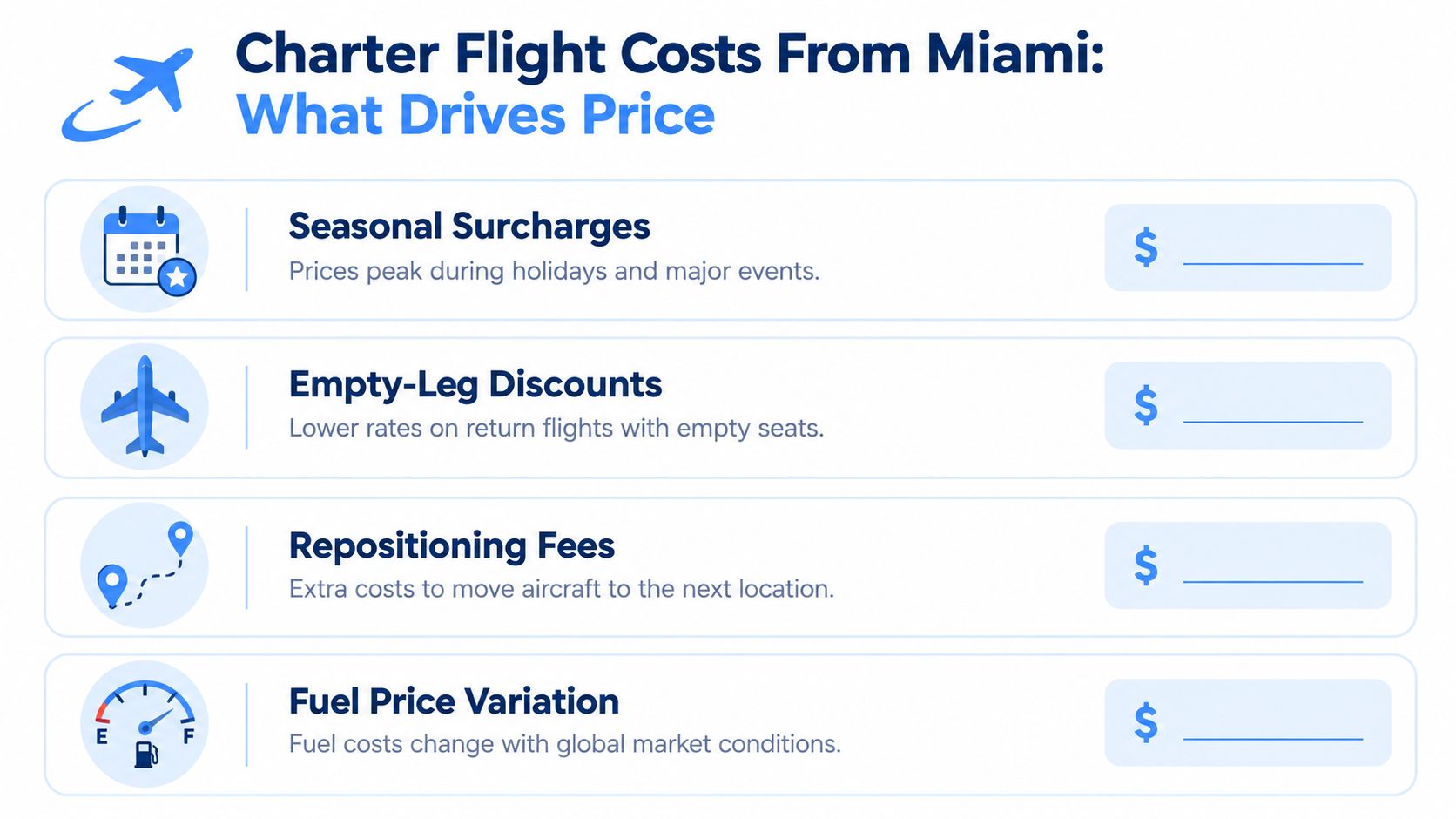
- Aircraft category: Light jets can suit smaller groups with lighter baggage. Midsize, super midsize, and heavy aircraft provide more cabin space, range, payload, and amenities. Choosing a larger aircraft than the mission requires raises the base cost. Choosing one that cannot carry the baggage or complete the route creates a scheduling and safety problem.
- Repositioning: The aircraft may need to fly empty to Miami before collecting passengers, then continue to another location after drop-off. On a short route, those positioning legs can account for a large share of the quote.
- Airport and handling charges: Landing, parking, FBO handling, customs, fueling, catering, and ground services may be listed separately or included in one total. The departure airport can affect both the charges and the aircraft options available.
- Demand timing: Holidays and major event periods reduce availability. Art Basel, Christmas and New Year, Presidents' Day weekend, and the Miami Grand Prix can create surcharges and fewer aircraft choices, as discussed in this Miami charter cost analysis.
| Cost Factor | Impact on Price | Seasonality Effect | Mitigation Strategy |
|---|---|---|---|
| Aircraft category | Larger or more capable aircraft increase the base charter cost | More pronounced when preferred categories are scarce | Match cabin, payload, and range to the mission |
| Repositioning | Empty positioning legs can materially increase a short trip's total | Harder to avoid during peak Miami demand | Compare nearby airports and flexible departure times |
| Airport services | FBO, landing, parking, customs, fueling, and handling add operational charges | Event and holiday congestion can reduce flexibility | Request an itemized quote |
| Timing and demand | High-demand dates reduce discounting and availability | December through March can carry a 10% to 25% rate increase | Move dates, use a different airport, or request an empty leg |
Short-haul flights can cost more than expected because fixed preparation and positioning work remains in place. A brief flight still requires crew coordination, aircraft movement, airport handling, and a plan for the aircraft afterward. A Caribbean hop may therefore compare poorly with a longer mission that begins and ends near the aircraft's existing schedule.
Airport choice can change the economics before the aircraft is selected. A South Miami departure may reduce ground-transfer time from Tamiami, while Fort Lauderdale or another nearby airport may offer a better aircraft match or repositioning arrangement. Miami International may make sense for international handling or a specific operating requirement, but congestion and handling complexity can affect the total. Ask for a comparison based on the complete journey, not just the quoted flight time.
When an empty leg helps
An empty leg can work well when the schedule is flexible and the aircraft is already moving in the right direction. It becomes a poor fit when you need a precise departure time, a particular airport, guaranteed return capacity, or a cabin layout that rarely appears on repositioning routes.
New York and Miami remain an active flow, so busy periods can give operators more pricing power. Compare the conditions, not only the headline discount. An empty leg offers a flexible trip with operational restrictions, while a dedicated aircraft provides greater schedule control.
For a detailed explanation of quote components, review private jet charter prices. Before accepting an offer, confirm whether the price includes repositioning, crew expenses, overnight costs, airport fees, international handling, catering, and changes caused by passenger or weather conditions.
Making the Right Choice Airport Aircraft and Timing Decisions
The best Miami charter plan is a combination of three decisions, not a single aircraft selection. Choose the departure airport for the passenger's starting point, select the aircraft for the actual payload and route, and set the booking window around the mission's tolerance for uncertainty.
Match the airport to the ground journey
A passenger leaving from Coral Gables shouldn't default to OPF just because OPF has a strong private aviation profile. TMB may reduce the road transfer and simplify a South Miami departure. A passenger headed to Miami Beach, Brickell, or a northern business district may find OPF more practical. MIA is appropriate when international connectivity or a specific operating requirement outweighs the congestion trade-off.
Use this quick decision test:
- South Miami, Coral Gables, or Keys corridor: Start with TMB and confirm customs, aircraft capability, and ground transport.
- Central or northern Miami business travel: Start with OPF, especially when aircraft choice and private aviation handling are priorities.
- International or commercial-hub requirements: Evaluate MIA, but ask the operator to explain the handling and timing implications.
- Northern Miami travelers: Consider nearby alternatives only when the ground transfer clearly improves the total journey, rather than assuming the closest runway is the cheapest option.
Match aircraft to people and baggage
Passenger count alone isn't enough. A light jet may work for a small group with compact luggage, but sports equipment, display materials, medical items, or extended travel baggage can change the requirement. A midsize or larger cabin may cost more while reducing the risk of payload restrictions and uncomfortable packing compromises.
For a short regional mission, prioritize useful payload, airport compatibility, and confirmed availability. For a longer domestic or international route, evaluate range, cabin comfort, lavatory configuration, baggage capacity, and crew requirements together. The cheapest aircraft category is not economical if it forces a second aircraft, a baggage restriction, or an airport change.
Treat urgent mobilization as a constrained mission
A 2–4 hour mobilization target is achievable only when the aircraft, crew, airport, paperwork, and passengers line up. It is not a substitute for planning. A last-minute request may work well when the broker finds an aircraft already positioned in South Florida, but it can become costly when the aircraft must travel to Miami and the international clearance process starts from zero.
Choose the airport that shortens the whole journey, not the one that looks most convenient on a map.
The final quote should show the assumptions behind the solution. Confirm the departure FBO, aircraft category, operator, luggage allowance, customs plan, cancellation terms, repositioning exposure, and ground transfer. That list gives you a more useful comparison than a headline hourly rate.
Approved Jets Miami Operations Real Examples and Capabilities
A Miami charter can look simple on the passenger side while several operational details determine whether the trip runs smoothly. The coordinator must match the aircraft to the runway, arrange FBO handling, confirm customs requirements, brief passengers, and keep ground transport aligned with the departure and arrival plan.

Approved Jets works with a global network of 1,000+ aircraft operated under FAA Part 135 or foreign equivalents. Its stated preferences include third-party safety credentials such as ARGUS Platinum and Wyvern Wingman. The Miami advisory team also states a two-hour quote turnaround target, offers 24/7 concierge access, and supports domestic and international itineraries.
A typical request could be a corporate group leaving TMB for Latin America, a family departing OPF for the Caribbean, or an executive needing a same-day aircraft search with coordinated transfers. The useful test is operational: can the team verify the operator, confirm airport suitability, explain repositioning and handling assumptions, and manage the itinerary through arrival?
The service scope includes catering, ground transfers, security coordination, customs paperwork, cargo logistics, medical evacuation, pet travel, and aircraft management. These capabilities matter when the charter forms part of a larger movement, not just a flight between two airports.
Airport, aircraft, and timing should be confirmed before accepting the quote. That sequence limits repositioning surprises, filters out unsuitable aircraft, and gives passengers a clear plan for the mobilization period.
Approved Jets can arrange on-demand charter flights from Miami through a vetted operator network, including aircraft matching, customs coordination, ground transfers, and 24/7 advisory support. Visit Approved Jets to request a charter plan based on your route, timing, passengers, and luggage.