Praetor 600 Range: Real-World Numbers and Trip Limits
Praetor 600 range explained: 4,018 nm certified figure, how passengers, weather and runway length change it, and which trips it can fly nonstop.
11 min read

4,018 nautical miles (7,441 km) is the Praetor 600's certified long-range figure with four passengers and NBAA IFR reserves. It's a planning benchmark, not a guarantee for every mission.
For a charter buyer, the useful question isn't how far the aircraft can fly under standardized conditions. It's whether your passengers, baggage, airports and departure-day weather leave enough fuel margin to complete your particular flight nonstop.
Table of Contents
- Praetor 600 Published Range at a Glance
- How to use the different figures
- What the 4,018 Nautical Mile Figure Assumes
- Why cruise terminology matters
- Payload Limit and the Fuel Trade-Off
- Two illustrative manifests
- What the operator needs
- Runway Length and Airport Access Limits
- Published distance versus usable runway
- Airport access is a door-to-door calculation
- Matching Trip Profiles to Real City Pairs
- Read the table as a decision sequence
- When a stop is the better answer
- Weather, Worked Example and Go or No-Go Checks
- A simplified headwind calculation
- Six checks before committing to nonstop
Praetor 600 Published Range at a Glance
The Praetor 600 range milestone wasn't a rounded marketing target. At certification in 2019, the aircraft exceeded its original 3,900-nautical-mile design target by 118 nautical miles, approximately 3.0%, according to Embraer's performance brochure.
That distinction matters when comparing aircraft. A published maximum describes a specified operating profile, not the distance an operator will necessarily offer on a charter quotation. Embraer reaffirmed the aircraft's intercontinental capability with four passengers and NBAA IFR reserves in its 2024 announcement.
Published Praetor 600 range figures by source and profile
Figure | Source and profile | Nautical miles | Kilometers |
|---|---|---|---|
Certified long-range maximum | Embraer, four passengers, NBAA IFR reserves | 4,018 | 7,441 |
Certified Mach 0.80 range | Embraer, four passengers, NBAA IFR reserves | 3,719 | 6,888 |
Up to range | 3,700 | 6,855 | |
Normal range | 3,700 | Not separately stated | |
Maximum range | GlobalAir, same listing | 4,018 | Not separately stated |
Maximum operating range | 4,018 | 7,441 |
The Embraer rows use the performance brochure's stated profiles. The other rows preserve each publisher's terminology rather than treating normal, up to and maximum operating as interchangeable measures.
How to use the different figures
Use the long-range maximum as the published ceiling for initial comparison, not as a charter commitment. Use the faster certified profile when the schedule matters and the route leaves adequate distance margin.
The normal-range and operator figures provide a more conservative first screening reference. They don't establish a universal dispatch limit, and their labels don't prove that every publisher used identical passenger, baggage, reserve or weather assumptions.
That's why averaging the figures would be misleading. You wouldn't obtain a more accurate range estimate, only a number that corresponds to no clearly defined operating profile.
Planning distinction: A specification tells you what the aircraft achieved under stated assumptions. A dispatch calculation tells you whether the proposed flight works.
For a first feasibility check, use the normal-operations reference to identify straightforward candidates. If a route approaches the published long-range ceiling, move directly to operator analysis rather than promising nonstop service from a brochure.
What the 4,018 Nautical Mile Figure Assumes
A published aircraft range works like a car's official fuel-economy rating. Standardized conditions make comparisons useful, but they don't promise the same result on a hot day with adverse winds and a heavier load.
The Embraer aircraft specification attaches four specific assumptions to its 4,018-nautical-mile figure: four passengers at 200 pounds each, long-range cruise, NBAA instrument-flight-rules reserves and fuel for a 200-nautical-mile alternate airport.
- Passenger weight: The reference passenger load establishes a defined starting point. A different manifest requires a different weight calculation, including baggage and other carried items.
- Cruise profile: Long-range cruise prioritizes distance capability. It isn't a promise that the aircraft can maintain its fastest cruise setting throughout the trip.
- IFR reserves: The aircraft must retain the specified reserve fuel. Dispatchers can't count that fuel as freely available to extend the planned destination leg.
- Alternate airport: The benchmark includes an alternate requirement, but the alternate needed for your flight must suit the destination weather, operating conditions and applicable rules.
The reserve assumptions explain why range isn't fuel capacity divided by an estimated hourly burn. An endurance calculation that consumes all available fuel would answer the wrong question for passenger transport.
Why cruise terminology matters
Buyers often ask for maximum speed and maximum range in the same sentence. Those are different performance objectives, and the dispatcher must select a cruise strategy that supports the itinerary.
For a useful explanation of the distinction between aircraft speed and operating altitude, the CFII explainer on cruising speed provides context before you compare aircraft specifications.
A normal-range listing can serve as an everyday planning reference, but the label alone doesn't establish its exact methodology. Don't assume that a shorter published figure is a formal weather allowance unless the publisher explains that calculation.
Our guide to how far private jets can fly also helps place aircraft categories in context. For a specific charter, though, category comparisons are only a starting point.
The practical rule is to validate the mission, not draw a radius. The operator needs forecast winds aloft, departure and destination runway performance, suitable alternates and its fuel policy before confirming nonstop capability.
Payload Limit and the Fuel Trade-Off
The Praetor 600's maximum payload is 4,001 pounds (1,815 kg), according to Aviation Week's certification report. That's a payload ceiling, not a statement that the aircraft can carry that load with full fuel on its longest mission.
The distinction prevents a common booking mistake. A passenger-and-baggage total can sit comfortably below the maximum payload while still being too heavy for the fuel load required by the route.
Two illustrative manifests
Using the benchmark passenger-weight assumption, the following arithmetic shows why the manifest must come before the range promise. These are hypothetical loads, not aircraft-specific dispatch results.
Illustrative manifest | Calculation | What the dispatcher can conclude |
|---|---|---|
Four passengers with substantial baggage | Four × 200 lb, plus 600 lb of bags = 1,400 lb | Below maximum payload, but full-fuel compatibility still needs confirmation |
Six-passenger party with bulky luggage | Six × 200 lb, plus 1,200 lb of bags = 2,400 lb | Also below maximum payload, but takeoff weight may constrain fuel uplift |
The lighter example doesn't prove that brochure range holds unchanged. The additional baggage still changes the load relative to the standardized passenger assumption, and only the operator's performance calculation can establish the resulting capability.
Likewise, the heavier example doesn't prove that fuel must be removed on every aircraft or departure. It identifies the question the dispatcher must resolve: can this particular aircraft carry the required fuel after accounting for its actual operating weight and the planned load?
Being below maximum payload is necessary, but it isn't sufficient evidence of maximum-range capability.
What the operator needs
Provide actual passenger weights where required, a baggage estimate, unusually heavy items and any cargo before requesting a firm nonstop assessment. Golf equipment, production cases and oversized luggage also need a loading assessment, not merely a total-weight check.
The operator's current weight-and-balance records establish the aircraft-specific starting point. Cabin equipment and configuration affect the weight available for passengers, baggage and fuel.
Once a weight limit becomes binding, extra payload can require less fuel, a different airport or a fuel stop. There's no defensible fixed distance deduction for each additional passenger without the aircraft's performance calculation.
Runway Length and Airport Access Limits
A runway that accommodates a lightly loaded arrival may not support a full-fuel departure. Embraer's certification announcement filed with the SEC distinguishes the takeoff requirement for a four-passenger, full-fuel mission from the requirement at maximum takeoff weight.
Published Praetor 600 performance figures that limit airport choice
Performance figure | Published value | What it limits |
|---|---|---|
Takeoff field length, four passengers, full fuel | 4,436 ft (1,352 m) | Runway needed under the published conditions |
Takeoff field length at maximum takeoff weight | 4,717 ft | Runway needed at the aircraft's maximum takeoff weight |
Unfactored landing distance | 2,165 ft | Landing distance before applicable operational safety margins |
Maximum payload | 4,001 lb (1,815 kg) | Passenger and baggage ceiling, subject to other weight limits |
Maximum operating altitude | 45,000 ft | Certified ceiling for high-altitude routing |
Engine thrust, each Honeywell HTF7500E | 7,528 lbf | Available rated thrust relevant to takeoff and climb calculations |
Fuel capacity | 2,410 US gal | Fuel-storage ceiling, not a guarantee that full fuel fits every load |
The runway figures come from Embraer's filing. The payload and ceiling are reported in Aviation Week's certification coverage, while the engine rating and fuel capacity are listed in Flycraft's Praetor 600 specifications, which also report a maximum cruise speed of 466 knots true airspeed.
Published distance versus usable runway
These figures aren't permission to book an airport merely because its runway is longer than the table entry. The operator must calculate performance for the actual slope, elevation, temperature, runway condition, obstacles and applicable regulatory margins.
An unfactored landing distance deserves particular caution. It isn't the same as the runway length an operator must have available for a commercial charter under the applicable conditions.
Our guide to difficult airports to land at explains why airport selection requires more than comparing runway lengths. A field may also impose pavement, approach or operating restrictions that affect suitability.
Airport access is a door-to-door calculation
Customs availability, operating hours, weather minimums, slots and handling infrastructure can rule out an otherwise suitable runway. Those constraints belong in the itinerary before the aircraft is selected.
Say a resort airport has adequate performance margins but no customs service on your arrival day. An international flight may need to use a larger airport and complete the journey by road.
The best airport is therefore the one that produces a reliable total journey, not automatically the closest runway. Carrying enough fuel for nonstop flight has little value if the chosen destination can't receive the aircraft when you need it.
Matching Trip Profiles to Real City Pairs
The certified faster-cruise profile gives up 299 nautical miles relative to the long-range profile, calculated from Embraer's published figures. A dispatcher therefore trades distance margin against elapsed time rather than assuming the fastest setting is always the best choice.
The route examples below are screening categories, not dispatch approvals. Exact airports and route distances must come from the proposed flight plan; city names alone don't justify precise great-circle figures.
Trip profiles against the published Praetor 600 range
Trip profile | Example route | Fit with published range |
|---|---|---|
Regional or domestic leg | Chicago to Miami | Ample screening margin; a full passenger and baggage load still needs weight approval |
Transcontinental US | New York to Los Angeles | Comfortable screening candidate at either published cruise profile |
Europe to Gulf | London to Dubai | Published intercontinental candidate; verify airports, reserves and forecast conditions |
Transatlantic | London to New York | Within the aircraft's published mission examples; verify direction-specific winds |
South Atlantic to North America | Sao Paulo to Miami | Treat as a long-range candidate requiring close payload, wind and fuel review |
Read the table as a decision sequence
For a regional itinerary, the buyer's main question may be airport access rather than maximum endurance. The operator can assess whether carrying the planned party and luggage changes the preferred departure airport or fuel strategy.
A transcontinental itinerary gives the dispatcher a reason to compare cruise profiles. If both produce satisfactory landing-fuel margins, schedule preference can guide the choice.
The intercontinental candidates need a more cautious answer. Embraer identifies London to New York, Sao Paulo to Miami and Dubai to London as representative connections, but a published city pair doesn't establish availability in both directions under every combination of load and weather.
A route can be a good aircraft match and still be a no-go nonstop on the requested day.
Sao Paulo to Miami deserves particularly close scrutiny as a long-range mission. Don't promise a fastest-cruise nonstop, or claim a precise remaining margin, without the operator's route calculation. A heavier party or unfavorable forecast may make long-range cruise appropriate, or make a planned stop the more dependable itinerary.
When a stop is the better answer
A planned stop isn't automatically a failure of aircraft selection. It can preserve the desired aircraft and passenger load when nonstop performance doesn't meet the operator's requirements.
The comparison should include stop logistics and total elapsed time, not just airborne distance. Our guide to international private jet flights provides context for the border and airport arrangements that also shape these trips.
Comfortable, conditional and stop-required are mission outcomes, not permanent labels attached to city pairs. The exact airports, forecast and manifest determine which description applies.
Weather, Worked Example and Go or No-Go Checks
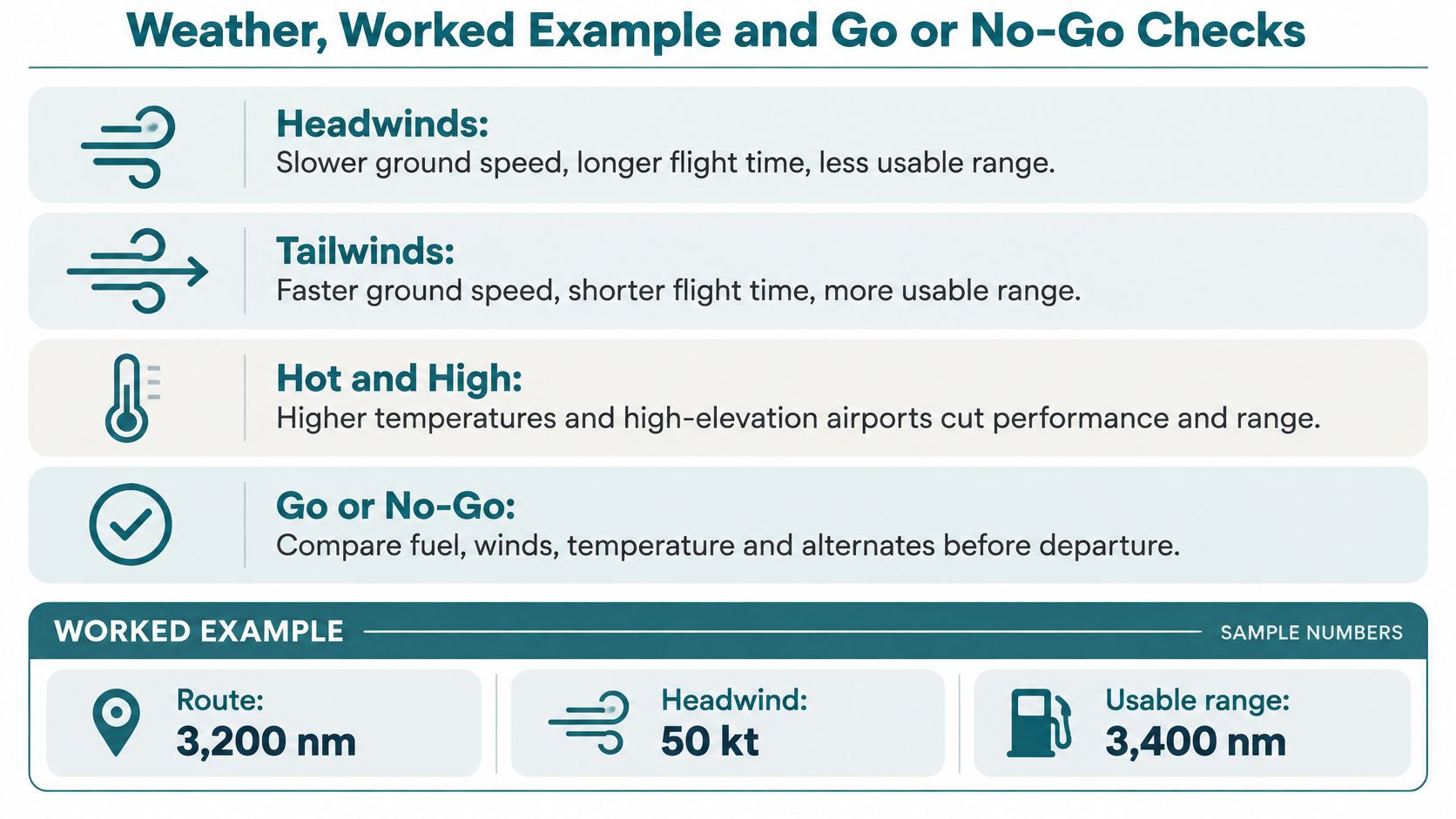
Headwinds reduce ground speed, extending the time needed to cover a route. Tailwinds do the reverse, while hot temperatures and high-elevation airports can restrict takeoff and climb performance before cruise range becomes the deciding factor.
The infographic summarizes those relationships. Its numerical strip is illustrative, not a calculated performance result for a particular Praetor 600 flight.
A simplified headwind calculation
For an illustration only, assume a constant true airspeed of 466 knots, a 3,000-nautical-mile route and a direct 60-knot headwind. This uses the listed maximum cruise speed to demonstrate arithmetic, not to predict a long-range mission.
- Still air: 3,000 ÷ 466 = approximately 6.44 hours.
- Headwind: Ground speed becomes 466 − 60 = 406 knots, so 3,000 ÷ 406 = approximately 7.39 hours.
- Difference: The hypothetical cruise takes approximately 0.95 hours longer, an increase of about 14.8%.
Those calculated times exclude climb, descent, routing changes and variable winds. They aren't block-time estimates, and the time increase isn't automatically the same percentage increase in total trip fuel.
The operational lesson is narrower and more useful: a route can remain geometrically inside the published range while requiring more flight time than the still-air comparison suggests. Add a heavier load, and the operator must assess both fuel availability and fuel required.
Six checks before committing to nonstop
- Confirm the manifest. Give us passenger numbers, baggage weights and unusual items so we can coordinate the operator's loading review.
- Request a route-specific calculation. The operator should use the exact airports, planned routing and forecast winds aloft.
- Check runway performance. Confirm departure and destination suitability at forecast temperature and runway condition.
- Resolve alternates and reserves. Suitable alternates and the operator's fuel policy must be included in the calculation.
- Verify airport services. Check hours, customs, handling and ground-transfer arrangements against the actual schedule.
- Compare a longer-range aircraft if necessary. We can assess an ultra long range alternative such as the Gulfstream G550, listed for 16 passengers, a range of 6,750 miles and a speed of 941 km/h. Its miles-based range shouldn't be compared directly with nautical-mile figures without aligning units and assumptions.
For the hypothetical headwind mission, the decision is no-go for an unconditional nonstop commitment until the operator confirms fuel, loading, runway and alternate margins. If every check clears, proceed nonstop; if any fails, plan a fuel stop, change airports or select another aircraft.
At Approved Jets, we arrange on-demand charter flights and coordinate aircraft selection, operator review and end-to-end travel logistics. Send us your exact airports, travel date, passenger count and baggage requirements so we can assess whether the Praetor 600 fits your nonstop mission or whether a different plan offers a more reliable journey.