Inside a Private Jet: Cabin Sizes, Seats and Amenities
Explore what it is like inside a private jet, with cabin sizes by aircraft class, seating layouts, amenities and real dimensions and range figures.
13 min read
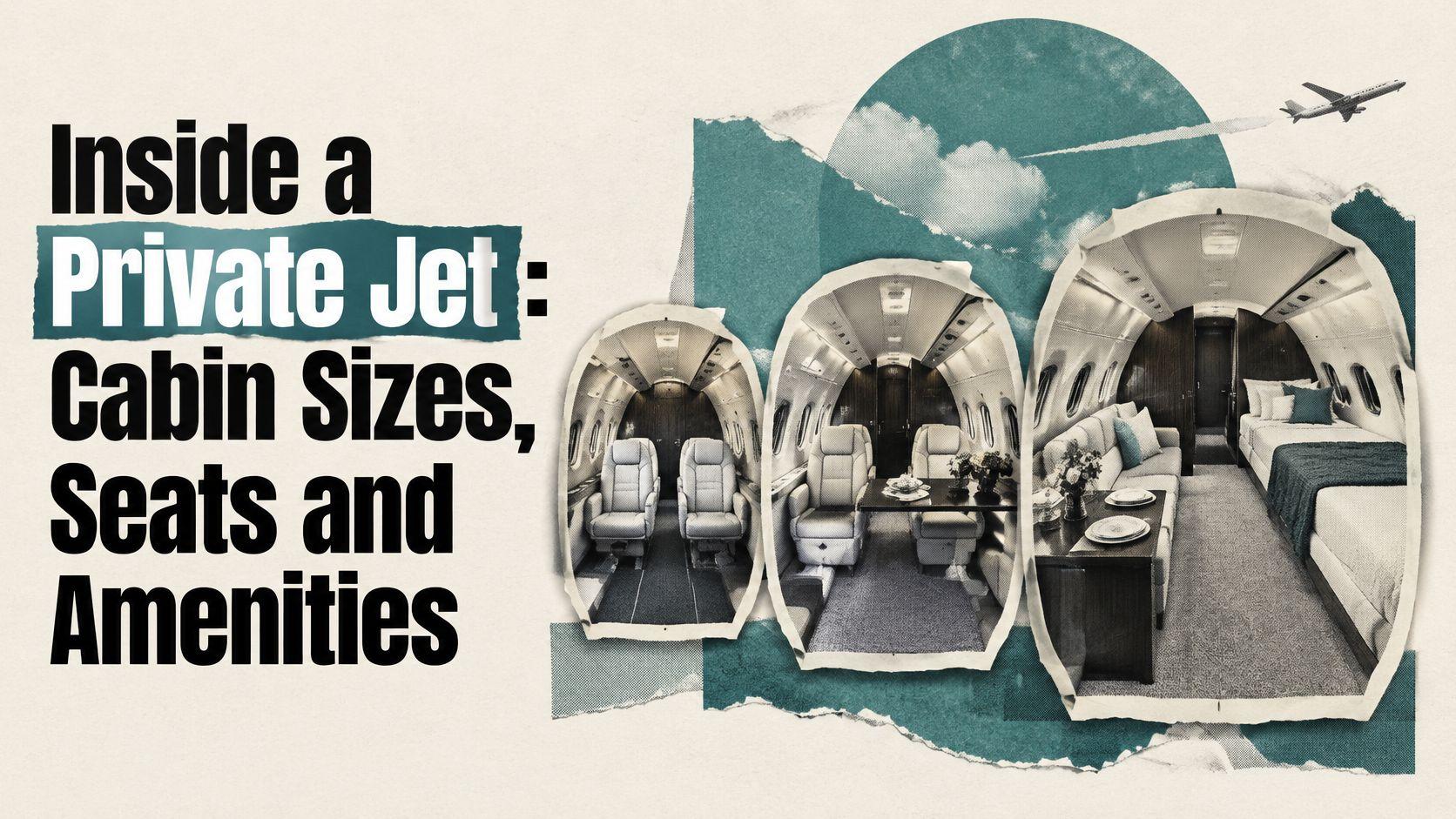
A cabin 56 feet 11 inches long changes what flying can mean. That's the interior length of the Gulfstream G700, according to Gulfstream's aircraft specifications, enough to think in terms of separate places to work, eat and rest rather than choosing a seat. Inside a private jet, the important distinction isn't the leather or woodwork. It's whether the cabin has enough usable space for the activities your trip requires.
That distinction matters because a comfortable seat, a usable bed and an accessible lavatory are different requirements. Compare aircraft by measured dimensions and their actual floor plans, and the trade-offs become much easier to see.
Table of Contents
- Cabin Sizes and Seat Counts by Aircraft Class
- Read dimensions as practical constraints
- How Cabin Zones Replace Airline Rows
- Furniture changes the purpose of the space
- Read the floor plan as a movement map
- Seating and Amenities Across Aircraft Sizes
- Evaluate the amenity in use
- Cabin Air, Noise and Comfort at Altitude
- Separate comfort features from medical suitability
- Accessibility and Mobility Inside the Cabin
- Ask about the complete journey through the cabin
- Confirm suitability in writing
- A Long-Haul Cabin Flight From Boarding to Landing
- Boarding and departure
- Work, meals and rest
- Preparing for arrival
- Matching a Cabin to Your Trip Before You Book
- Test the selection against real activities
- Separate aircraft suitability from the estimate
Cabin Sizes and Seat Counts by Aircraft Class
Light jets seat 5 to 8 in a cabin roughly 4 feet 6 inches high and 15 to 20 feet long. That envelope supports seated travel, but it limits standing, stretching and separation between passengers.
Aircraft class | Typical seats | Cabin height | Cabin length |
|---|---|---|---|
Light jet | 5–8 | About 4 ft 6 in to 5 ft | About 15–20 ft |
Midsize jet | 6–9 | About 5 ft 10 in to 6 ft | About 22–25 ft |
Super-midsize jet | 8–10 | About 6 ft | About 26–30 ft |
Bombardier Global 7500 | Up to 19 | 6 ft 2 in | 54 ft 5 in |
Gulfstream G700 | Up to 19 | 6 ft 3 in | 56 ft 11 in |
The two large-cabin figures are measured specifications, not planning bands. The Global 7500 measurements come from Bombardier's aircraft factsheet, which lists 6 feet 2 inches of height, 8 feet of width, 54 feet 5 inches of length and maximum range of 7,700 nautical miles. The G700 specifications list 6 feet 3 inches of height, 8 feet 2 inches of width, 56 feet 11 inches of length, seating for up to 19, 2,603 cubic feet of cabin volume plus a separate 195-cubic-foot baggage compartment, and maximum range of 7,750 nautical miles, according to Gulfstream's G700 specifications.
Range varies by model in the light through super-midsize classes, so compare the selected aircraft's published figure against the trip distance. Published maximum range is a performance benchmark. Passenger load, baggage, weather, routing and required reserves affect whether a specific aircraft completes an itinerary nonstop.
Read dimensions as practical constraints
Height determines posture. A low cabin works when everyone expects to remain seated. It changes boarding, stretching and movement to the lavatory.
Length creates opportunities for separation. It does not establish how much open floor remains after galleys, lavatories, storage, partitions and safety clearances are installed. Width matters when passengers need to pass a table, transfer into a seat or move alongside a deployed bed. Curved sidewalls also reduce usable headroom away from the centerline.
Our guide to midsize private jets explains that intermediate category in more detail, but the aircraft's measurements should decide whether it fits your group.
Practical rule: Choose the posture and activities you need first. Then find the cabin dimensions that support them.
How Cabin Zones Replace Airline Rows
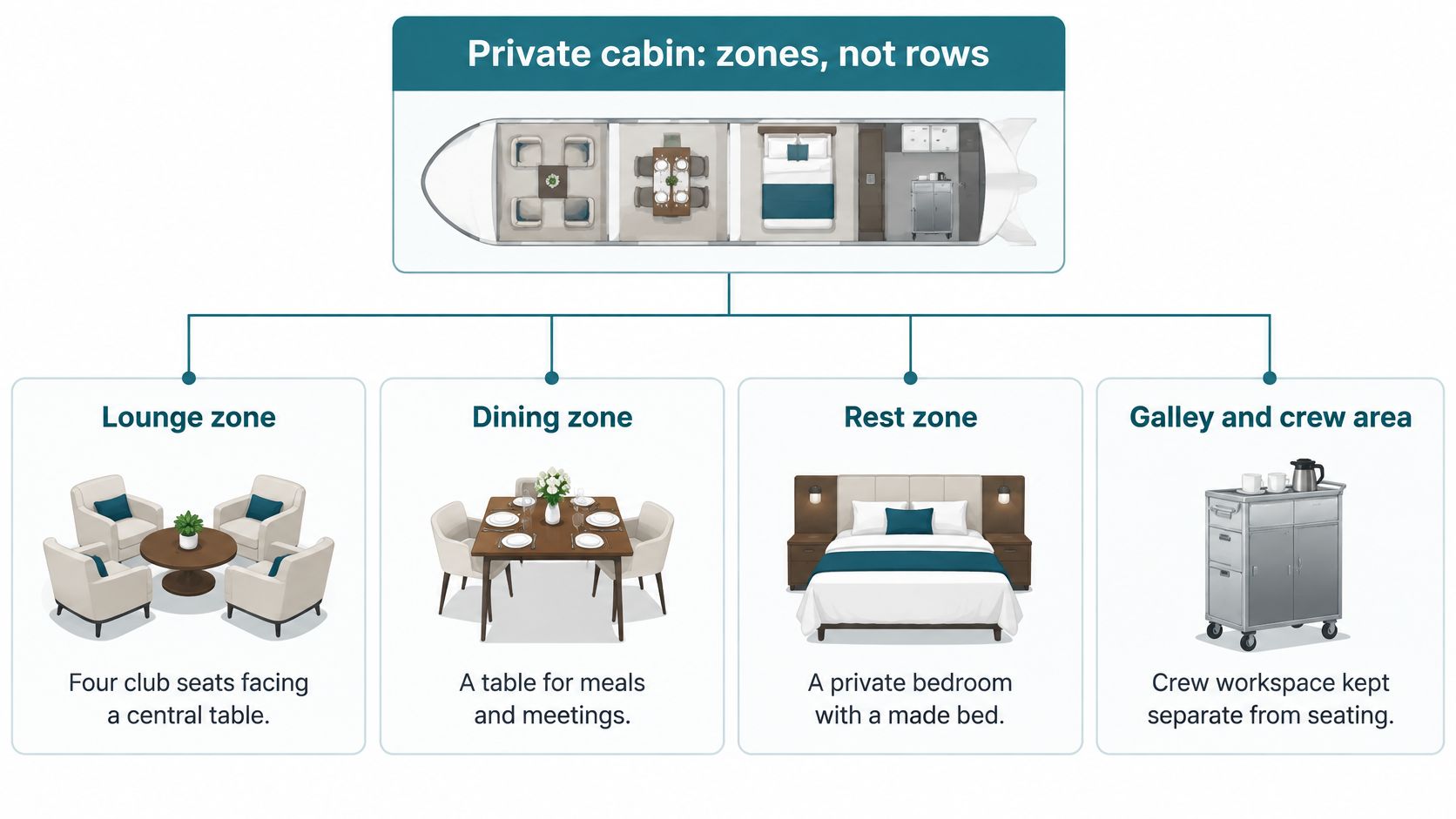
A private cabin is better understood as a small apartment than as a shortened airline cabin. A lounge supports conversation, a dining area provides a shared work surface, and a rest area lets someone withdraw from the group. The useful question is whether those activities can happen at the same time.
The layout below separates the main functions without suggesting that every private aircraft contains every zone.
Furniture changes the purpose of the space
A club arrangement places seats opposite one another around a table. Facing pairs make conversation and document sharing straightforward, but they don't provide the privacy of an enclosed room. A divan runs along a cabin wall and can support a different kind of rest when its approved configuration allows conversion.
The Global 7500 illustrates the distinction between a long cabin and usable passenger space. Furniture-style seats and divans occupy only part of the interior: galleys, lavatories, storage, partitions and safety clearances also need room. You can't treat the entire published cabin envelope as a passenger lounge.
Consider colleagues sharing an overnight flight. Someone reviewing a presentation needs a stable work surface and suitable lighting, while another passenger wants darkness and minimal interruption. Separate zones help only if the circulation route doesn't send meal service and lavatory traffic through the sleeping area.
Read the floor plan as a movement map
Start at the entry door and follow the paths passengers and crew will take.
- Entry and galley: Check whether boarding and service activity occur beside the main seating group.
- Dining area: Look for space to approach occupied seats without disturbing the table.
- Rest area: Establish whether it's enclosed, screened or open to the lounge.
- Lavatory route: Trace the journey from each intended sleeping position.
A partition can improve privacy while reducing openness. A larger galley can support more elaborate meals while taking space from seating. Neither choice is better; the right arrangement depends on whether you're transporting a working team, a sleeping family or passengers with different routines.
The strongest floor plan isn't the one with the most labels. It's the one that lets your group use the cabin without continually interrupting one another.
Seating and Amenities Across Aircraft Sizes
Swivel club seats, recliners, fixed seats and convertible divans serve different purposes. A seat that turns toward a colleague may be useful for conversation, while a recliner prioritizes individual rest. A divan that becomes a bed offers a different sleeping arrangement again, subject to the aircraft's approved configuration and crew instructions.
Treat the following as a screening guide rather than an equipment promise. The selected aircraft's configuration sheet should establish what's installed.
Seating and amenities by aircraft class
Feature | Light jet | Midsize jet | Large or ultra-long-range jet |
|---|---|---|---|
Main seating | Club or fixed seating | Swivel club seats, some recliners | Club seats, divans and dining seats |
Work surface | A fold-out table may be the principal surface | Multiple tables may be available | Conference or dining table in suitable layouts |
Lavatory | Small, or absent on some models | Enclosed and compact | Enclosed, generally more spacious |
Galley | Limited storage or none | Refreshment center | Full galley in suitable configurations |
Sleeping | Don't assume a flat sleeping surface | Convertible seats on some models | Bedroom or divan bed on some models |
Wi-Fi and entertainment | Confirm installed equipment and coverage | Confirm installed equipment and coverage | Confirm installed equipment and coverage |
Evaluate the amenity in use
A table is useful only if it supports the intended task. Ask whether there's room for a laptop and documents, whether power is within reach, and whether the adjacent seat remains usable while the table is deployed. A photograph of an open table doesn't answer those questions.
The same applies to a galley. Refrigeration, heating equipment, preparation space and service arrangements determine what a meal can realistically involve. Our private jet catering guide helps connect menu expectations with the practical limits of onboard service.
Consider a hypothetical regional business hop compared with an overnight intercontinental journey. On the shorter trip, a supportive seat and a convenient work surface might satisfy nearly every passenger need. On the overnight journey, the lavatory, meal service and sleeping arrangement become central to whether travelers can maintain a workable routine.
A reclining seat is not the same product as a flat bed, and a bed in an open lounge is not the same product as a private bedroom.
Connectivity needs an equally concrete check. Establish whether the installed system covers the proposed route and supports your intended activity, rather than accepting a general Wi-Fi label.
Before committing, request photographs and the configuration sheet for the specific aircraft, including the seating and sleeping arrangements. Matching model names don't guarantee matching interiors.
Cabin Air, Noise and Comfort at Altitude
The normal-operation pressurization standard centers on a cabin pressure altitude no higher than 8,000 feet, under the conditions explained in the FAA's pressurization guidance. That's the pressure-equivalent altitude inside the cabin, not the aircraft's cruising altitude. Pressurization reduces the physiological effects of flying high, but it doesn't necessarily recreate ground-level conditions.
For passengers, that distinction can mean less available oxygen and fatigue. Some newer aircraft offer lower cabin-altitude profiles, making pressurization a useful comparison for overnight travel or a journey followed immediately by demanding work. The relevant specification is the profile at the planned cruise conditions, not an isolated marketing claim.
Separate comfort features from medical suitability
For a hypothetical overnight flight, compare how the cabin will support rest as a whole. Pressure altitude matters, but so do seat posture, turbulence, lighting and noise. A quiet environment can still be unsuitable for sleep if the passenger can't find a comfortable position.
Use a short comfort checklist:
- Pressure profile: Request the certified cabin-altitude information for the proposed aircraft.
- Noise conditions: Compare specifications under comparable operating conditions rather than assuming a larger cabin is quieter.
- Rest environment: Confirm lighting controls, bedding and how nearby service activity will be managed.
- Personal needs: Discuss oxygen equipment, monitoring or medical assistance before the aircraft is selected.
Dryness and hydration deserve attention, but avoid treating extra water or a cabin feature as a remedy for every cause of travel fatigue. For practical help managing light and settling down, SleepHabits' in-flight sleep advice for restless sleepers can complement aircraft selection.
Health boundary: A lower-altitude or quieter cabin is a comfort feature, not medical treatment.
Passengers with heart or lung conditions, recent surgery or other relevant health constraints should obtain individualized medical advice. The operator and any medical team also need to confirm equipment compatibility and assistance requirements; wellness branding can't establish clinical suitability.
Accessibility and Mobility Inside the Cabin
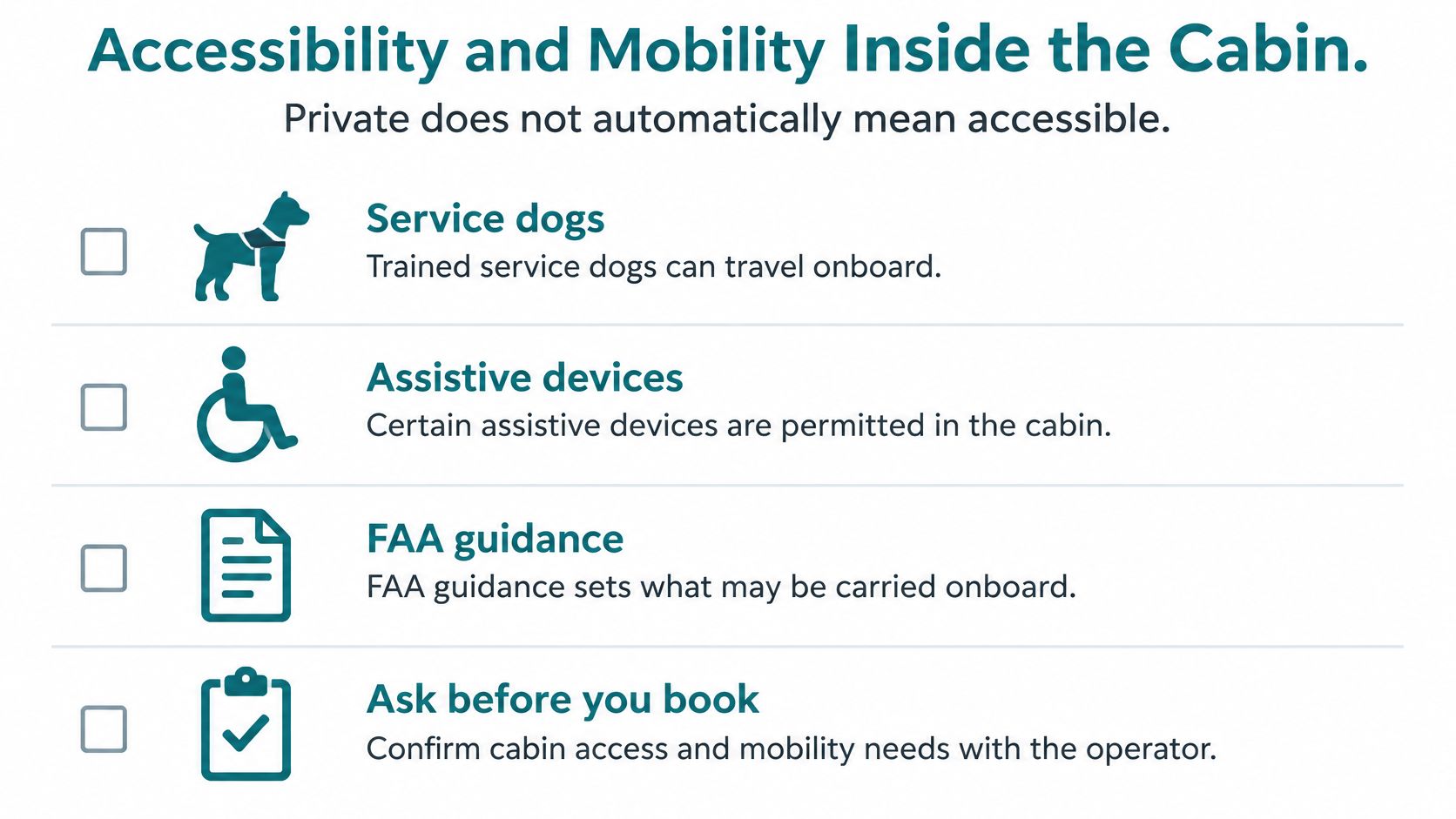
Private does not automatically mean accessible. Direct routing and a private boarding environment don't establish whether a passenger can negotiate the entrance, transfer into a seat or use the lavatory independently.
FAA accessibility guidance addresses trained service dogs and assistive devices, including folding wheelchairs, canes, walkers, prescription medications and portable oxygen concentrators, subject to applicable safety, stowage and hazardous-material requirements. An onboard wheelchair, suitable wheelchair stowage or an accessible lavatory must be confirmed for the aircraft and configuration rather than assumed.
Use the checklist as a starting point for an aircraft-specific conversation.
Ask about the complete journey through the cabin
Accessibility involves a chain of movements. Successful boarding doesn't resolve a difficult seat transfer, and a comfortable seat doesn't resolve an unusable lavatory.
- Entrance clearance: What are the clear door dimensions, stair arrangement and available boarding aids?
- Transfer assistance: Who will assist, and what equipment and procedures will they use?
- Seat-to-lavatory route: Can the passenger use the actual aisle with furniture in its flight configuration?
- Lavatory use: Are the entrance, turning space and transfer arrangement suitable for that passenger?
- Mobility-device storage: Where will the aid travel, and can it be accessed when needed?
- Batteries and equipment: What documentation and handling arrangements apply to the specific device?
- Service-animal arrangements: What documentation and onboard positioning must be confirmed?
- Ground continuity: Is a lift-equipped transfer or medical escort needed at either airport?
Consider a wheelchair user comparing a compact aircraft with a larger cabin. The smaller jet might provide the preferred departure time yet have an entrance and lavatory that make the trip impractical. The larger aircraft is the better fit only if its measured access and transfer arrangements solve those problems.
Confirm suitability in writing
Send the passenger's functional requirements, not just a diagnosis or a request for assistance. Explain whether they can climb steps, transfer with support, walk a short distance, or remain seated without repositioning.
Request cabin measurements, an aircraft-specific configuration sheet and written confirmation of the agreed arrangements from the operator. We coordinate ground transport and special requests as part of trip planning, but the operating carrier must confirm what the aircraft and crew can accommodate.
A Long-Haul Cabin Flight From Boarding to Landing
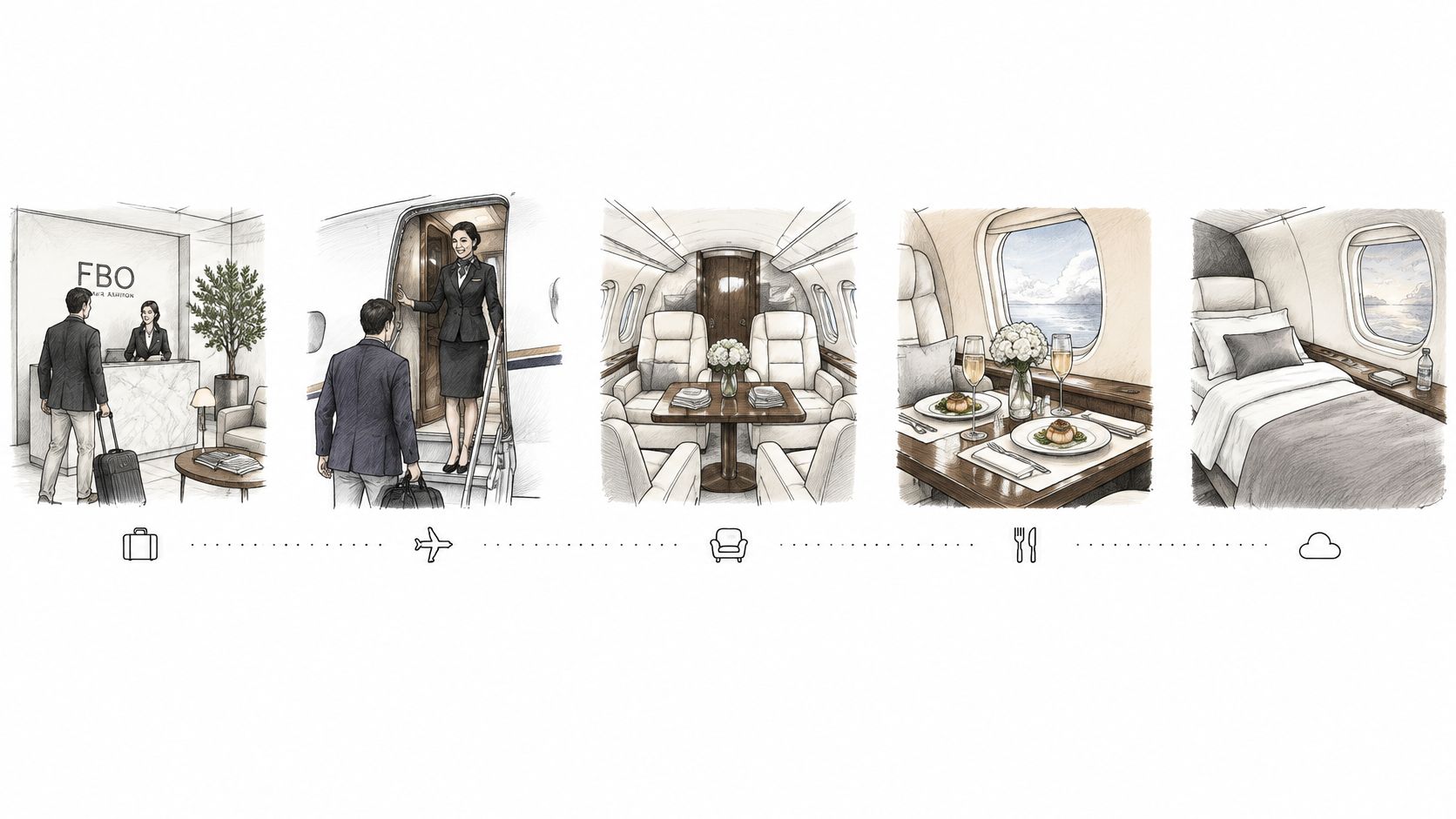
Consider a hypothetical transatlantic journey in a large ultra-long-range cabin. The passengers arrive through a fixed-base operator, where the boarding process is organized around the flight rather than an airline departure gate. Before anyone settles into a work session, they need to understand how the cabin functions during normal operations and emergencies.
The boarding-to-cabin sequence looks simple, but each transition has practical requirements.
Boarding and departure
Under Federal Aviation Regulations §135.117, the pre-takeoff passenger briefing covers restraints, passenger entry and emergency exits, and life-saving equipment; accessible printed cards must supplement it with emergency-exit diagrams and operating instructions. The rule also requires an appropriate briefing for a passenger who may need evacuation assistance and that person's attendant.
In this scenario, each traveler finds the briefing card, checks the nearest usable exit and asks the crew about flotation equipment for the overwater segment. Bags and personal items go into approved stowage rather than occupying the aisle. Everyone uses the seating and restraints directed by the crew for departure.
Work, meals and rest
Once the crew permits movement, the working passengers gather in the lounge. Later, they move to the dining area, leaving the rest zone available for someone who wants to withdraw. The G700-style multi-zone arrangement makes sense here because different passengers can follow different routines.
Meal planning should account for preferences between the main services as well as dinner itself. For ideas to discuss before departure, Rip Van on staying energized midair offers a snack-planning resource, without replacing individualized dietary advice.
The embedded video provides another visual reference for the cabin experience.
As the cabin settles for the night, one passenger uses the divan while another retreats to the private sleeping area, if that arrangement is installed. Anyone comparing a different Gulfstream should use our Gulfstream G650 charter guide as a starting point, then verify the offered aircraft rather than transferring expectations between models.
Preparing for arrival
Before descent, the crew directs passengers back to suitable seats and secures the cabin. Work materials, meal items and bedding shouldn't obstruct movement or emergency equipment.
Keep these actions straightforward:
- Locate the exit: Know which usable exit is nearest your assigned seat.
- Preserve clearance: Keep aisles and exit areas free of belongings.
- Understand service areas: Know where the galley and lavatory are without entering crew workspace unnecessarily.
The successful long-haul cabin isn't merely spacious. It supports a sequence of activities while allowing the crew to maintain a safe, orderly flight.
Matching a Cabin to Your Trip Before You Book
Start with passenger count, flight length, intended activities, accessibility and comfort sensitivities. Those requirements establish the minimum useful cabin. Finish quality should come later, because it can't compensate for an unsuitable layout.
A light jet is a sensible candidate for a short domestic trip when the group mainly needs seats and direct transportation. Midsize and super-midsize aircraft become stronger candidates as standing room, a lavatory and a larger seating group become more important. Large cabins deserve consideration when the mission includes overnight rest, separate meetings or intercontinental travel.
Test the selection against real activities
Consider a family planning an overnight journey. Don't begin by asking whether the aircraft has enough passenger seats; establish whether everyone who needs to sleep has an appropriate sleeping position and whether the adults can assist children without disturbing the entire cabin.
For a small business group on a short hop, the decision may be simpler. If everyone can sit comfortably, share documents and carry the required baggage, additional living zones might add little practical value.
Trip requirement | Evidence to request before booking |
|---|---|
Everyone can travel comfortably | Approved seating plan and measured cabin dimensions |
Passengers need to sleep | Sleeping layout, bedding and privacy arrangement |
Someone needs assistance | Written boarding, transfer and lavatory arrangements |
Work must continue onboard | Table layout, power access and connectivity details |
Altitude or noise is a concern | Cabin-altitude profile and relevant comfort specifications |
Separate aircraft suitability from the estimate
We receive travel requirements, source aircraft and operators through our network, and present the available options with itinerary details. We act as a broker, not the operating carrier, so aircraft-specific capabilities need confirmation from the applicable operator.
Quotes from Approved Jets are estimates only. They can change with aircraft availability, fuel costs, positioning fees, landing fees, overnight charges, de-icing, catering and ground transportation.
Before booking, answer these questions plainly: How many people are traveling? How long will they be onboard? Does anyone need to lie down, work privately or move independently? Give the answers alongside baggage and assistance requirements, so the proposed cabin can be evaluated against the trip rather than a photograph.
We arrange personalized charter proposals and provide active oversight from departure through arrival. Visit Approved Jets to contact our flight advisors or use the Get a Quote button, and share your passenger, work, sleep and mobility requirements so we can match the available aircraft options to your journey.