How Much Private Jet Rental Cost in 2026
How much private jet rental cost in 2026: hourly rates by jet size, positioning and airport fees, empty legs, and sample trip totals.
13 min read

Private jet rental in 2026 spans planning bands from about $2,000 an hour for a turboprop to roughly $9,000–$22,000 for a heavy jet, based on BlackJet's turboprop pricing and Haute Jets' heavy-jet guidance. The invoice covers the whole mission, including passenger flight, positioning, airport charges, taxes, and trip-specific services.
The gap can be substantial. Jets & Capital gives an example where ferry charges alone add approximately $3,000–$15,000 to an initially unvetted quote. A nearby aircraft with a higher hourly rate may therefore cost less overall than a cheaper one that must fly empty to collect you.
For corporate travel managers, families, and team coordinators, the useful comparison is the lowest acceptable all-in mission total, not the hourly rate alone. An empty leg may reduce the bill, but only if its fixed schedule suits the trip.
Table of Contents
- What a Private Jet Rental Costs Before Fees
- Establish the aircraft-time baseline
- Hourly Charter Rates by Aircraft Category
- Choose capability before cabin size
- Read the row as a starting assumption
- Hourly One-Way and Empty-Leg Pricing
- Compare the commitment, not the marketing name
- Decide how much schedule risk you can accept
- Fuel Positioning Crew and Airport Fees
- Separate airport costs from federal charges
- Make exclusions visible
- Sample Itineraries and What They Cost
- A locally positioned light jet
- A transcontinental mission
- The positioning trap
- Ways to Lower the Charter Bill
- Change the expensive requirements first
- Compare recurring access and included services
- Confirm the Quote Before You Book
- Verify who operates the flight
- Reconfirm before payment
What a Private Jet Rental Costs Before Fees
By mid-2026, reported average hourly prices were $8,456 for light jets, $9,557 for midsize jets, and $15,236 for large-cabin jets, according to the Travel Statistics Bureau. Those averages offer a higher-side budgeting check, not a promise that every aircraft in a category will quote near that amount.
Published ranges are broader. Haute Jets' 2026 charter guidance places light jets at approximately $4,000–$6,500 per hour, midsize and super-midsize jets at $5,500–$10,500, and heavy jets at $9,000–$22,000. These are different publishers' measures, not a single comparable price survey, so a lower advertised range and a higher reported average aren't necessarily contradictory.
Establish the aircraft-time baseline
A four-hour light-jet mission at $4,000 per hour produces $16,000 of aircraft time before extras, using the worked example published by Silver Air. That subtotal is a starting point, not a checkout price.
Two quotes for the same city pair can differ because one aircraft is already nearby while another needs positioning. The operators may also use different daily minimums or include different services in their hourly figures. Fuel and tax treatment must match before the prices are meaningfully comparable.
Budgeting rule: Carry an all-in mission budget into the comparison, not an hourly ceiling.
You're usually chartering an entire aircraft, not buying a seat. A lower passenger count doesn't automatically reduce the aircraft charge, while a larger group may require more baggage capacity, different seating, or a larger category altogether.
Hourly Charter Rates by Aircraft Category
2026 private jet charter hourly ranges by category
Category | Indicative hourly range | Mid-2026 reported average | Typical mission |
|---|---|---|---|
Turboprop | $2,000–$3,000 | No comparable average cited | Short regional hops |
Light jet | $3,000–$6,500 | $8,456 | Two- to three-hour trips, about six to eight seats |
Midsize jet | $5,000–$8,000 | $9,557 | Longer domestic sectors |
Super-midsize jet | $7,000–$10,500 | No comparable average cited | Nonstop transcontinental |
Heavy and large-cabin jet | $9,000–$16,500 | $15,236 | International and larger parties |
Ultra-long-range jet | $10,000–$22,000 | No comparable average cited | Intercontinental nonstop |
The indicative baseline comes from BlackJet's 2026 category guide, which lists turboprops at $2,000–$3,000, light jets at $3,000–$5,000, midsize jets at $5,000–$8,000, super-midsize jets at $7,000–$10,000, and heavy or ultra-long-range aircraft at $10,000–$14,000 or more per hour. The table combines those baselines with the broader published bands and reported averages identified earlier; it isn't one operator's rate card.
Choose capability before cabin size
Turboprops deserve consideration for short regional travel. They aren't jets, but they belong in the cost comparison when the departure airport, destination, luggage, and passenger requirements make them suitable. Don't dismiss an aircraft purely because its cruise speed is lower; compare the complete itinerary and usable airports.
Light jets fit smaller parties on relatively short trips. The seating and duration shown in the table are planning illustrations, not guarantees for every model. Before choosing one, confirm the actual seating layout and whether everyone's luggage fits without compromising the proposed mission.
Midsize aircraft add cabin space and range, but the category label alone doesn't establish nonstop capability. Our guide to midsize private jets helps distinguish aircraft that may look similar in a quotation but offer different baggage arrangements and mission suitability.
For super-midsize aircraft, transcontinental travel is a common use case, subject to the particular aircraft, winds, payload, and route. Heavy and ultra-long-range aircraft become relevant when the itinerary requires greater range, more usable cabin space, or a larger party.
Read the row as a starting assumption
The aircraft's quoted hourly rate is only useful after the operator confirms it can perform the proposed flight. A lower-category aircraft that needs a fuel stop may not offer the best total price or arrival time.
- Seats: Check the actual passenger configuration, not the category's maximum advertised capacity.
- Baggage: Describe golf clubs, skis, instruments, medical equipment, and oversized cases before aircraft selection.
- Range: Request a mission assessment with your passenger and luggage load.
- Cabin requirements: Identify accessibility, working space, or medical needs that rule out otherwise cheaper options.
Choose the smallest suitable aircraft, not the smallest available aircraft. Then compare its complete mission quote against the next suitable category.
Hourly One-Way and Empty-Leg Pricing
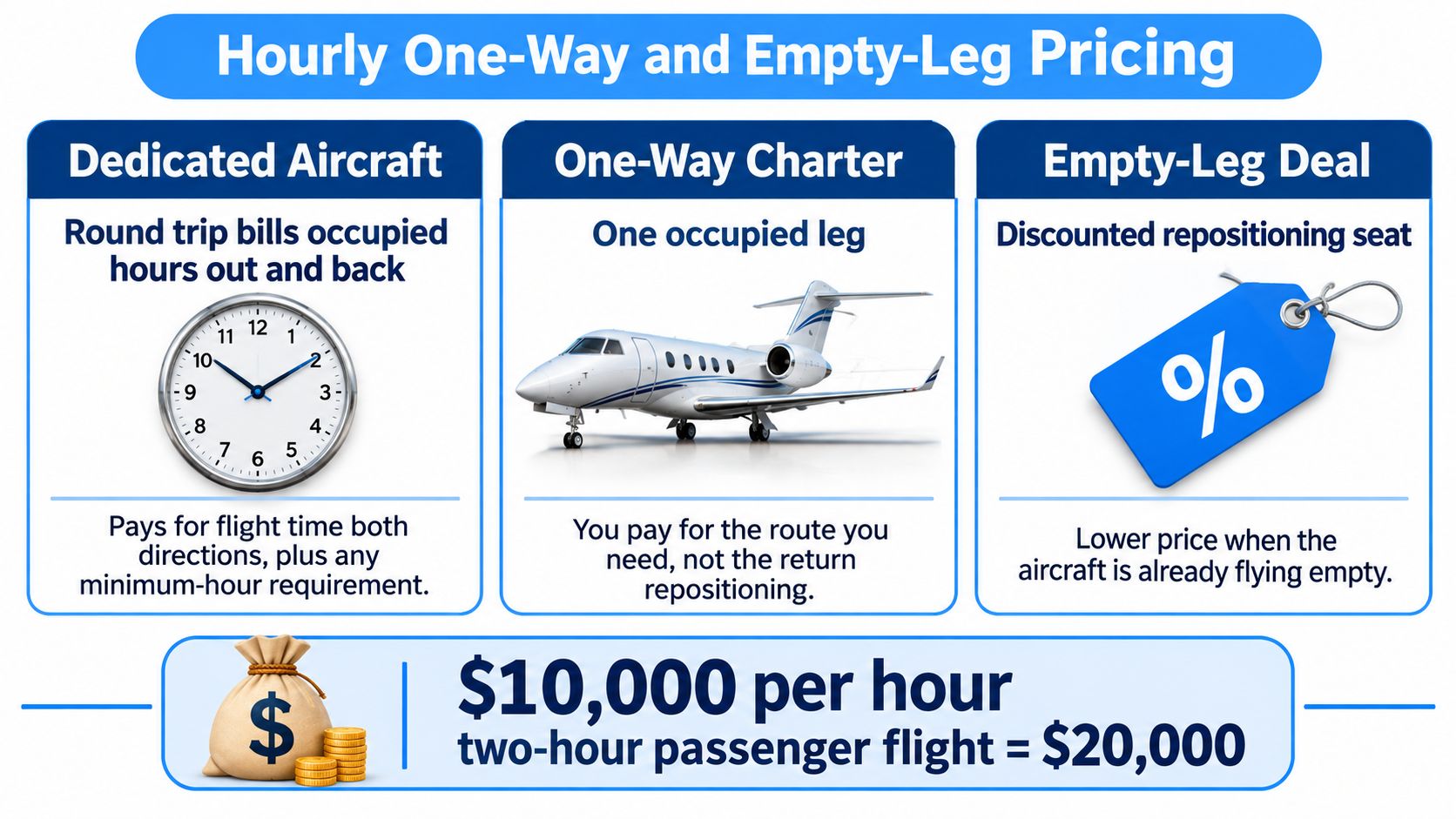
A dedicated aircraft, a one-way charter, and an empty-leg booking can all use similar aircraft while allocating costs differently. The important distinctions are which movements you're funding and how much control you retain over departure.
This visual separates the common sales models, but the written quotation determines whether repositioning is included.
Compare the commitment, not the marketing name
Booking model | What the traveler funds | Main trade-off |
|---|---|---|
Dedicated aircraft | Occupied outbound and return flying, plus applicable minimums and trip costs | Greater itinerary control, but waiting and overnight requirements can increase cost |
One-way charter | Passenger flight plus any positioning allocated to the booking | No passenger return required, but ferry costs may remain |
Empty-leg deal | An existing aircraft repositioning movement | Lower price potential, with restricted routing and schedule control |
A one-way charter doesn't automatically mean you pay only for occupied flying. Repositioning may be billed at the same hourly rate as the passenger segment, while an empty-leg market snapshot published by Haute Jets reported a median price of approximately $7,691 across 4,565 listings, with about 75% below $10,000 for the entire aircraft.
Those figures describe a tracked marketplace, not a guaranteed discount for your route. An empty leg only becomes useful when the aircraft's existing movement aligns with your departure, destination, and timing. It's generally a whole-aircraft opportunity, not necessarily an individual discounted seat.
A cheap departure that can't deliver you to the meeting on time isn't a cheaper version of the same service.
Decide how much schedule risk you can accept
A leisure traveler with alternate dates may reasonably choose an empty leg. A medical coordinator or team manager usually needs a firmer commitment because a changed departure can disrupt treatment, ground transport, accommodation, or an event.
Our explanation of private jet charter empty legs is useful when weighing those restrictions. Check cancellation terms, the permitted departure window, luggage acceptance, pet accommodation, and what happens if the underlying aircraft assignment changes.
The accompanying video provides another way to review the booking options.
Don't assume the booking model determines the winner. A dedicated aircraft may be economical for a compact return itinerary, while a competitively positioned one-way aircraft may suit a traveler staying at the destination. The total and the contract decide.
Fuel Positioning Crew and Airport Fees
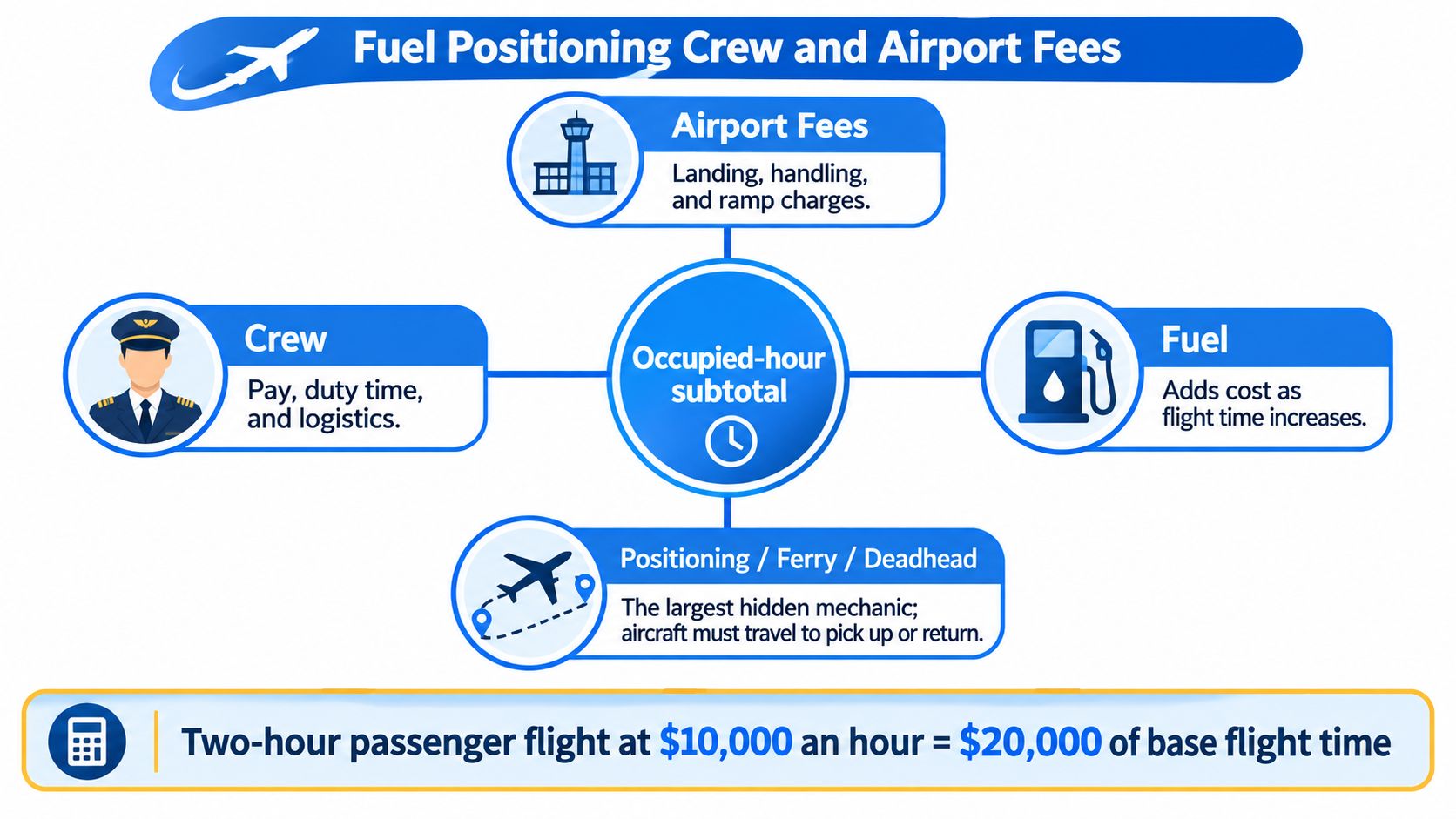
Start with the occupied-hour subtotal, then identify every movement and service required to deliver it. Positioning, also called ferry or deadhead travel, can be the largest addition because the aircraft may need to reach your departure airport and leave your destination without passengers.
As a hypothetical illustration, a passenger flight billed at two hours can require equally long inbound and outbound positioning movements. The passenger experiences one flight, but the operator must account for all the flying assigned to that booking.
The diagram shows how those costs sit outside the passenger-flight subtotal.
Separate airport costs from federal charges
Haute Jets' fee guide places domestic landing and handling at approximately $150–$3,000 per sector, premium international FBO handling at $2,500–$5,000, and fuel surcharges at approximately $200–$800 per flight hour when the assumed fuel price is exceeded. Its worked example adds $3,200 in fuel surcharge to a four-hour flight, then $2,000 in handling, producing $5,200 before taxes or repositioning.
U.S. federal charges are separate: Paramount Business Jets identifies a 7.5% federal excise tax on taxable transportation and a 2026 domestic segment fee of $5.30 per passenger per segment. Its example of a $40,000 taxable transportation charge, carrying six passengers on one segment, produces approximately $3,000 in excise tax plus $31.80 in segment fees.
Charges that sit outside the hourly rate
Charge | Typical amount | When it appears |
|---|---|---|
Positioning or ferry time | May use the occupied-leg hourly rate | Aircraft must reach the origin or reposition afterward |
Domestic landing and handling | $150–$3,000 per sector | Airport services associated with the flight sector |
International FBO handling | $2,500–$5,000 | Premium international handling arrangements |
Fuel surcharge | $200–$800 per flight hour | Fuel exceeds the operator's quotation assumption |
U.S. federal excise tax | 7.5% of taxable transportation | Applicable domestic taxable transportation |
Domestic segment fee | $5.30 per passenger per segment | Each applicable U.S. domestic segment in 2026 |
Crew overnight and extras | Quoted for the itinerary and services | Overnight stays, weather disruption, or special requests |
The amounts above use the fee guidance and federal-charge example just identified. They shouldn't be automatically added to a quote that already includes them.
Make exclusions visible
Airport selection matters because handling, parking, and ground services differ between facilities. A nearby regional airport can be worth comparing, provided the aircraft can use it and the longer ground transfer doesn't erase the benefit.
Crew accommodation, de-icing, international permits, parking, and catering need explicit treatment. Some are predictable itinerary costs; others remain contingent on weather or operational circumstances.
Require these distinct quote lines:
- Flying: Occupied hours, positioning hours, and minimum-hour adjustments.
- Operating extras: Fuel assumptions, airport services, crew logistics, and contingent charges.
- Taxes and total: Applicable government charges and whether the displayed amount includes them.
Sample Itineraries and What They Cost
These are hypothetical planning illustrations for 2026, not live operator offers. The named routes provide context; the assumed flight times and rates are inputs for arithmetic, not confirmed flight plans, and each illustration expires when availability or mission assumptions change.
A locally positioned light jet
Say a light jet is already in the New York area for a Teterboro-to-Miami departure. Under the illustration below, the aircraft-time subtotal is straightforward; the important remaining question is whether the quotation includes every required airport and tax item.
A longer light-jet mission shows why per-person figures require care. Dividing a whole-aircraft subtotal among a full party can make the comparison useful, but it doesn't turn the flight into a per-seat fare or remove the extras.
Illustrated one-way mission totals
Trip | Aircraft time | Main extras | Illustrated total |
|---|---|---|---|
Teterboro to Miami, local light jet, assumed 2.5 hours at $5,000 | $12,500 | Assumed handling of $150–$3,000 plus 7.5% tax | Approximately $13,600–$16,400 for these listed items |
Four-hour light-jet mission at $4,000 | $16,000 | Ferry, overnight, or peak premium if applicable; taxes and other charges additional | $16,000 before extras |
Van Nuys to Teterboro, super-midsize, assumed 5.5 hours at $9,000 | $49,500 | Assumed handling of $150–$3,000 plus 7.5% tax, aircraft already positioned | Approximately $53,400–$56,200 for these listed items |
Two-hour trip at $10,000 with four ferry hours | About $60,000 | Airports and taxes additional | About $60,000 before extras |
The route calculations are illustrative arithmetic using the stated assumptions, not published route quotations. They omit domestic segment fees and any services not expressly listed, so the displayed totals aren't full all-in offers.
A transcontinental mission
For the Van Nuys-to-Teterboro illustration, the aircraft is assumed to be locally positioned and suitable for the proposed nonstop mission. The operator must still verify the actual aircraft's range with the expected passenger load, baggage, winds, and reserves.
A fuel stop changes more than fuel consumption. It can introduce another airport service requirement and additional time, so the comparison should use the operator's complete routing rather than an assumed nonstop duration.
The positioning trap
The final row follows the example published by Icarus Jet: two occupied hours, two inbound positioning hours, and two return hours at $10,000 per hour can represent approximately $60,000 before taxes and airport charges, rather than the $20,000 suggested by the passenger flight alone.
Quote test: Highlight every hour you'll spend aboard in one color and every aircraft movement without your party in another.
An empty-leg counterpart could be attractive if your itinerary matches an existing ferry movement. But it isn't an equivalent replacement when your departure must remain fixed or you need a guaranteed return.
Map your own quotation to occupied flying, ferry flying, minimums, taxes, and services. If a bundled subtotal prevents that comparison, request the breakdown before deciding which aircraft is cheaper.
Ways to Lower the Charter Bill
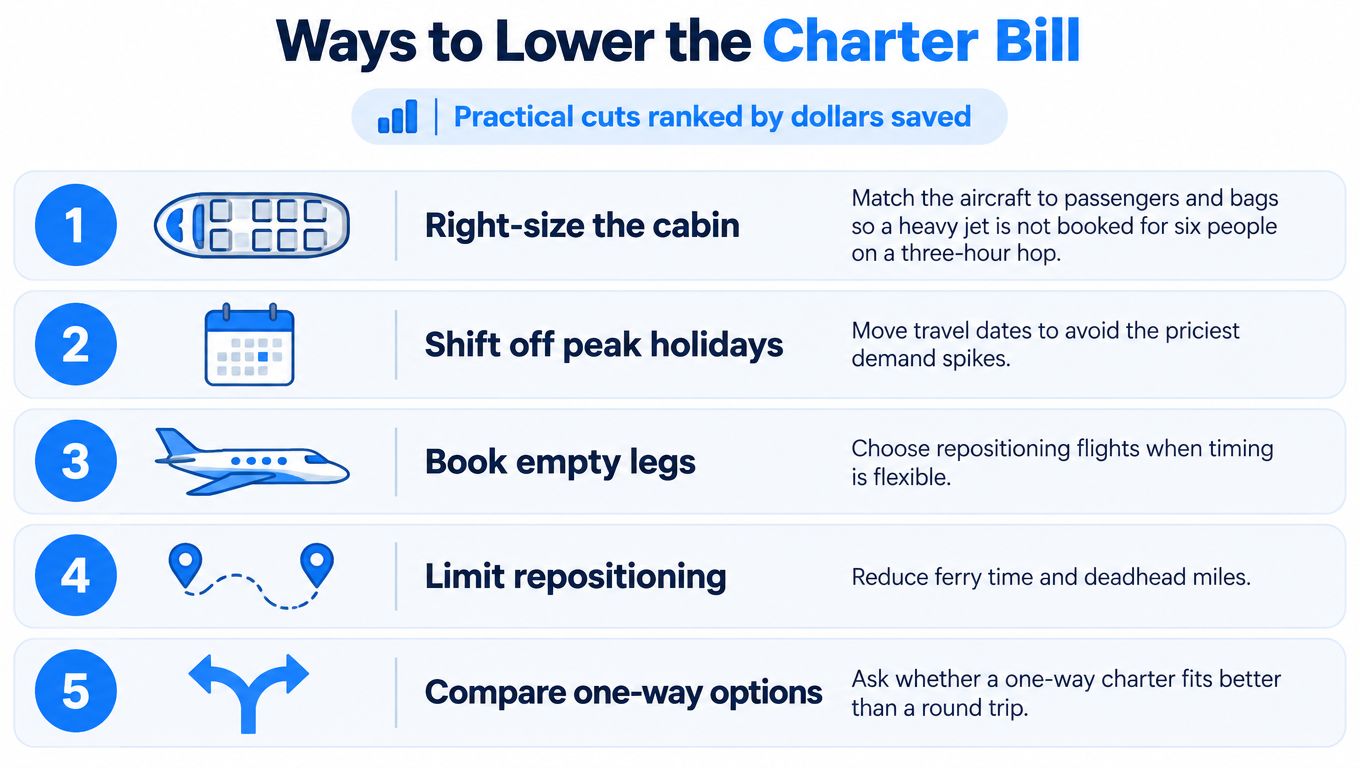
The largest savings usually come from changing the aircraft or itinerary, not removing refreshments. Rank the options by their effect on the complete booking, while preserving the capabilities and reliability the trip needs.
The visual summarizes common savings levers; the practical order below gives priority to decisions you can make before aircraft sourcing.
Change the expensive requirements first
- Right-size the aircraft. Provide the passenger manifest and a realistic luggage description before selecting a cabin. Don't pay for long-range capability the itinerary doesn't require, but don't downsize into a fuel stop or inadequate baggage space.
- Offer alternate departure windows. If possible, compare a non-holiday date or a departure outside a busy Friday-afternoon period. Request a complete revised quote, because moving the flight can change aircraft availability, minimums, and crew accommodation rather than just the hourly rate.
- Compare usable airports. Include the ground transfer in the calculation. A cheaper arrival airport isn't better value if it creates an impractical drive, misses a meeting, or can't support the required aircraft.
- Price the return itinerary as a whole. If you're returning soon, compare a dedicated return arrangement with separately sourced departures. Don't assume either structure wins before the operator assesses aircraft scheduling and crew requirements.
Compare recurring access and included services
- Check catering inclusions. Our standard VIP snacks, premium beverages, and fully stocked bar are included on most flights. Separate those inclusions from special meals or other requests so the same service isn't budgeted twice.
- Benchmark a jet card against actual recurring routes. A William Blair aviation-services industry update reports late-2025 average guaranteed jet-card pricing of $11,578 per occupied hour, including fuel surcharges and the 7.5% U.S. federal excise tax. That buys a different pricing structure, not proof that a card is cheaper than on-demand charter.
For recurring corporate travel, compare the card's availability commitments, booking restrictions, category access, and inclusions against representative on-demand missions. The best choice may be the one that reduces administrative uncertainty rather than the lowest isolated hourly figure.
Medical evacuation, sports team movements tied to events, and departures that cannot slip shouldn't depend on speculative availability. For these travelers, preserve guaranteed arrangements and appropriate equipment before seeking discretionary savings.
Confirm the Quote Before You Book
A published hourly rate is a starting point, not a confirmed offer. Before paying, make sure the written proposal identifies the aircraft and operator, the itinerary and billable time, the costs included, and the terms that apply if plans change.
Check the proposed aircraft's category, seating, baggage acceptance, and operating carrier. Confirm how the quote treats occupied flying, positioning, minimums, and stops. It should also state assumptions for fuel, landing and handling, parking, crew accommodation, and weather-related charges. Ask which services, such as catering, pet arrangements, and ground transfers, are included or priced separately.
Verify who operates the flight
For a U.S. charter, confirm that the operating carrier holds the appropriate FAA Part 135 certificate for the mission. Approved Jets is a charter broker, not an aircraft operator. It processes travel requirements, sources aircraft and operators through its network, and presents charter options, pricing, and itinerary details.
Understanding aircraft charter brokerage helps clarify the distinction between the broker arranging the trip and the carrier operating it. Compare itemized all-in mission totals for the same requirements. A nearby aircraft at a higher hourly rate may cost less overall than a lower-rate option that needs positioning.
Reconfirm before payment
Approved Jets quotes are estimates in U.S. dollars. Availability and pricing can change with fuel, positioning, landing fees, overnight charges, de-icing, catering, and ground transportation. A quote is valid for the period stated, or 48 hours from issuance if no period is stated. Once it expires, pricing and availability must be reconfirmed.
Final pricing is confirmed only when a booking agreement is executed or Approved Jets provides written confirmation. Give the advisor your dates, airports, passenger count, luggage, pets, and whether the departure time is fixed, so the proposal reflects the actual trip. Request an itemized quote and check each charge before committing. Empty-leg pricing is useful only if its fixed schedule suits your plans.
Approved Jets flight advisors are available 24/7 at +1 (866) 678-1411 for immediate charter requirements. For international trips, check eSIM refund eligibility if connectivity arrangements change.
Approved Jets arranges on-demand charter options and provides itemized quote support. Visit Approved Jets with your route, dates, passenger count, and baggage requirements to request suitable options and a written proposal.