Lightweight 5th Wheel: What to Check Before You Tow
Learn what makes a lightweight 5th wheel light, which weight specs matter, and how pin weight and truck payload decide whether it is safe to tow.
18 min read
In 10 of 14 truck configurations, towing at the pickup's advertised trailer capacity leaves less than 600 pounds for occupants and cargo, according to the RV Towing Calc fifth-wheel pin weight guide. That single finding explains why so many shoppers who buy a lightweight 5th wheel end up legally overloaded before they even leave the driveway. You can stay thousands of pounds below your truck's headline tow rating and still crush the rear suspension, overheat the brakes, or exceed the rear axle's certified limit.
That gap matters more right now because buyers are pouring into lighter rigs. According to Dataintelo, the lightweight fifth-wheel segment reached $4.84 billion and accounted for 26.3% of the fifth-wheel trailer market in 2025. Dealers know "half-ton towable" and "ultra-lite" stickers move inventory, so brochures put dry weight in big bold print while burying the numbers that govern safety.
Here is the test every experienced towing specialist runs first. Pin weight and remaining truck payload, not dry weight or a marketing badge on the front cap, decide whether a trailer fits your pickup. Once you understand how a loaded trailer presses down on your truck bed, the math takes five minutes and saves you from a costly mistake.
Table of Contents
- What Lightweight Really Means on a Fifth Wheel
- Why the Lightweight Label Sets No Weight Limit
- The Weight Specs That Define a Lightweight Model
- Reading the Five Numbers in Order
- Weight Specs to Compare on a Lightweight Fifth Wheel
- What Water, Propane and Gear Add to the Load
- Watching One Load Hit Two Different Margins
- Four Steps to Calculate Your Real Cargo Buffer
- The Check That Decides Fit
- Hitch Weight and Axle Balance Still Count
- Seven Steps to Verify Truck Compatibility
- When a High Tow Rating Still Fails
- Trade-Offs Lighter Weight Brings to Ownership
- What Manufacturers Trim to Cut Weight
- When Lighter Weight Actually Pays Off
- Worked Examples and the Final Go or No-Go
- Testing Both Models on Two Real Truck Setups
- Your Final Go or No-Go Checklist
What Lightweight Really Means on a Fifth Wheel
Manufacturers are building fifth wheels at a rapid clip, with the RV Industry Association reporting 65,632 fifth-wheel travel trailers shipped in 2025, up 21.6% from 53,958 in 2024, and 4,752 units in December 2025 alone, up 22.9% from 3,866 in December 2024. Those are wholesale shipments leaving factory gates for dealer lots, not retail registrations to families. The category is large and actively supplied, so parts and floor-plan choices are not rare finds. That still says nothing about whether a particular badge fits your pickup. Pin weight and remaining truck payload decide that.
Why the Lightweight Label Sets No Weight Limit
Walk across a dealership lot and you will see "Lite," "Half-Ton," and "Ultra-Lite" decals on trailers of very different sizes. No legal weight ceiling defines a lightweight 5th wheel. Manufacturers set their own cutoff to position lighter floor plans for pickups with smaller payload and towing ratings.
Two real 2025 models show how loose the label gets. The KZ Sportsmen Fifth Wheel 231RK is listed at 6,340 lb dry, 7,500 lb GVWR, and 1,010 lb pin weight, while the Forest River Chaparral Lite 25RE is listed at 7,273 lb dry, 9,800 lb GVWR, and 1,115 lb pin weight, according to the CamperTrailers.com fifth-wheel pin weight guide. Shoppers cross-shop both under the same lightweight umbrella, yet their fully loaded weight ceilings sit 2,300 lb apart.
Dry weight fails as a buying test because nobody camps in an empty fiberglass shell. Fill the fresh water tank, mount batteries, top off propane, and stock the pantry, and hundreds of pounds settle onto the frame. A meaningful share moves forward to the kingpin. Before comparing prices, check pin weight and payload against the truck you own. The label may make a trailer look approachable, but the loaded pin load is what the rear axle feels.
A lightweight fifth wheel is judged by its loaded weight and pin load, never by the label on the side wall.
The Weight Specs That Define a Lightweight Model
Think of trailer weight specs like a staircase. Dry weight is the bottom step, GVWR is the top landing, and pin weight is the share of that top landing resting squarely on your truck's frame. Buyers get into trouble when they stare at the bottom step and assume they'll never climb higher.
As the CamperTrailers.com fifth-wheel pin weight guide details, published figures for the 2025 KZ Sportsmen Fifth Wheel 231RK and Forest River Chaparral Lite 25RE show why you must evaluate the entire weight chain together. Government towing guidance explicitly warns that fifth-wheel coupling shifts trailer mass directly onto the tow vehicle, requiring strict compliance with both vehicle and trailer GVWR and GAWR (Gross Axle Weight Rating).
Reading the Five Numbers in Order
I always teach buyers to read five numbers in a strict sequence so they never skip the bottlenecks:
- Dry weight (UVW): This is the empty trailer mass straight off the factory line before water, propane, dealer-installed batteries, or personal gear. Use it only to calculate how much cargo room the trailer leaves you.
- GVWR (Gross Vehicle Weight Rating): The maximum loaded weight the trailer's frame, suspension, tires, and axles can legally support. Always base your truck-matching calculations on GVWR rather than dry weight, because most campers creep close to their ceiling after a season of upgrades.
- Pin weight: The downward vertical force the trailer exerts through the kingpin onto your bed-mounted hitch. Brochure pin weight reflects an empty trailer; once you load forward storage bays and tanks, real pin weight climbs substantially.
- Cargo margin (GVWR minus dry weight): This figure represents your actual room for water, propane, batteries, food, tools, and camp gear. Subtracting dry weight from GVWR yields 1,160 lb of cargo margin on the KZ 231RK and 2,527 lb on the Chaparral Lite 25RE. The Chaparral gives you far more packing room, yet its heavier starting pin weight demands a tougher truck up front.
- Truck payload and rear-axle rating: These two numbers govern your tow vehicle, not the trailer. Payload caps everything added to the pickup after it leaves the factory, while the rear-axle rating caps how much total weight the rear wheels and axle housing can carry safely.
Weight Specs to Compare on a Lightweight Fifth Wheel
Use this table as a worksheet when you compare any two models on a dealer lot.
Spec | Where to find it | What it tells you | Example values |
|---|---|---|---|
Dry weight | Manufacturer spec sheet | Empty trailer mass before fluids and gear | KZ 231RK: 6,340 lb; Chaparral Lite 25RE: 7,273 lb |
GVWR | Trailer spec sheet or certification label | Maximum loaded weight the frame and axles allow | KZ 231RK: 7,500 lb; Chaparral Lite 25RE: 9,800 lb |
Pin weight | Spec sheet, or a loaded scale weigh | Downward load the truck carries at the hitch | KZ 231RK: 1,010 lb; Chaparral Lite 25RE: 1,115 lb |
Cargo margin (GVWR minus dry weight) | Calculated from the two figures above | Room for water, propane, gear and people | KZ 231RK: 1,160 lb; Chaparral Lite 25RE: 2,527 lb |
Truck payload | Driver-door sticker | Cargo the truck can carry, including the hitch | Truck-specific; read from the door label |
Truck rear-axle rating | Door sticker or owner's manual | Maximum load the rear axle can carry | Truck-specific; read from the door label |
Every trim package, sunroof, skid plate, or four-wheel-drive transfer case reduces a pickup's remaining capacity. Because of that, your truck payload and rear-axle rating must come from your specific truck's driver-door certification label, never from the trailer brochure or a generic manufacturer marketing chart.
What Water, Propane and Gear Add to the Load
A fresh-off-the-lot trailer weighs less on delivery day than it will ever weigh again. Once you outfit the kitchen, stock the basement pass-through, and fill the tanks, your cargo margin shrinks faster than most owners expect. Water is the biggest single swing factor on every trip.
Fresh water weighs roughly 8.34 lb per gallon. In a typical scenario, filling a 30-gallon fresh tank puts about 250 lb on the trailer, while topping off a 50-gallon tank adds 417 lb before you pack a single jacket. If you prefer to travel with minimal water in the holding tank and fill up once you reach the campground, reviewing caravan water filter options from Ring Hot Water lets you treat local park spigots safely instead of hauling hundreds of extra pounds down the highway.
Water is only the opening act. Traditional lead-acid deep-cycle batteries often weigh 50 lb or more each, and two filled propane cylinders add dozens of pounds right near the front pin box (check the tare weight stamped on each cylinder collar and add the propane fill weight from the label). Add cookware, canned goods, leveling blocks, sewer hoses, camp chairs, tools, and bicycles, and a light weekend kit builds up quickly.
Watching One Load Hit Two Different Margins
Say you pack the exact same realistic weekend load into both of our example trailers so you can see how two different cargo margins respond. Picture a full 50-gallon fresh tank (417 lb), two 65-lb batteries (130 lb), and 200 lb of groceries, bedding, hoses, and camp gear. That puts 747 lb inside the trailer before you add propane, bikes, or outdoor toys.
On the KZ 231RK, that 747 lb load eats nearly two-thirds of its 1,160 lb cargo margin, leaving just 413 lb of buffer before you account for full propane tanks or extra gear. Put that identical 747 lb inside the Chaparral Lite 25RE, and its 2,527 lb margin absorbs the load with 1,780 lb to spare. That extra space looks tempting on paper, but because the Chaparral starts at a 1,115 lb dry pin weight and climbs toward a 9,800 lb GVWR, that open basement only helps if your pickup has the payload capacity to carry the heavier pin load.
Practical rule: Plan your weight math around how you actually camp, not around an idealized dry-travel checklist. One half-full grey tank left onboard after a morning shower can quietly add a couple hundred pounds you forgot to count.
Four Steps to Calculate Your Real Cargo Buffer
Run this quick inventory before you pack for your first long trip so you know where your trailer stands relative to its ceiling:
- Multiply your fluid gallons by 8.34 lb. Include whatever fresh water you tow with, plus any grey or black water you might haul out of a dry-camping site to a dump station.
- Weigh or look up fixed hardware and loose gear. Pull battery specs from the manufacturer label, read full propane weights off the cylinder collar, and weigh coolers, toolboxes, grills, and bikes on a household bathroom scale.
- Subtract the combined load from your trailer's cargo margin. Deducting fluids and gear from the GVWR-minus-dry-weight allowance tells you immediately whether you are pushing the trailer's own axles too hard.
- Protect the remaining buffer and carry the loaded total forward. Keep your leftover margin for surprise additions and hitch-side weight shifts, then test the trailer's loaded weight against your truck's payload and axle limits.
The Check That Decides Fit
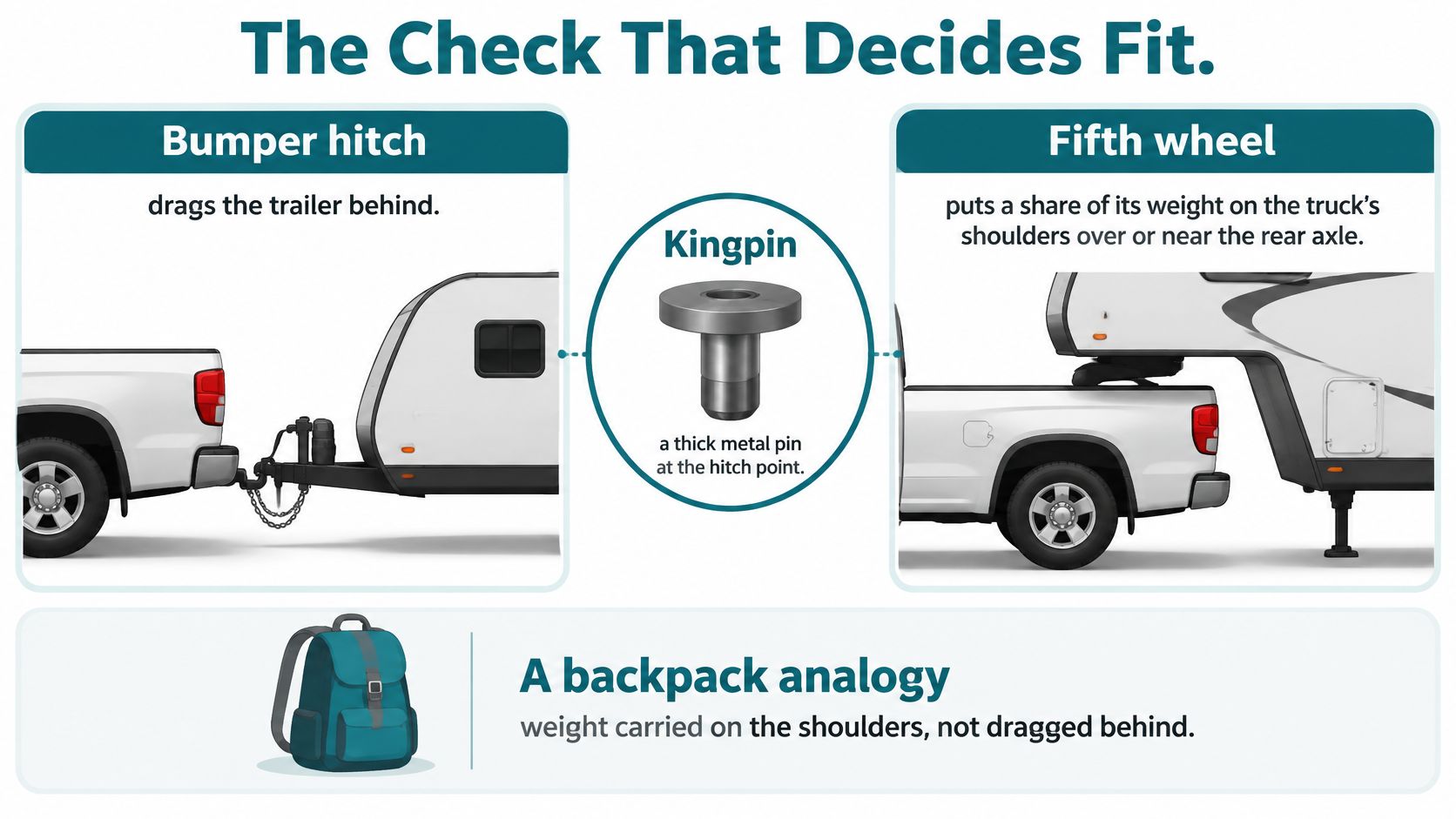
A bumper-pull travel trailer rides behind your rear receiver, dragging most of its weight behind the tow vehicle. A lightweight 5th wheel works like a heavy backpack, resting a substantial share of its total mass directly on the truck's shoulders over or slightly ahead of the rear axle.
According to the CURT Manufacturing 5th wheel hitches guide, the trailer's kingpin (a thick metal cylinder extending down from the forward overhang) locks into the bed-mounted fifth-wheel hitch, transferring downward pin weight that typically runs 15% to 25% of the trailer's gross weight. Shortening the lever arm between truck and trailer makes fifth wheels feel far more planted in crosswinds and semi-truck wash than bumper pulls, yet that same geometry loads your pickup's payload and rear axle heavily.
Seeing how the load shifts from behind the bumper onto the rear axle clarifies why payload runs out long before engine power does.
Use 20% of loaded trailer weight as your everyday planning midpoint, and use 25% whenever a floor plan puts large storage bays, batteries, or holding tanks ahead of the trailer axles. Here is how those vertical loads scale across four common loaded weights:
Loaded trailer weight | Pin load at 15% | Pin load at 20% | Pin load at 25% |
|---|---|---|---|
8,000 lb | 1,200 lb | 1,600 lb | 2,000 lb |
10,000 lb | 1,500 lb | 2,000 lb | 2,500 lb |
12,000 lb | 1,800 lb | 2,400 lb | 3,000 lb |
14,000 lb | 2,100 lb | 2,800 lb | 3,500 lb |
Hitch Weight and Axle Balance Still Count
Choosing an aluminum hitch makes bed installation far easier on your back, but hitch mass and rated capacity are two separate numbers. CURT's technical guide cites a lightweight hitch weighing about 60 lb while rated to handle 20,000 lb, whereas conventional steel hitches can easily weigh triple that or more. No matter how light the assembly is, every pound bolted into your truck bed counts straight against GVWR, GCWR (Gross Combined Weight Rating), and available payload.
Axle balance also carries legal and safety consequences on the highway. The Origin RV pin weight and payload guide calculates that a 9,800-lb loaded trailer imposes roughly 1,470 to 2,450 lb on the pickup before you add passengers, cab gear, or the hitch itself, and notes that U.S. commercial-vehicle rules require fifth-wheel placement to distribute combined weight properly across axles so steering, braking, and maneuverability stay sharp. Overload the rear axle and the front steer axle gets light, stretching your stopping distance in wet weather and hurting steering authority on curves.
Seven Steps to Verify Truck Compatibility
Run these seven steps in order for your exact pickup before making an offer on any lightweight 5th wheel:
- Read payload directly off the driver-door sticker. The California DMV Recreational Vehicles and Trailers Handbook defines payload as the tow vehicle's GVWR minus curb weight, giving a practical example where a truck with a 12,500-lb GVWR and 10,500-lb curb weight has 2,000 lb of available payload.
- Subtract hitch hardware, passengers, fuel-adjusted gear, and bed cargo. Deduct every person riding in the cab, your pets, tools, firewood, tonneau cover, and fifth-wheel hitch from that sticker figure, because the handbook warns that tow-vehicle GVWR includes curb weight, payload, and hitch weight combined.
- Estimate loaded pin weight at 15% to 25% of trailer GVWR. The California handbook places a typical fifth-wheel hitch load around 20% of trailer weight (putting roughly 1,400 lb onto the truck from a 7,000-lb loaded rig), while 25% serves as your conservative safety check.
- Compare estimated pin weight against remaining payload. Make sure the number fits with deliberate breathing room rather than squeezing down to the final few pounds.
- Confirm your rear gross axle weight rating (GAWR) and rear tire load ratings. Match the expected rear-axle load against both the door-jamb GAWR and the combined maximum load stamped on your rear tire sidewalls, and keep tires inflated to manufacturer-specified cold pressures.
- Weigh the fully loaded combination on a certified scale. Pull onto a three-pad CAT scale with your typical travel load so you get separate, verified readings for the front steer axle, rear drive axle, and trailer axles.
- Recheck after any gear or tank changes. Adding a second battery, carrying a portable generator in the bed, or switching from empty to full tanks alters pin weight immediately, so update your worksheet whenever your setup evolves.
When a High Tow Rating Still Fails
A big tow-rating number on a window sticker is the easiest trap in truck shopping. The 2024 Chevrolet Trailering Guide states that fifth-wheel kingpin weight runs 15% to 25% of loaded trailer weight (1,500 to 2,500 lb for a 10,000-lb trailer and 1,800 to 3,000 lb for a 12,000-lb trailer) and explicitly requires subtracting additional equipment and passengers from available payload without exceeding either GVWR or rear GAWR.
Apply that rule to a common half-ton or lightly equipped three-quarter-ton scenario. If your pickup has 2,100 lb of remaining payload after passengers and gear, and a 12,000-lb loaded trailer drops 2,400 lb onto the bed at 20% pin weight, the combination fails by 300 lb. That failure stands even if the truck's brochure advertises a tow rating above 12,000 lb.
If the loaded pin weight does not fit inside your truck's remaining payload, the combination fails, regardless of what the tow rating says.
Trade-Offs Lighter Weight Brings to Ownership
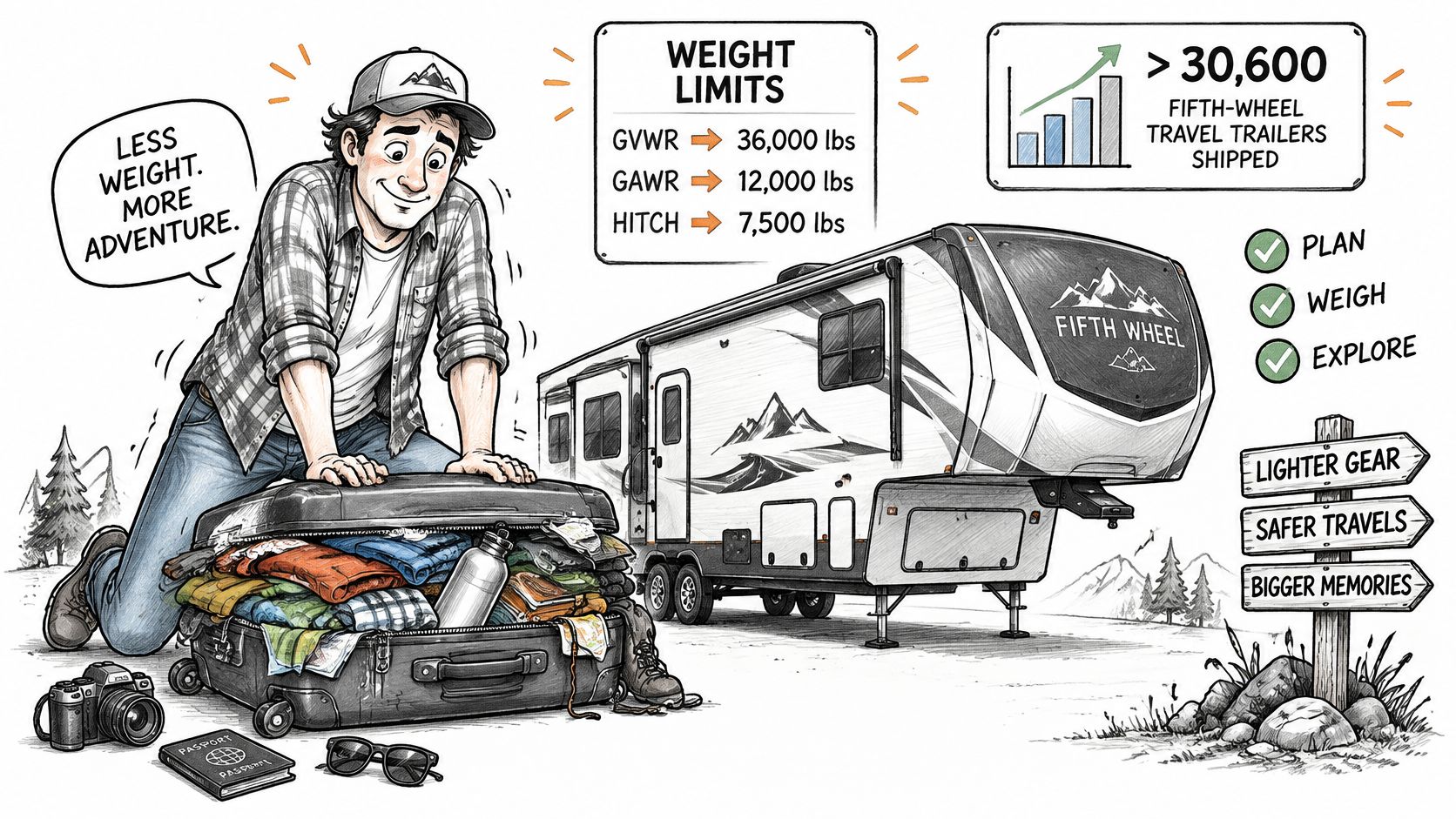
Factory shipment momentum tells you manufacturers are pushing lighter models onto dealer lots. Berkadia's July 2025 Manufactured Housing Monthly Insight reported more than 30,600 fifth-wheel travel trailers shipped through May 2025, up 22.4% year over year while overall RV shipments rose 5.3%. That demand does not settle the ownership question. A lightweight 5th wheel works like an ultralight suitcase you still pack to the brim. Removing weight from the shell helps only when the loaded pin and the truck's remaining payload still fit within every limit.
Packing too much into a lighter shell exposes where factories trimmed pounds to reach an attractive brochure number. The badge on the side tells you very little by itself.
What Manufacturers Trim to Cut Weight
Engineers cannot make physics disappear. Every pound shaved off a fifth wheel comes from somewhere, and those savings show up during real ownership:
- Reduced structural margin: Lighter frames, thinner laminated walls, and lower-rated axles leave less mechanical cushion on pothole-scarred highways, especially when you travel near GVWR.
- Smaller water and propane tanks: Shrinking fresh, grey, and black holding tanks lowers wet weight and saves space, yet off-grid campers feel the shortfall fast.
- Tighter storage compartments: Shorter floor plans and shallower basements limit what fits inside the trailer. Heavy items such as generators, firewood, and bikes then move into the pickup bed, where they consume truck payload anyway.
- Fewer residential features: Solid-surface countertops, heavy porcelain fixtures, washer-dryer prep, residential refrigerators, and thicker insulation packages are often the first comforts left out.
- Shifted ownership economics: Fuel savings from a slightly lighter trailer stay modest because aerodynamic drag still matters. Owners still pay for hitch installation, heavy-duty tire replacements, maintenance, possible truck or suspension upgrades, and resale behavior that can differ sharply between entry-level lightweight builds and heavier mid-profile fifth wheels.
When Lighter Weight Actually Pays Off
A lighter design improves total ownership in one clear scenario. You already own a properly rated pickup with healthy payload margin, you camp light, and you want a shorter, nimble trailer that fits tight state-park and national-forest sites where 38-foot rigs cannot maneuver.
The math flips when a lightweight sticker pushes you into a truck upgrade, an expensive specialty slider hitch for a short bed, or cramped tanks and light-duty cabinetry that wear out early. I would compare a lightweight 5th wheel against a heavier mid-profile fifth wheel, or even a conventional travel trailer, on total cost of ownership, interior usability, pin weight, remaining truck payload, and long-term durability. The weight badge is the beginning of the check, not the decision.
Worked Examples and the Final Go or No-Go
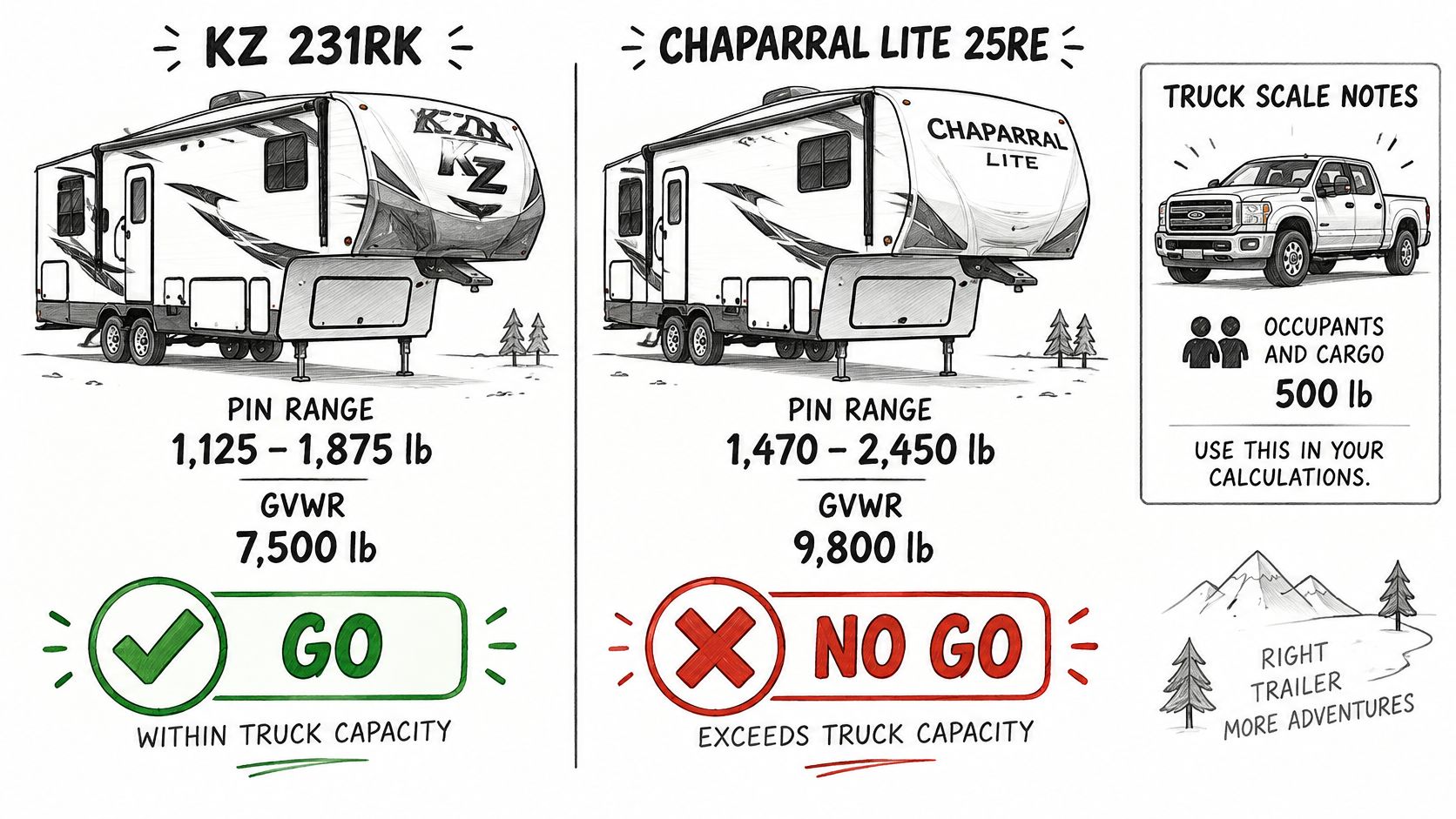
Putting real numbers into a side-by-side comparison settles the compatibility debate immediately. Below are both running models evaluated at their full GVWR, paired with an explicit 500 lb allowance covering two adults, light cab and bed items, and a lightweight bed hitch assembly. If you travel with a family of four, dogs, a heavy steel slider hitch, and a generator in the bed, swap that 500 lb placeholder for your true scale total.
Trailer (GVWR) | Pin range (15-25%) | Pin at 20% | Required payload with 500 lb load (15-25% / 20%) |
|---|---|---|---|
KZ Sportsmen 231RK (7,500 lb) | 1,125-1,875 lb | 1,500 lb | 1,625-2,375 lb (2,000 lb at 20%) |
Forest River Chaparral Lite 25RE (9,800 lb) | 1,470-2,450 lb | 1,960 lb | 1,970-2,950 lb (2,460 lb at 20%) |
Comparing those payload totals against two real pickup classes shows why compatibility always belongs to the specific truck-and-trailer pair, never to the trailer by itself.
Testing Both Models on Two Real Truck Setups
Start with a well-equipped half-ton pickup showing 2,100 lb of available payload on its door sticker. Hitch up the KZ Sportsmen 231RK with our 500 lb occupant, cargo, and hitch allowance:
- At 15% pin weight (1,125 lb): Total payload needed hits 1,625 lb, passing comfortably with 475 lb to spare.
- At 20% pin weight (1,500 lb): Total payload needed climbs to 2,000 lb, passing with a razor-thin 100 lb margin that disappears the moment you toss a loaded cooler and firewood in the bed.
- At 25% pin weight (1,875 lb): Total payload needed reaches 2,375 lb, failing by 275 lb.
On that same 2,100 lb half-ton pickup, the Forest River Chaparral Lite 25RE doesn't come close. Even at 20% pin weight, its 2,460 lb combined requirement exceeds payload by 360 lb, and at 25% (2,950 lb) it blows past the door sticker by 850 lb.
Now move both rigs onto a three-quarter-ton pickup with 3,000 lb of door-sticker payload and the same 500 lb passenger and hitch load. Here, the KZ 231RK clears every single pin-weight percentage with room to spare. The Chaparral Lite 25RE needs 2,460 lb at 20%, fitting with a healthy 540 lb of margin, and hits 2,950 lb at 25%, leaving just 50 lb beneath the ceiling. That 50 lb cushion tells you to keep heavy gear centered over the trailer axles rather than in the front pass-through, or step up to a one-ton if you haul heavy family cargo.
Notice how a pickup boasting a 12,000 lb headline tow rating can still fail these exact tests. Pulling capacity measures engine cooling, transmission gearing, and frame pull strength, whereas payload measures vertical load over your axles.
Seeing a loaded fifth-wheel combination walk through real axle weights makes it clear why every serious towing specialist trusts certified scales over brochure promises.
Your Final Go or No-Go Checklist
My go or no-go rule is simple. Buy the trailer only when its loaded pin weight at 25% of GVWR, plus your real occupants, bed cargo, and hitch hardware, fits inside your pickup's remaining door-sticker payload while staying safely beneath both rear-axle and rear-tire ratings.
Follow four concrete checks before and right after you buy:
- Verify the specific unit's certification label at the dealership: Factory options like a second air conditioner, solar panels, or auto-leveling jacks add real pounds before you take delivery, so read the yellow weight sticker on that exact trailer rather than a generic web brochure.
- Photograph your truck's Tire and Loading Information sticker: Keep your exact payload, GVWR, and front and rear GAWR figures on your phone so you never guess on the sales floor.
- Weigh the loaded rig immediately after purchase: Load your standard water, propane, gear, and passengers, then cross a certified truck scale to log steer, drive, and trailer axle weights separately.
- Recheck whenever your setup changes: Swapping battery types, mounting a rear bike rack, or filling water tanks shifts pin load, so treat weight verification as an ongoing habit rather than a one-time chore.
A lightweight fifth wheel is a smart buy only when the real scale numbers make the case, never because the label promises an easy tow.
Getting from point A to point B safely comes down to matching the right equipment to your exact payload, passenger count, and route without guessing. At Approved Jets, we apply that same mission-first discipline to private aviation, matching your itinerary and luggage needs (from light jets carrying 4 to 5 soft-sided bags to heavy jets holding 15 or more) with FAA Part 135 operators that prioritize Argus Platinum and Wyvern Wingman safety ratings. Visit our site to coordinate on-demand private charters and end-to-end trip logistics around your exact schedule.